Chris’ Michigan Answer: Creating a way for himself and others
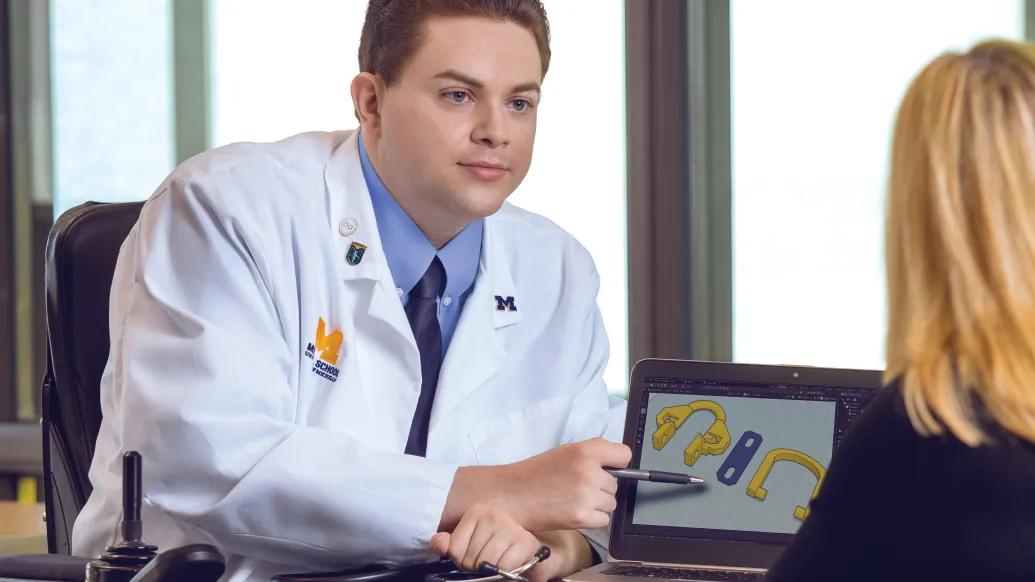
It was December 2017, and Chris Connolly was four months into medical school, when he discovered it was difficult for him to hold onto a cardiology stethoscope when reaching across a patient’s hospital bed. It was time to take a trip to the hardware store.
“Before I started medical school, I worked with occupational therapists to make sure I could do all of the physical exam maneuvers that my classmates could do,” says Connolly, who is an incomplete quadriplegic. He was able to do everything, sometimes with the help of modified equipment. “I had made a handle that could fit over a regular stethoscope,” he says. But it didn’t work with a cardiology stethoscope.
At the hardware store, Connolly purchased fasteners to fashion a device that would stabilize the stethoscope. Problem solved. Sort of.
“There need to be assistive devices for people who want to pursue careers in health care,” says Connolly. “It’s a chicken-and-egg problem, not letting people into medical school because we can’t accommodate them. And because we aren’t letting them in, there are no accommodations.”
The chicken-and-egg problem also creates a supply-and-demand problem, making it impractical to manufacture devices like the one Connolly created on a large scale. That’s why Connolly taught himself computer-aided design. With help from rehabilitation engineer Seong-Hee Yoon, he designed and 3D-printed a stethoscope handle that allows him to complete physical exams like his peers who don’t have disabilities. “I realized that selling adaptations as 3D-printable files could reduce barriers for future medical professionals with limited dexterity and address supply and demand issues.” The final model, patented by U-M, can now be purchased and 3D-printed on demand.
“As more people with disabilities are accepted into medical school and nursing school, this will be available for them,” says Connolly. He says it may also help older health care providers, if they develop hand dexterity issues. “This will be something they can download, print, and use as they need it.”
Connolly’s road to this stage of his life — one in which he can think about ways to make medical professions more accessible to people with disabilities — came with more than a few speed bumps. “You can be denied admission to medical school if you have certain types of disabilities,” including quadriplegia, says Connolly, an M.D./MBA student who is about to complete his last year of medical school at U-M.
He says his experience at Michigan Medicine, however, has been entirely welcoming. He was accepted to a few different medical schools, but when he spoke with the deans at Michigan Medicine, they told him the medical school was a family. “We take care of family,” he recalls them saying.

Health Lab
Explore a variety of health care news & stories by visiting the Health Lab home page for more articles.
Featured News & Stories

The Race to Uncover the Hidden Causes of Idiopathic Pulmonary Fibrosis

Beyond the White Coat: Finding Your Voice at the Patient’s Bedside

Alum reconnects to his roots through Doctors of Tomorrow scholarship fund

Treating a rare coronary artery aneurysm without open heart surgery

Medicine, music, and crossword puzzles