This article is part of a special issue celebrating the 175th anniversary of the University of Michigan Medical School. See the full issue here.
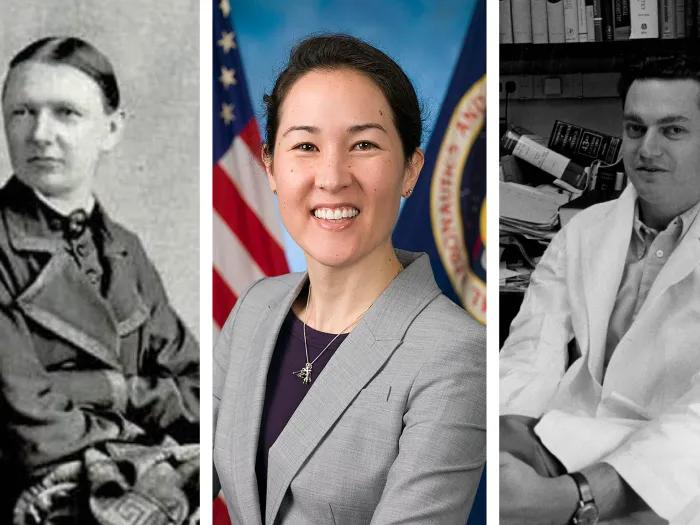
While we’ve shone our spotlight on the proud history of Michigan Medicine, we would be remiss if we did not mention a few of the less savory elements. This is not a comprehensive list of past misdeeds, but the three people highlighted here represent three groups: people who were wrongfully excluded from the Medical School because of their identity, people who subscribed to popular ideas that we now acknowledge are wrong, and people who committed heinous crimes. Remembering these moments reminds us that we are fallible and the success of our mission relies on each of us striving daily to do our best for our communities.
A victim of racism
It was October 1863 — around halfway through the Civil War — when Alpheus W. Tucker came to the Medical Department at U-M and submitted his enrollment fee. He had come to Michigan in part because another mixed-race student — John H. Rapier, Jr. — had already been admitted to the department.
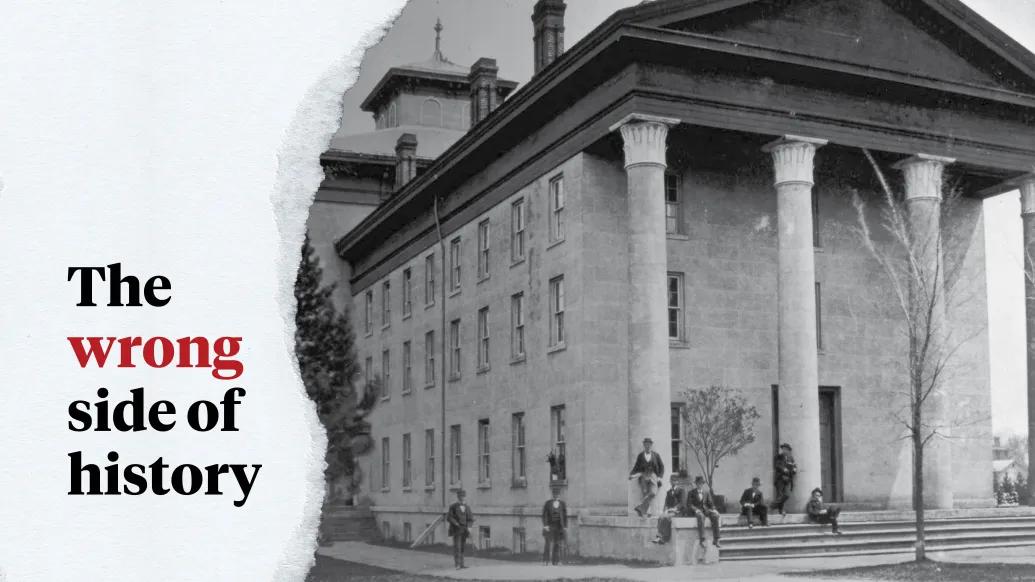
But some students and faculty quickly made it known that he was not welcome. When Tucker entered a lecture hall, according to the U-M William L. Clements Library’s Quarto publication, “he was greeted by jeers from students already seated for the lecture. As a dark-skinned, mixedrace man, Tucker suffered shouts of ‘take him out!’” and a variety of slurs, leaving him “visibly alarmed.” The professor arrived and asked Tucker to leave; Tucker did so but attended other classes until about a week later, when a faculty member told him “that objections of the students compelled him to ask Tucker to leave the University entirely.”
Not only was Tucker asked to leave, but his presence at the school was literally erased when a secretary wiped his name off the student register.
Detroit-native Tucker explained his departure in a letter to the editor in an anti-slavery publication. “I question very much whether a dozen students out of the 300 in attendance ever said a word to the Professors in regard to my being there, and I have good reasons for believing that the objection originated with one of the Professors and not the students,” he wrote.
Tucker earned his medical degree in Iowa and practiced in Washington, D.C.; he died in Detroit in 1880. “Had Tucker graduated from U-M,” the Clements Library publication pointed out, “we would now be celebrating his presence here.”
A prominent proponent of eugenics
“Victor C. Vaughan (1851–1929) was a noted medical educator, microbiologist, and active proponent for the idea of eugenics.” That tidy summary of the longtime Medical School dean is found in an article authored by Medical School professors Joel D. Howell, M.D., Ph.D., Laura Hirshbein (M.D. 1997), Ph.D., and Alexandra Minna Stern, Ph.D., who examined the entanglements of eugenics, public health, and academic medicine in Vaughan’s life story.
To be sure, Vaughan’s legacy is a complicated one; he was a widely respected educator and leader, the first dean of the Medical School appointed by the president and Board of Regents, and the longest-serving dean in the school’s history. He pushed for science-based curriculum changes at the Medical School and was an early believer in germ theory. His early-career work on separating arsenic from other metals was considered groundbreaking, and he helped lead investigations into the typhoid fever epidemic during the 1898 Spanish-American War and the influenza epidemic in 1918.
Yet Vaughan lectured about “race betterment” and enthusiastically supported forced-sterilization legislation in Michigan. In one talk, Vaughan warned of the “alarmingly large class of morons” who “constitute a menace to the betterment of the race.” In another, he said, “There must be laws preventing the marriage and reproduction of the unfit.”
In 2019, a group of medical students chose to remove his name from a medical society, and an endowed professorship removed his name. The building at 1111 E. Catherine Street continues to be named for him.
In their article, Howell, Hirshbein, and Stern wrote: “We conclude that the use of any name from the past carries meanings about what our values are in the present and that, if there was ever a moment to celebrate the life of Victor Vaughan, that moment has passed.”
The devil
He was Herman Webster Mudgett or Dr. Henry Howard Holmes or H. H. Holmes. He was nicknamed the Beast of Chicago, the Devil in the White City, and the Torture Doctor. And he was a U-M Medical School alumnus.
In 1882 and then known as Mudgett, Holmes enrolled at Michigan, which was “noted for its emphasis on the controversial art of dissection,” the author Erik Larson wrote in the 2004 book The Devil in the White City. Mudgett graduated in 1884 and would go on to become one of the first documented serial killers in the United States.
By many accounts, he did not distinguish himself as a student. The Ann Arbor Argus reported that he “did get into trouble” with a Mrs. Fitch, a widowed hairdresser, who demanded that he marry her — which he couldn’t do because he was already married. He “narrowly escaped expulsion” when the matter was brought before the medical faculty. Victor Vaughan, the Argus reported, voted for him not to graduate.
Several accounts say that he began to procure cadavers to study, dissect, and use in his own research during medical school. He is said to have robbed graves and morgues to sell cadavers to medical schools and swindle insurance companies.
In a house in Chicago that became known as his “murder castle,” as well as in other locations, Mudgett/Holmes seduced many young women and then killed them in the house that he built himself, complete with trap doors and a kiln for cremation. The exact number of his victims is unknown, though estimates are as high as 200 people. He killed many of them during the World’s Fair in Chicago in 1893.
In his confession in 1896, Holmes said: “I was born with the devil in me. I could not help the fact that I was a murderer, no more than the poet can help the inspiration to sing.”
Featured News & Stories
Milestones in the history of women in medicine and biomedical science at U-M
A long time coming: The saga of today’s University Hospital
Pioneers and pathbreakers: Black History milestones at Michigan Medicine
Celebrating 175 years of the Medical School: #17–30

Big ideas drive big changes in medicine