What is your favorite bit of med school lore?
Alums weigh in
What is your favorite bit of med school lore?
Hinerman’s Law: “You give a medical student a choice between two things and he’ll pick the wrong one every single time.”
Background: Dorin Hinerman, M.D., was a full professor in the Department of Pathology in 1957, and as a full professor he didn’t have to teach the sophomore microscopic pathology lab. But he loved to teach, and he loved medical students, and he loved to harass medical students. In addition to being an excellent teacher, he had a great sense of humor. We were laughing every day. So the scenario was that he would call on one student to get up in front of the class and talk about a microscopic slide being projected up on a screen. I was fortunate enough to be in his half of the class.
Hinerman: “Mr. Van Krimpen, describe what you see!”
Van Krimpen: “Well, the entire field is covered with white blood cells.”
Hinerman: “White blood cells! Well, Mr. Van Krimpen, are those lymphocytes or granulocytes?”
Van Krimpen: (Pause). “Lymphocytes.”
Hinerman: “Wrong! There, you see? You give a medical student a choice … ”
— Carl Van Krimpen (M.D. 1960)
In November 1964, the game day in Columbus was cold, around 10 degrees or so, and Dave Hershey (M.D. 1966) and I had spent the game kneeling on the OSU sideline trying to keep warm. The Michiganensian photographer Jerry Aronheim had drafted us as “caption writers,” but it was just a ruse to get us a free sideline view.
OSU coach Woody Hayes stood nearby in his customary shirtsleeves and cap, trying to demonstrate his toughness, and he remained so with less than 45 seconds to go and Michigan about to win 10 to nil.
We had lost track of Jerry, and of course had written no captions, when he suddenly reappeared creeping up behind Hayes and holding a rolled up copy of that morning’s Michigan Daily. The paper had printed a full-page ad — a composite photo of Hayes’ head being pushed into the turf under a Michigan player’s very large cleat. Jerry proceeded to insert it under Woody’s right arm, which was no doubt frozen beyond full proprioception. Then he disappeared down the sideline leaving Dave and myself gaping in disbelief.
Hayes did not react, but someone who may have been an assistant coach quietly came up behind Hayes and withdrew the document and pocketed it. Given Hayes’ later semi-violent sideline tantrums, I believe anyone might agree that we were quite fortunate. And given current security protocols, these days that stunt might have landed us in a Columbus jail for a short stay. (In later years, Jerry has denied doing any of this, but we were nonplussed witnesses to the deed.)
We beat it back to old P-Bell that evening to celebrate the victory and an upcoming Rose Bowl trip.
— Paul Helman (M.D. 1966)
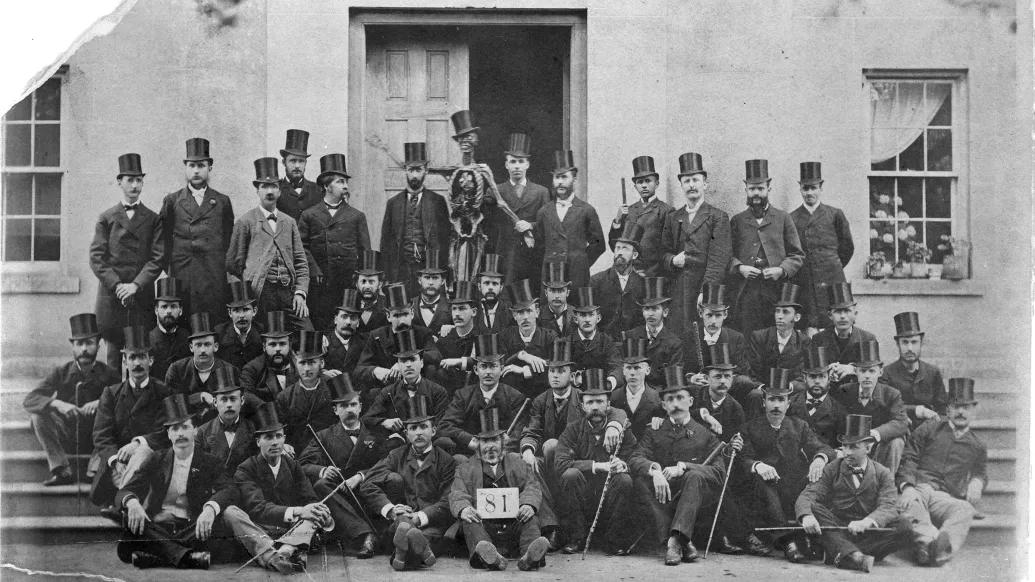
It has been over 50 years, but I still remember my first walk up the “Hall of History,” between the Medical School and University Hospital with pictures of graduates from every University of Michigan Medical School class stretching back into the 1880s hanging on the walls. I was filled with a sense of awe of being on hallowed ground and being about to enter into a momentous endeavor that would be larger than me alone.
Then, when I saw that students of the class of 1881 were posing with a skeleton wearing a top hat, I knew I would be in for a wild ride.
— Brian Ito (M.D. 1981)
A two-week ENT class was a requirement in our first two years of med school. The class, although partly didactic, primarily involved lab to learn various forms of intubation. Each student was paired with another student, each in turn being the guinea pig. Coincidentally, my assigned partner was one of my closest med school friends.
During hands-on practice, I was easily able to accomplish the required procedures. Sadly, my friend could not master essentially any of the techniques. Why? Because I was a terrible guinea pig, one with a terrible gag reflex. Gagging, sometimes throwing up, I sealed my friend’s fate. He failed the class. I felt tenable.
During a short summer break from classes, my friend repeated the ENT class. This time he passed.
When we were seniors, looking for internships, I was incredibly amused to find out that my friend was applying for an internship which would lead to a career in ENT.
Not only did he become an otorhinolaryngologist but, in time, the chairman of an ENT department at a major university medical center. And yet he accomplished even more. With further training, he became a world-renowned neuro-otologist, doing very highly specialized intricate surgery for pathology of the cranial nerve necessary for hearing and balance.
As is asserted by horse riders and others; “You’re not a rider unless you’ve fallen off seven times.”
— Cary Stegman (M.D. 1970)
Dr. Paul Gikas was, by far, the very best teacher/professor I had in all of college and medical school. In clinical medicine lectures, he showed photos of automobile accident victims with radio knobs inside their skulls as well as photos of numerous other, often fatal, injuries. Dr. Gikas was instrumental in both improving automobile safety and in convincing a reluctant me to wear a seatbelt. In his renal lectures he would show, side by side, a normal renal cortex and a diseased one so we could better understand both the disease and the pathology.
We were divided into small groups for pathology. By the luck of the draw, I was assigned to Dr. Gikas’ class. Here he excelled. He might call you Jack even if you were Karen or Jim. He would tell us, “You can get anything you want in Fairbanks, Alaska.” But mostly he taught exceedingly well. I’m sure I disappointed him on an exam when we were to identify a renal pathology slide of hydronephrosis. For the life of me I could not recall the proper name and eventually wrote down ‘hyperhydrosis.’
I think everyone in that class loved Dr. Gikas. We planned a surprise birthday party for him. One of the medical students made a cake and others of us came up with gag gifts. We knew he was a runner so one gift was a pair of beat up, worn out running shoes. He ate his piece of cake and laughed heartily at the gifts. He then asked with some alarm if the frosting was made with butter. “Jack” confessed it was. Apparently, he did not eat butter, except for that special day.
In medical school I knew for certain I did not want to be a pediatrician (sick kids and anxious parents), a neurologist (incomprehensible) or a nephrologist (also incomprehensible). I became a nephrologist, at least in part, because of Dr. Gikas.
— Paul G. Smith (M.D. 1977)
During my first week of neurosurgery rotation, I found myself in the OR with Edgar Kahn (M.D. 1924) and a surgical intern in his first week of internship. Eddie Kahn did a brief craniotomy with a new saw he was trying out. The sales rep from the company that made the saw was in the OR. As soon as he was done, he walked out with the sales rep saying to the intern and me, “You two can close.” Of course neither one of us had a clue what to do. The nursing staff identified the problem immediately, called a neurosurgery resident, and all ended well.
“The green light is on” was announced when an autopsy was starting. The line of colored bulbs around the hospital only had a green bulb illuminated. We all ran to the autopsy room because we had to attend a requisite number of autopsies and assist on one or two.
“Grades are up” meant a paper had been posted on the bulletin board with our exam grades. They were coded for privacy; I was #1011.
During my internal medicine rotation, there was a refrigerator full of stool samples that were to be tested for occult blood with a “stool guaiac.” It seemed like they were there forever and never tested. At the same time, Frank Mowry, M.D., was the chief resident of internal medicine. Apparently his primary job was to check the medical students’ sections of the chart, and when he saw no guaiac recorded he wrote “F.M. guaiac.” We referred to him as F.M. Guaiac.
During a neurosurgery lecture by Richard Schneider, M.D., I fell asleep — the only time in my life I ever did so in class. I was awakened by him saying, “You in the blue shirt, wake up and learn these three signs of increased intracranial pressure: headache, vomiting, and papilledema, and then you can go back to sleep.” I couldn’t have been more embarrassed.
I was sitting in the front row of a neurosurgery lecture being given by Eddie Kahn, M.D. He was putting up films from a pneumoencephalogram, and he described them as post-op showing no residual tumor. Glenn Kindt, M.D., was the resident assisting him in the presentation, and he whispered to Dr. Kahn, “Those are the pre-op films.” Dr. Kahn responded, “They’ll never know the difference,” and continued without hesitation.
— Robert S. Sweet (M.D. 1965)
Featured News & Stories
Continuing to celebrate the 175th anniversary of the University of Michigan Medical School

Still celebrating the 175th anniversary of the University of Michigan Medical School
X-Ray Vision
Petticoat Junction
Alum reconnects to his roots through Doctors of Tomorrow scholarship fund