What can a building be?
The D. Dan and Betty Kahn Health Care Pavilion will be both high-tech and "homey"
Author |

When the D. Dan and Betty Kahn Health Care Pavilion opens its doors to patients in the fall of 2025, the new 12-story adult hospital will not only be the most advanced and ambitious building in Michigan Medicine history. It will be a study in contradictions.
Then Kahn Pavilion will be a hospital touched by the hands of many, as countless staff, faculty, and students, along with patients and their loved ones, volunteers, and community members, participated in years of planning the building. And it will be a hospital for individuals — a place where everyone, no matter their abilities, can feel cared for and comfortable.
It will be a hospital informed by the past, one that brings to bear lessons from Michigan Medicine’s century and a half of health care history. And it will be a hospital for the future — a building that can adapt to rapid changes in health care.
The Kahn Pavilion will be a high-tech hospital, packed with the latest technology to help patients get better faster. And it will be a “homey” hospital — a warm and inviting space where visitors can relax by the cozy fireplace or take a quiet moment for reflection in Michigan’s afternoon light.
“From the moment of this building’s conception, we wanted to think about it differently,” says Karin Muraszko, M.D., professor of neurosurgery and chair emeritus of the department, who was involved in the planning. “We wanted to think about it being able to almost breathe and grow, adapt and change, to be what we needed to be at the moment, while realizing there may be things we didn’t think about that it would need to be.”
A building can be a community commitment.
When it came time to plan the Kahn Pavilion, everyone had their say. Physicians, nurses, and other clinicians aided with room design and helped with closet placement and supply storage. Cafeteria staff and environmental services workers advised on equipment storage. Researchers and technicians shared opinions on the locations of lab microscopes and lighting.
“This wasn’t an undertaking in isolation,” Muraszko says. “All those people from every part of the hospital put their fingerprints on this.”
But perhaps the most important members of the planning team were patients and community volunteers who brought an outside perspective to the hospital design process. They were integral, for instance, to the design of a nondenominational reflection space within the hospital, which includes storage for prayer rugs, and to advising on parking and creating easy access to the building without disturbing community traffic flow.
Zachary Tomlinson, a Michigan Medicine patient since suffering a spinal cord injury in 1997, says everyone was enthusiastic about taking the opinions of patient and community volunteers into account. “What excites me most about the new hospital are the lengths to which Michigan Medicine has gone to make sure that the facility meets the biological, psychological, and social needs of both their future patients and their loved ones — who might be involved in their care beyond hospital walls.”
A building can be accessible to all.
Muraszko, who uses a wheelchair, says she was focused on ensuring that the Kahn Pavilion was designed with non-ambulatory patients and visitors in mind. All hospital rooms will have doorways large enough to easily accommodate wheelchairs. Cafeteria tables and bathroom sinks will be placed at appropriate heights. Even reception areas within the new hospital have been designed to be accessible. “You won’t get to the front desk in a wheelchair and find yourself incapable of seeing someone easily,” Muraszko says.
Also new to the Kahn Pavilion: A computer-based gait training and analysis system, set up on an overhead track, will protect patients from falls while providing personalized body-weight support as they practice walking, balancing activities, sitting to standing, climbing stairs, getting off the floor, and more. The system will be especially useful for patients who have had a stroke, traumatic brain injury, spinal cord injury, orthopaedic surgery, and other diagnoses that impact balance.
Other nods to accessibility include carpeting and flooring designed for people with visual impairments, consideration of light and noise sensitivity for patients with brain disease or injury, and rehabilitation facilities located on every level of the hospital for easy access.
A building can be big enough for everyone.
The new 690,000-gross-square-foot hospital will immediately expand access to patients who need complex and high-acuity health care. Specialties including cardiovascular health, neuroscience, and otolaryngology will get the space they need to deliver state-of-the-art care to patients with heart disease, brain tumors, spinal cord injuries, Parkinson’s disease, epilepsy, stroke, head and neck cancers, and more.
“There are so many patients who want Michigan Medicine care,” says Mark Prince, M.D., the Charles J. Krause Collegiate Professor of Otolaryngology-Head and Neck Surgery and chair of the department. “Not having enough space to do that is frustrating. This new building is going to solve those problems for us.”
A building can be a safe haven from global threats.
Along with converting to intensive care rooms, nearly 100 of the Pavilion’s patient rooms are also designed to become part of a regional infectious containment unit.
Though the COVID-19 pandemic made it clear why such capability is needed, the pandemic hadn’t begun when Michigan Medicine broke ground on the hospital in 2019. Instead, it was earlier public health emergencies, such as the H1N1 flu and avian flu, that prompted the hospital’s planning committees to consider containment capabilities and airflow — features that can’t be easily changed after construction is completed.
“Its patient rooms are designed to facilitate care for various types of severely ill patients, from those with COVID-19 respiratory failure to the most complex critically ill patients with cardiac or neurologic disorders,” says Kim Eagle, M.D., the Albion Walter Hewlett Professor of Internal Medicine and codirector of the Samuel and Jean Frankel Cardiovascular Center. “This unique capability and flexibility is a resource not just for us, but for the entire state during times of extraordinary medical needs.”
A building can be a place where precious seconds are saved.
Accelerating the time between stroke diagnosis and treatment is proven to improve outcomes and save lives. “Every minute that goes by, patients are potentially losing millions of brain cells,” says Aditya S. Pandey, M.D., surgical director of the Comprehensive Stroke Center, the Julian T. Hoff M.D. Professor of Neurosurgery and chair of the department, and professor of otolaryngology-head and neck surgery and of radiology.
In the Kahn Pavilion, CAT scans and MRIs will be next to and within operating rooms and interventional radiology suites, making the new hospital’s stroke unit one of the most advanced in the country. “We are co-locating resources and treatment teams to be able to salvage every minute we can — to give patients the best opportunity for recovery,” Pandey says. “We are going to identify ourselves as the most unique place on the planet for stroke patients, including those facing brain aneurysms and other bleeding brain injuries.”
Another time-saver: the Kahn Pavilion’s endovascular suite will include an operating room, a patient care room, and a CT scanner in one location, enabling physicians to seamlessly convert from an endovascular procedure to an open surgical procedure, and back to an endovascular procedure. It will eliminate the complications and time elements of transfer and enable physicians to make full use of each of these therapies in the treatment of a patient.
A building can be high-tech and low volume.
The Kahn Pavilion will house 20 operating suites, outfitted for specialties including cardiac surgery, general thoracic surgery, neurosurgery ortho-spine, otolaryngology and maxillofacial surgery, and vascular surgery. With magnetic resonance imaging (MRI) capabilities in every operating suite, Michigan Medicine will be at the leading edge of advanced, collaborative treatment for patients with a wide spectrum of conditions.
“The amount of technology we use in any given operation has only increased,” Muraszko says, “and the ability to fit all of that together in one space for one patient is crucial.”
But all this extra equipment could lead to an increase in noise and disruption in the operating suites. Enter the Kahn Pavilion’s new electrically silent operating room. By using specific electrical wires and construction techniques to isolate potential noise sources, Muraszko says, the Kahn Pavilion’s designers created an operating suite meant to produce as little electrical sound as possible.
“Patients often require a calmness — a sense of peace — that allows their body to begin to heal itself,” Muraszko says. “For patients who have had a head trauma, for example, you want an environment that provides stimulus at certain points, but can be very quiet and calming at others.”
With brain-machine interface becoming part of neurosurgical therapy, an electrically silent operating room will enable Michigan Medicine physicians to perform better physiologic studies, make improved assessments of electrical devices placed in the brain, and create better recordings from the brain to understand the fine physiologic and electrical impulses within.
A building can be where loved ones are cared for.
Michigan Medicine believes strongly in family-centered care, and, Muraszko says, families and loved ones are meant to be active participants, not afterthoughts. In fact, families and loved ones are some of the most important caregivers, and the Kahn Pavilion is designed to help them help patients.
“We are going to create an environment where all voices — including patients, families, staff, learners, and faculty — have space to be heard,” Prince says, “so that we will be able to provide the most innovative care in the most supportive culture found anywhere.”
Given the complicated, unique kinds of diseases that will be treated in the new hospital, Michigan Medicine aims to make it easy for patients and families to access computer references and the latest health care materials. They are encouraged to become advocates and learn as much as they can with the goal of them becoming knowledgeable consumers of the kind of health care Michigan Medicine delivers.
The Kahn Pavilion will also feature a Family and Caregiver Wellness Center, a space for loved ones to relax, work, and rejuvenate, anticipating that many are on-site through patients’ 12- to 18-hour surgeries and recognizing that their presence is essential to patient healing and well-being.
“There is good evidence that patient support has a direct impact on their outcomes,” Prince says. “Bringing that right into the hospital will have a big impact, not just by making people happier, but by having a meaningful impact on outcomes.”
A building can be adaptable.
“All of us in medicine appreciate that there are new challenges that come up every day,” Muraszko says. “We wanted to have flexibility.”
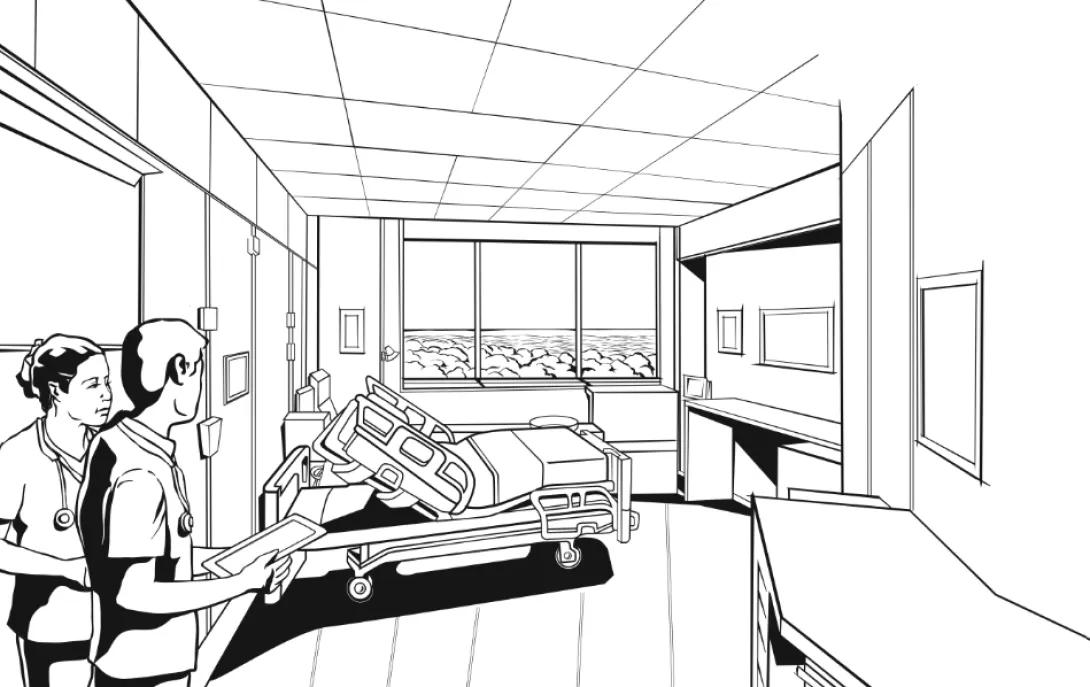
To that end, the Kahn Pavilion will have built-in adaptability. All of its 264 single-patient rooms will be able to convert seamlessly into intensive care rooms, a tremendous advantage over older hospitals, Prince says. “We are anticipating that in-house health care is going to go more toward the most critically ill patients, so we need to have that capacity,” he says. “We’ll end up with more sick patients in the hospital. Less sick patients will be at home and being taken care of appropriately there.”
A building can be liberating.
The Kahn Pavilion’s new Epilepsy Monitoring Unit will take advantage of wireless technology to give patients — who are being monitored 24 hours a day — more freedom. The unit will feature a day room so patients can leave their private rooms to exercise, watch TV, and relieve the monotony.
A building can be a hub for collaboration.
The Kahn Pavilion’s three new interventional radiology suites will make it easier for doctors in multiple specialties to collaborate on a patient’s care — especially the most serious cases. “We deal with massive hemorrhages that can occur with a nosebleed,” Prince says, “or even from a cancer that affects the blood vessels in the neck.”
Some of these patients are whisked straight to the operating suite, while others are treated by interventional radiologists. “Our abilities will be expanded through this new hospital,” Prince says, “and make a huge difference in how we manage our patients.”
A building can be one with nature.
The Kahn Pavilion will celebrate Michigan’s natural beauty — and foster a sense of calmness for patients and visitors — by bringing the outside in. “Michigan will shine through the building,” Muraszko says.

Parts of the hospital’s interior design will be inspired by the Huron River and Michigan’s famed Petoskey stones. A fireplace will add a cozy quality and be a place to warm up during frigid winters. Architects also incorporated natural light throughout the Kahn Pavilion.
A healthy, highly efficient and cost-saving “green” facility, the Kahn Pavilion will achieve LEED Platinum status, a testament to Michigan Medicine’s priorities of sustainability and reducing its carbon footprint. “We wanted it to be not only a safe building,” Muraszko says, “but a building that considers the future of the planet.”
So while a building can’t be quite human, it can be built to reflect the humanity of all those who will pass through its doors in the decades to come.
“Even though it’s cutting edge with the highest levels of technology available,” Muraszko says, “the hospital still tries to maintain a touch and a feel that is human, that recognizes the importance of patient well-being and staff well-being and family-centered care.”
Editor's note: A previous version of this story gave the incorrect date for the completion of the building. It is scheduled to open in fall 2025.
Related

Michigan Medicine receives $50M; will name new hospital after philanthropists D. Dan and Betty Kahn
Featured News & Stories

What’s changing in Medicaid and what can you do?
Study outlines a new framework for direct cell reprogramming

New insight into how lipodystrophy can affect overall health

Is the United States Lagging Behind Europe in Memory Improvement?

Nerf gun accident causes retinal detachment in pediatric patient