
Sci-fi to real life
A basic scientist is bringing the promise of RNA therapy to rare diseases
Author |
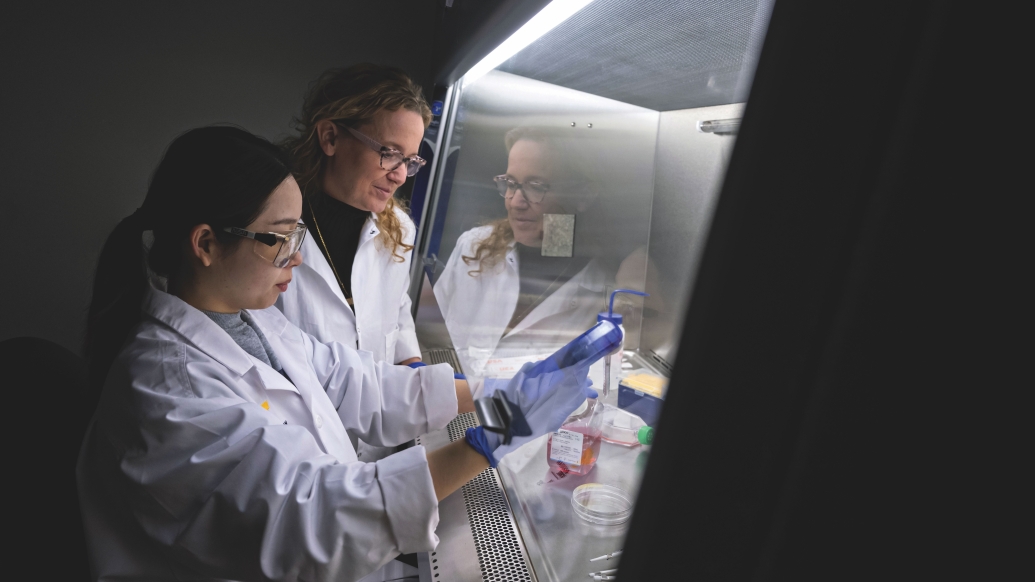
For Michelle Hastings, Ph.D., it was a moment of magic in the lab that sparked her interest in RNA-based therapies. Early on Hastings considered becoming a genetic counselor, but her trajectory shifted during graduate school and later as a postdoctoral fellow where she began researching basic principles of gene expression and the genetic basis of disease.
“I’ll never forget, I was doing my postdoctoral fellowship at Cold Spring Harbor Laboratory, and somebody else was testing out some new molecules, called antisense oligonucleotides, that were designed to specifically correct the effect of a genetic mutation that causes the pediatric neurodegenerative disease spinal muscular atrophy. They came in the lab one day and said, ‘You’re never going to believe this,’” Hastings says. They had treated a mouse that had been genetically engineered to have severe spinal muscular atrophy with the new molecules and found that the mice were “totally fine.” The drug had dramatically slowed the disease.
As an avid lover of science fiction, Hastings draws inspiration from the futuristic inventions on Star Trek. When bionic limbs and cell phone-like devices were first featured on the show decades ago, they were just sci-fi imaginations, but now they’re a part of everyday life.
“Star Trek is one of my favorite shows,” Hastings says. “There, if you have some kind of an ailment, you just go to Sickbay, and they use their tricorder devices to immediately diagnose and treat you and you’re cured. Can we make that a reality? It’s something that is always in the back of my mind.”
The discovery of the spinal muscular atrophy drug was revolutionary. “When I was first starting out almost 20 years ago, we were using these short antisense oligonucleotides (ASOs) primarily as tools in the lab,” says Hastings, now the Pfizer Upjohn Research Professor of Pharmacology at the Medical School and director of RNA Therapeutics at the U-M Center for RNA Biomedicine.
ASOs are small, synthetic, RNA-like molecules that act like mirror images of genetic material. They attach to specific pieces of RNA in a cell — much like one side of a piece of Velcro attaching to its mate — to modify how the gene behaves. These molecules can be injected into and absorbed by the body’s cells. At the time, Hastings could not imagine ASOs would evolve into potential genetic therapies with real-life applications. The molecules being used then were not good candidates for medicines because they weren’t very stable and had other undesirable qualities. However, Hastings says scientists were refining the chemistry to make them more drug-like. New chemical modifications to ASOs began to show promise in animal models, like the ones being used to develop a treatment for spinal muscular atrophy.
“Realizing that ASOs that I was working with at the bench had the potential to be developed into medicines to treat disease was a game changer for me,” Hastings says. “I saw those particular ASOs that were being tested in the lab I was working in at Cold Spring Harbor Laboratory go on to be Spinraza, a blockbuster drug for spinal muscular atrophy that is changing the course of disease and saving lives.”
The realization that ASOs could be used as treatments became Hastings’ North Star. Her research focuses on creating therapeutics that change how genes work by adjusting RNA splicing and other processing events. Hastings recently developed an ASO in her lab that is now being used to treat twins in North Carolina living with Batten disease, a fatal pediatric neurodegenerative disorder caused by a mutated gene.
“To have an ASO from my lab being used to treat this devastating disease is incredibly meaningful to me,” she says. It’s because of this experience that Hastings is so motivated to grow the RNA Therapeutics initiative at U-M. She says RNA Therapeutics is one of only a handful of initiatives in the country doing this kind of work to develop treatments for previously intractable genetic disorders. U-M is uniquely positioned to become the place to do it all, from making the discoveries to initiating clinical trials.
“There are experts here at all levels, from scientists and drug development specialists to genetic counselors and clinicians and others that, together, can feasibly make a medicine for a patient starting at diagnosis, going to the research bench, and bringing it back to the patient’s bedside for treatment,” she says in an RNA Translated article.
Drug development can cost millions of dollars, which Hastings says can be prohibitively expensive for rare diseases affecting only a few people. However, RNA Therapeutics may offer a more affordable solution. The fundamental structure of the drug molecules is similar, regardless of whether they target common or rare diseases. Only the nucleic acid sequence — the order of building blocks that carries genetic information — is tailored to an individual’s specific genetic mutation. Therefore, classifying RNA therapies as a single drug class rather than individual drugs should, Hastings hopes, make their development less expensive.
“I’m really excited that we’re heading in the direction of creating more curative treatments for diseases rather than Band-aids that just treat symptoms,” Hastings says.
The research behind RNA therapies has implications for more common diseases as well. Although her first ASO drug was created for a rare genetic disorder, Hastings says RNA-based medicines also are being developed for common diseases from Alzheimer’s and Parkinson’s to cancers and beyond.
Perhaps it’s not too unbelievable to think that in the future diseases can be swiftly diagnosed and cured like they are aboard Federation starships. Back in the real world Hastings says we have a long way to go. “But I start to see a world where we’re able to diagnose and understand more diseases as a result of our ability to sequence genomes and identify the problems that are causing disease.”
Additional reporting by Kelly Malcom and Paul Avedisian.
In This Story

Michelle L Hastings
Professor
Featured News & Stories
Still celebrating the 175th anniversary of the University of Michigan Medical School
Continuing to celebrate the 175th anniversary of the University of Michigan Medical School
Managing pain one (super-thin) needle at a time

A Chat with Better Together: A Scalable Solution to Physician Burnout

Finding answers for Dravet syndrome, a deadly form of epilepsy

