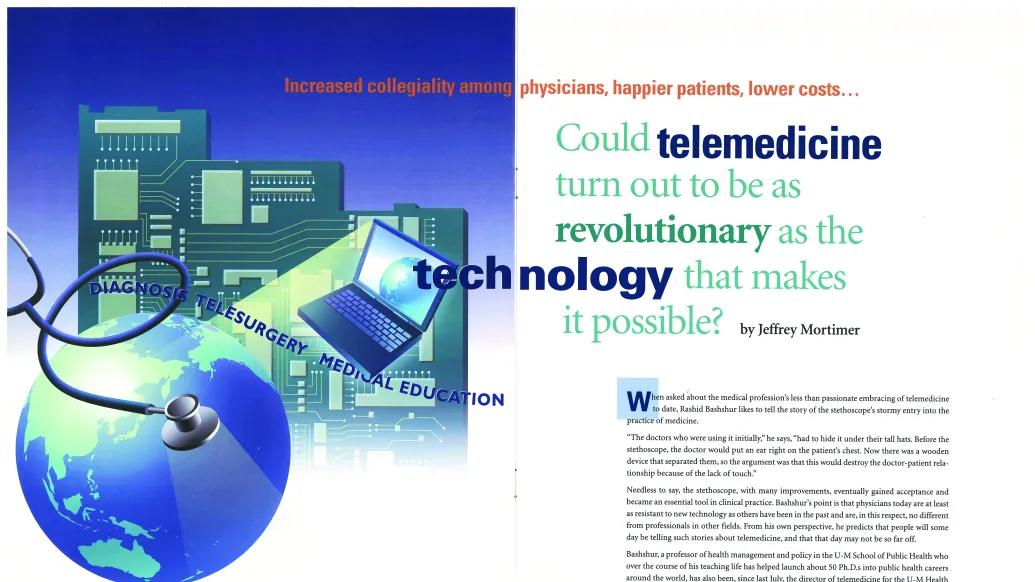
When the first issue of the Medicine at Michigan magazine landed in mailboxes in mid-1999, 10 of its pages brimmed with positive predictions about the potential of telemedicine. Quotes from early-adopter Medical School faculty who had started to use technology to see patients from a distance hinted at the promise of widespread transformation.
But for the next 21 years, that promise went mostly unfulfilled.
Held back by restrictive regulations and uncertainty, virtual health care increased only slowly at U-M and most other health systems. Meanwhile, rapid advances in high-speed internet, smartphones, and social media revolutionized how Americans communicate, and electronic health records and patient portals became a regular part of clinical care.
Then came the COVID-19 pandemic.
In spring of 2020, the long-awaited telemedicine transformation happened within a few weeks, as clinics and health systems scrambled to serve patients with as little in-person contact as possible. The federal declaration of a public health emergency greatly eased Medicare and Medicaid regulations about how patients and providers could connect from home or across state lines and erased limits on insurance reimbursement for types of telemedicine sessions.
Clinicians and patients found themselves hurled into virtual care, ready or not.
Fast forward to today
Today, about 20% of all ambulatory clinical activity at Michigan Medicine takes place over some sort of virtual connection, whether it’s via video, patient portal messaging, or old-fashioned telephones. That’s down from 2020 heights but steady since 2021.
And it’s not just Michigan Medicine: U-M research shows similar percentages of visits now take place over virtual care among people nationwide covered by traditional Medicare and among Michiganders covered by Blue Cross Blue Shield of Michigan.
Other recent research by U-M teams has shown how telemedicine has safely changed obstetricians’ approach to prenatal care, helped psychiatrists keep people in treatment for mental health diagnoses, allowed surgical teams to follow up on their patients, and enabled family medicine physicians to conduct primary care visits.
A new generation
Who’s leading the charge in telemedicine clinical care and research? Medical School faculty who were in high school and college when that futuristic 1999 article appeared. Among them: Chad Ellimoottil, M.D., assistant professor of urology and medical director of telehealth, and Laurie Buis, Ph.D., associate professor of family medicine, who leads a telemedicine research effort at the U-M Institute for Healthcare Policy and Innovation (IHPI).
They’re planning for an even greater use of virtual connections between U-M providers and patients or other providers, while navigating the post-pandemic return of regulation and reimbursement requirements that started this spring.
They’re also trying to spur rapid-turnaround research that can inform policymakers, insurance companies, and clinical organizations going forward — potentially influencing the replacement for temporary federal rules that are in place through the end of 2024.
A pioneer reflects
Rashid Bashshur, Ph.D., hopes the path will be smoother for them.
Now 90 years old, he was a leading researcher and advocate of virtual care at U-M, nationally and internationally, starting in the early 1970s as a faculty member at the U-M School of Public Health.
That 1999 magazine article appeared months after he became Michigan Medicine’s first director of telemedicine.
But by the mid-2010s, he had to battle for funds to keep any sort of clinical telemedicine afloat.
In the earliest days of the COVID-19 pandemic, he wrote an urgent message to Michigan Medicine leaders, suggesting that they implement telemedicine promptly and take steps to continue it long term.
He and others expanded that letter into an editorial that they published in April 2020 in the journal Telemedicine and e-Health. It called for research and policy to ensure “that telemedicine is central to care going forward, not just through this crisis. This way, future generations will derive benefits from our bitter experience.”
Bashshur looks back on the past three years as evidence of the critical role of telemedicine in expanding access to care, improving care quality, and containing costs for patients. But he still sees the barriers that stand in its way and the inequality it can exacerbate.
One big barrier that he, Ellimoottil, and Buis all agree on: Getting physicians and large health systems to change the way they do things.
“Medicine is a field that doesn’t always embrace change, for all kinds of reasons,” says Bashshur. “The science behind the field continues to change, but at almost every turn medicine has resisted before accepting it.”
Getting past that inertia requires careful attention not just to big-picture strategy, but on-the-ground implementation, he says.
Moving forward
Ellimoottil agrees. That’s why he and his colleagues took pains to involve many people in the development of a five-year roadmap for virtual care at Michigan Medicine.
“We envision going well beyond video visits, into managing the health of large populations of our patients at home and using these technologies to support our growing statewide network,” he says, referring to the hospitals in the Grand Rapids area and Lansing that are now part of Michigan Medicine, and the affiliated hospitals and clinics in northeastern Michigan, as well as referring providers anywhere. “If we want to stay in the forefront of delivering health care, we must do this. It’s where the future is going, and we want to be there.”
Harnessing telemedicine to connect U-M specialists to providers at owned, affiliated, or referring locations can help patients get care where they live and avoid traveling to Ann Arbor. Each virtual visit at U-M currently saves patients an average of 67 miles of driving.
Allowing U-M providers to deliver virtual care from their own homes can help reduce the risk of burnout, he notes. It also expands the number of patients who can be seen at U-M outpatient sites, by using clinic space for those who require in-person care.
Similarly, virtual connections can extend the ability of nurses to support patients at home, such as helping them follow discharge instructions or prepare for upcoming procedures.
Some telemedicine programs involve equipping patients with a kit of devices to measure and report their own vital signs at home and a tablet to connect them to providers.
Other programs involve patients’ own devices — including smartphones and smart watches — to track measures and alert clinicians when patients need more care.
Immediate need for research
Buis keenly feels the need to accelerate research on all these programs and on the use of telemedicine nationwide. IHPI’s Telehealth Research Incubator is working to connect and support dozens of faculty from all over campus.
Finding ways to help researchers get their findings out to those who can use them, without the delays of academic publishing, will be key.
“We need data, and we need new knowledge now, to inform the path forward,” she says. “We need to reach those who will make decisions about everything from requirements for location and licensing, to payment, to incentives to improve equity.”
Featured News & Stories
Doctors in the house: History of medical interns and residents at Michigan Medicine
A gene discovery that changed cystic fibrosis care, and genetic research, forever
Milestones in the history of women in medicine and biomedical science at U-M
A long time coming: The saga of today’s University Hospital
Pioneers and pathbreakers: Black History milestones at Michigan Medicine