Protecting Physicians in Syria
U-M researcher documents the effects of attacks on the health system in Aleppo and calls for international mobilization
Author |
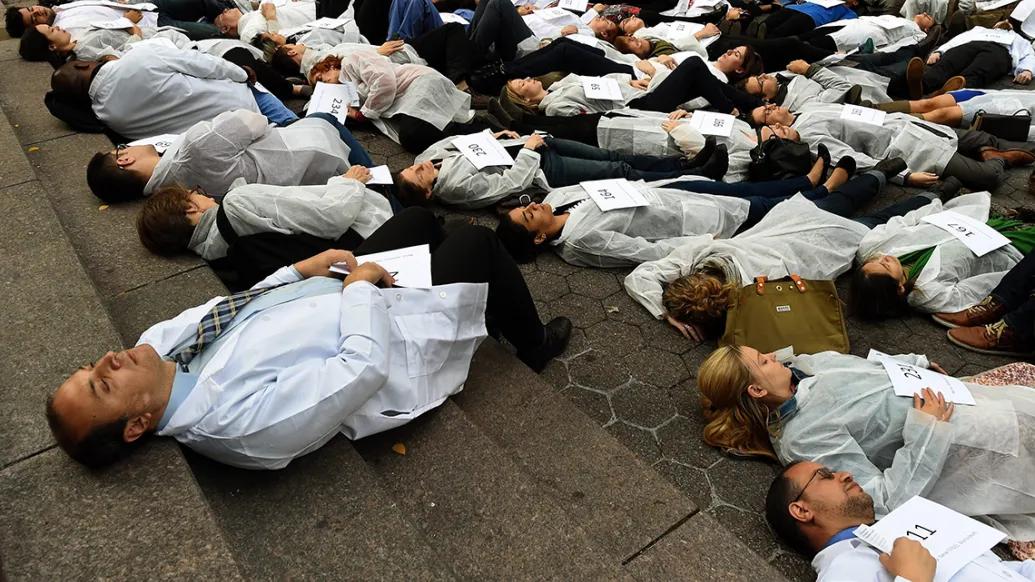
For more than four years, Bashar al-Assad, president of Syria, and the Syrian government have been embroiled in a civil war with anti-government opposition forces.
In early 2012, there were 33 functioning hospitals in eastern Aleppo, Syria; now there are 10. The remaining doctors have moved their services underground or to the bottom floors of medical facilities and rotate working on-call, 24 hours a day for 15 days. There are no longer any CAT scan or MRI machines that work in the city, so patients with traumatic brain injuries are not able to receive immediate surgery.
Significant gaps in medical expertise have opened, too. Aleppo has only one thoracic surgeon, plastic surgeon, renal surgeon, neurologist and cardiologist. There are no psychiatrists or psychologists.

Michele Heisler, M.D. (Residency 2000, Fellowship 2002), recently brought these facts to light as part of her report on increasing attacks on hospitals and health care providers in Syria. Heisler, a University of Michigan professor of internal medicine and of health behavior and health education, together with Physicians for Human Rights, or PHR, investigator Elise Baker, conducted the report for PHR. PHR has a long history of monitoring violations of medical neutrality — the right to provide health care in conflict zones. These rights are enshrined in international law.
"[Over] the last two years, it came to PHR's attention that the Syrian government has been, arguably, one of the most egregious perpetrators of systematic attacks on medical professionals, as well as attacks on medical facilities," Heisler says. "[This is] likely done with the idea of intimidating medical professionals and the civilians who seek medical care. It can be a very insidious weapon of war."
According to PHR's findings, 2015 was the worst year yet for attacks on the Syrian health care system, with a total of 112. Overall, between March 2011 and November 2015, PHR reported 336 attacks on 240 medical facilities. Nearly 700 medical personnel have been killed, with the Syrian government and its allies responsible for 95 percent of the deaths.
Heisler's and Baker's report, "Aleppo Abandoned: A Case Study on Health Care in Syria," focused on the attacks on the health care system in eastern Aleppo. Since the opposition group gained control of eastern Aleppo in 2012, there have been nearly 50 attacks on medical facilities there. In 2013, these attacks began to include barrel bombs, which are filled with explosives, shrapnel, nails and oil and weigh between 200 and 2,000 pounds.
Heisler and her colleagues conducted interviews for the investigation with 24 medical professionals who had temporarily crossed the border into southern Turkey for a medical conference in July 2015. They are part of a core group of medical professionals who have continued to provide health care in the face of these attacks, though 95 percent of physicians have left the city.
"There has been a lot of task shifting to nurses and other technicians," Heisler says. "Physicians trained in one area are forced to work in others. In terms of civilian population health, they have not seen new illnesses, but there were high rates of pre-existing illnesses that are not being adequately treated with the breakdown of the health care system, lack of diagnostic services, high rates of waterborne diseases, and again just the constant threat of bombing."
Heisler says that PHR is calling for international mobilization against the violations of medical neutrality. The organization maintains that a first and important step would be for the United Nations Security Council, the body that refers these types of cases to the international criminal court, to enforce its resolutions against targeting medical facilities and civilians. Heisler's report also serves as a message to medical professionals: They must make clear that targeting health professionals, facilities and patients will not be tolerated, or there is a real risk that it will become the standard weapon of war throughout the world.
"Attacking medical facilities is a very effective way to sow terror and demoralize civilian populations," she says. "The effects go far beyond the damage to the medical facilities themselves. And if we don't stop them and make it clear that they are unacceptable, I think we may see such attacks more and more in conflicts around the world."
Additional Reading
"Aleppo Abandoned: A Case Study on Health Care in Syria," Physicians for Human Rights, November 2015.
Featured News & Stories
Beyond the White Coat: Global & Local Health Experiences

Reaching across the globe
The digital pathology revolution

The path(ology) forward
Opioids for dental pain still more common in U.S.