The Next Frontier

An obstetrician and researcher pushes for patients to get STI prescriptions for themselves and their partners

Author | Mike Wilk
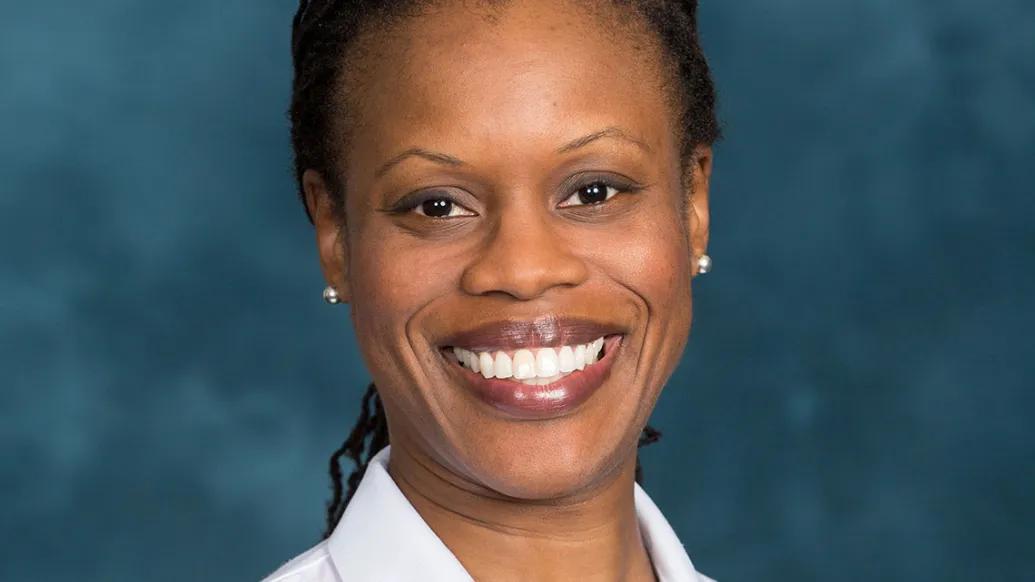
Photo by Eric Bronson, Michigan Photography

When Okeoma Mmeje (M.D. and MPH 2006), assistant professor of obstetrics and gynecology, was a resident, she began to see how her research on the treatment and prevention of sexually transmitted infections (STIs) could help shape health policies and benefit a larger community. 

"Seeing an issue with one patient, you have to assume that it's not only impacting that person, but others," says Mmeje, also a member of the U-M Institute for Healthcare Policy and Innovation and an adjunct professor at the School of Public Health. 

With training in reproductive infectious diseases, Mmeje is uniquely positioned to study how novel treatments affect larger populations. Such a treatment is expedited partner therapy (EPT), an approach that allows patients who test positive for an STI to receive medication or a prescription for themselves and their partner, even if the partner was not seen by a doctor. 

Mmeje found that in states that allow EPT, the incidence of certain STIs was lower. There were also fewer recurring infections. Because some STIs can cause lingering reproductive health complications, EPT shows promise in reducing health care costs and expenditures in the long-term. 

"When trying to think about how to stop the STI epidemic, the question is: Can we find a way to support treatment of both partners?" Mmeje says. "I think that's the next frontier. We've definitely shown that EPT is safe and effective, but how do we get it to more people?" 

EPT was approved for use in Michigan in January 2015. Since then, Mmeje has worked with Michigan Medicine to ensure that patients diagnosed with chlamydia or gonorrhea are being offered EPT. Michigan Medicine also is collaborating with the Michigan Department of Health and Human Services to implement and address the barriers to EPT uptake in Michigan. 

"I think you get real satisfaction from your work when you're able … to think about how we can use health care innovation and discovery to affect communities and society at large," Mmeje says. "Being involved in research that has helped advance policies has been very meaningful to me." 


More Articles About:

Gynecology EPT Expedited partner therapy public health Sexually Transmitted Infections (STI)

Featured News & Stories

Well-Being at Michigan Medicine with Dr. Elizabeth Harry
Well-Being at Michigan Medicine

The Power of Mattering

What does it take to create a culture where people can truly thrive? In this episode, Dr. Elizabeth Harry welcomes Dr. Robert Ernst, Chief Health Officer and Associate Vice President for Health and Wellness at the University of Michigan, about building well-being into systems, policies and everyday experiences. They explore purpose-driven leadership, belonging, mental health and why helping people feel they matter can strengthen entire communities.
The Fundamentals Podcast Hero Card Final 1800 x 1350
The Fundamentals

The Bioethics of Data and A.I. in Healthcare

Season four of The Fundamentals is here, and we're celebrating by doing a special two-episode release to launch the season! On this episode of the Fundamentals, we talked to Professor Kayte Spector-Bagdady, the George E. Wantz Professor of Bioethics, about the use of massive amounts of data, artificial intelligence, and more. Be sure to check out our second launch episode and our entire back catalog on The Fundamentals website, or on your favorite podcast player.
Health Lab Podcast in brackets with a background with a dark blue translucent layers over cells
Health Lab Podcast

An expert's view on hantavirus

A University of Michigan infectious disease expert shares their insights into the latest hantavirus outbreak and answers questions about common concerns.
Minding Memory with a microphone and a shadow of a microphone on a blue background
Minding Memory

Addressing Senior Social Isolation in the Community

In this episode, Matt & Lauren build off their previous conversation with Ashwin Kotwal about social isolation by speaking with Eve Lefkowitz, the Executive Director of the non-profit organization, A Conversation to Remember, which connects older adults – including those who live with cognitive decline – with young adult college students to combat the epidemic of social isolation and loneliness. Lauren & Matt learn about the populations this non-profit serve as well as perspectives on how to address social isolation with older adults.
ferility pink moving time clocks vials pregnancy test baby outline
Health Lab

What causes infertility? A doctor answers common questions and clears up misconceptions

For fertility, timing and age to stress and lifestyle all play a factor. Here, a Michigan Medicine fertility doctor explains what impacts your chances of getting pregnant and when to get help.
Minding Memory with a microphone and a shadow of a microphone on a blue background
Minding Memory

The Impact of Social Isolation and Loneliness on Cognitive Health

In this episode we're going to discuss a topic that's increasingly recognized as central to cognitive health and social connection. We'll define what it is and what happens when it's missing. Social isolation and loneliness are now widely discussed as public health concerns, and evidence has really mounted that social disconnection has profound effects on health, including cognitive decline and dementia risk. To help us think through this, we're joined by Dr. Ashwin Kotwal, a geriatrician and health services researcher at UCSF and the director of the Social Connections and Aging Lab. His work examines how social relationships shape aging related outcomes, including cognitive health, disability, and mortality.