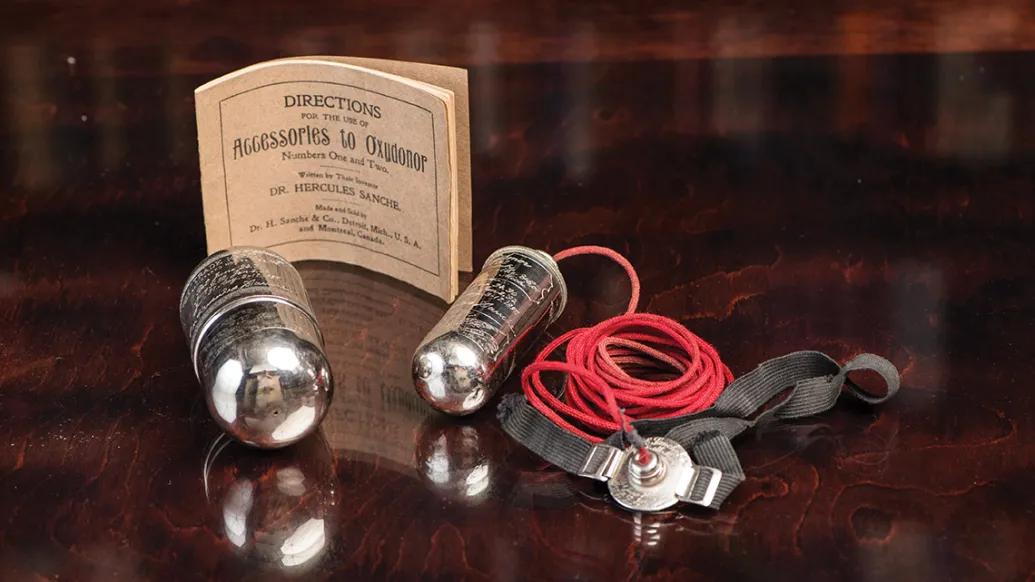
In the late 1800s, Hercules Sanche, an itinerant businessman who claimed to be a doctor, devised a subfield of medicine called diaduction. Sanche believed that an undercurrent existed between all natural organisms and a disruption to that current resulted in illness, or "Devitalization." The body, according to diaduction, craved oxygen — and "Revitalization" was achieved only when it was restored. Enter the Oxydonor Victor, a piece of medical quackery custom-made by Sanche that promised to provide that vital, missing element. It cost a princely $35 and was buttressed by hyperbolic testimonials (a requisite, it seems, of the patent medicine era). The Oxydonor could treat any and all ails, Sanche extoled, so long as it was used properly.
Consisting of a long rope connected to a tubular piece of metal — the "Vocor" — and several "contact discs," the Oxydonor was affixed to the wrists and ankles with elastic. For best results, the Vocor needed to be submerged in ice-cold water.
The address listed on the Oxydonor's patent was originally in Detroit, but Sanche moved around to avoid authorities and legal issues. He also campaigned heavily for imitators to be shut down, and each authentic device came with a stalwart warning: "Caution: There is but one Genuine Oxydonor. It has the name of the originator and inventor plainly stamped in the metal parts. Look for the name. Don't risk your life or throw away your money on fraudulent imitations."
Sanche's sham was eventually exposed by the U.S. government, and he took his products to Montreal, where they continued to be sold and marketed until the 1950s.
SOURCES
Phisick Medical Antiques
Sullivan-Fowler, Micaela. "The Giver of Oxygen: Hercules Sanche and the Oxydonor." Journal of the Medical Humanities.
The University of Michigan Center for the History of Medicine
Featured News & Stories
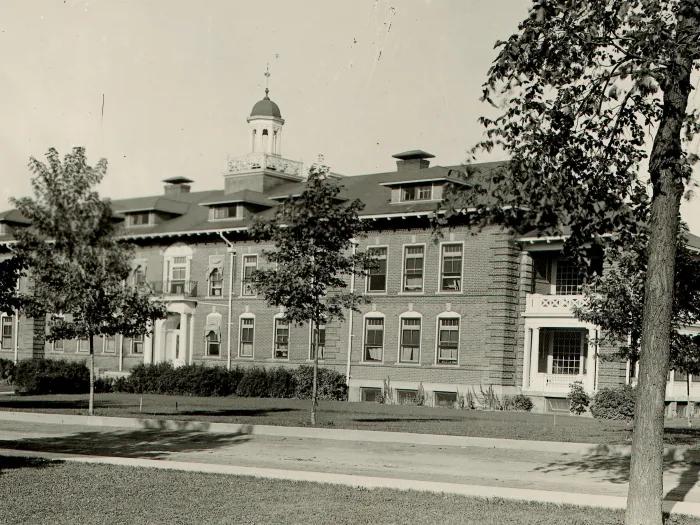
Exploring the mind’s mysteries: 130 years of mental health care & innovation at U-M

How U-M helped bring depression out of the darkness
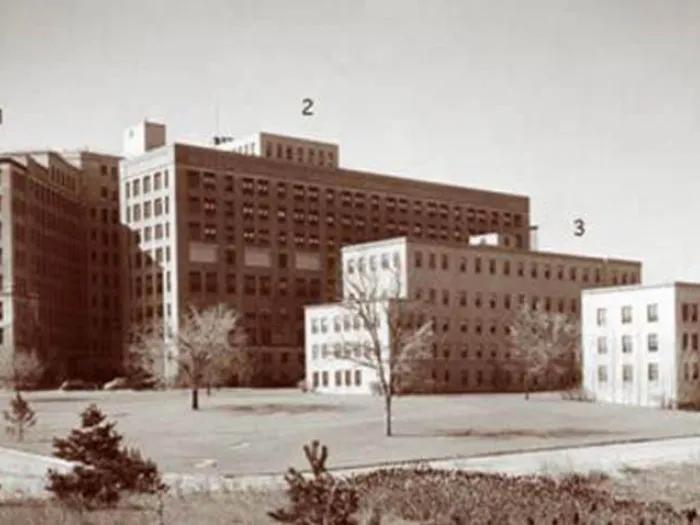
Doctors in the house: History of medical interns and residents at Michigan Medicine
Still celebrating the 175th anniversary of the University of Michigan Medical School
The era of Jewish quotas in med schools