$25M gift to benefit patients at U-M’s new Weiser Family Center for Breast Cancer
Author |
Michigan Medicine will launch a new era in comprehensive breast cancer care, thanks to a generous donation from the Weiser Charitable Foundation.
The foundation’s $25 million gift will support establishing the Weiser Family Center for Breast Cancer at the University of Michigan Health Rogel Cancer Center. The funding will assist in improving treatment experiences through the creation of programs to support patients and their families, as well as expanding opportunities for education and research around breast cancer.
The gift includes $5 million in matching funds to encourage additional gifts to the center.
“The Weiser Charitable Foundation is proud to make this transformational gift to improve outcomes in all aspects of breast cancer prevention, treatment, and survivorship, and offer hope to those who need it most,” says former U-M regent Ron Weiser, president of the foundation. “We are honored to assist in establishing a center that will provide expanded care throughout patients’ breast cancer journeys by building new programs, testing innovative ideas, and transforming the patient experience for breast cancer patients.”
“The expert medical professionals at Michigan Medicine work daily to improve outcomes for every patient,” says Marschall S. Runge M.D., Ph.D., CEO of Michigan Medicine, executive vice president for medical affairs, McKay Professor, and dean of the Medical School. “We are grateful for the support of the Weiser Charitable Foundation as we further establish ourselves as a home for high-level and compassionate care.”
“We are so grateful for this transformational gift from the Weiser Charitable Foundation,” says U-M president Santa J. Ono, Ph.D. “This extraordinary gift will speed new discoveries, open new insights, and strengthen Michigan Medicine’s place as one of the nation’s leading medical centers.”
Breast cancer is the most common cancer in women and the second leading cause of cancer death in women in the U.S. More than 310,000 Americans are diagnosed with breast cancer each year — almost 9,000 of them in Michigan.
“The Rogel Cancer Center is a national leader in breast cancer research and care, but our providers care for about 4.5% of breast cancer patients in our state. This generous gift will allow us to significantly increase our impact. Not only will we bring world-class cancer care to more Michiganders, but the knowledge our teams uncover will improve how breast cancer is diagnosed and treated worldwide,” says Eric R. Fearon, M.D., Ph.D., director of the Rogel Cancer Center, associate dean for cancer programs at Michigan Medicine, the Emanuel N. Maisel Professor of Oncology, and professor of internal medicine, of pathology, and of human genetics.
The foundation’s $25 million gift will support various elements at the Weiser Family Center for Breast Cancer:
Staff, including care navigators, clinical research coordinators, and faculty leadership support
Technology, including contrast-enhanced mammography machines and microsurgery equipment
Infrastructure, marketing, and other operational requirements for excellent patient experiences
Research and education, providing support for clinical research and access to breast cancer trials; establishing endowment for annual provider and community educational programs
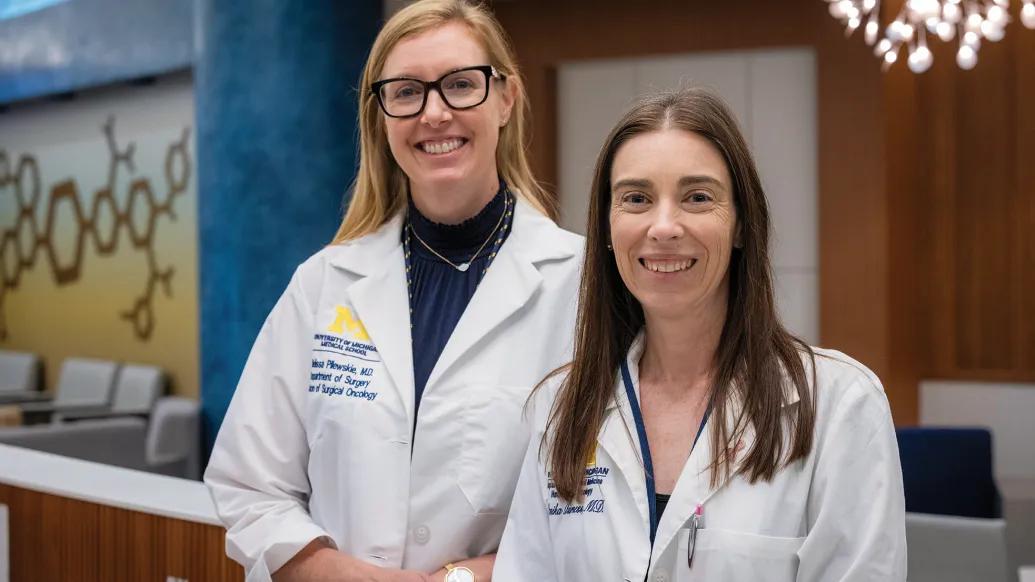
The Weiser Family Center for Breast Cancer will be co-led by Melissa Pilewskie, M.D., associate professor of surgery, and Monika Burness, M.D., assistant professor of internal medicine, ensuring multidisciplinary care for all patients.
“This impactful gift will have a tremendous influence on the care we provide, supporting our current plans for this center and beyond,” says Justin Dimick, M.D., M.P.H., the Frederick A. Coller Distinguished Professor of Surgery and chair of the department.
“Investing in innovative programs advances our ability to deliver exceptional clinical care and expand our services to meet the evolving needs of our patients.”
Support programs
The gift will help expand services for patients at all stages of breast cancer, from early disease to metastatic disease. Specialty programs will address those at high risk for developing cancer or with aggressive disease. Resources will also assist patients seeking plastic surgery or breast reconstruction, and prevention of lymphedema through state-of-the-art microsurgical procedures. The center plans to launch a comprehensive breast cancer survivorship plan to support patients as they navigate care and follow-up after completing their treatment.
Technology
This gift will support the center in creating a dedicated healing environment where patients have timely access to diagnostic testing and treatments. The center plans to purchase several individual pieces of breast cancer care equipment. These include breast imaging technology like contrast enhanced mammography and expanding cold capping options to prevent hair loss during chemotherapy. The foundation’s gift will also support plans to upgrade communication channels and marketing efforts, including increasing virtual options for some appointments.
Research
The breast cancer center will focus on collaboration with researchers so that clinical research is integrated into patient care settings. The foundation’s gift will support additional clinical research coordinators who will continue to pave new paths in breast cancer treatment. In addition to the plans currently in place, the Weiser Charitable Foundation’s gift will provide opportunities for future expansions to the center as needed.
About the donor
Weiser and his family have committed more than $200 million to the University of Michigan to date. He served on the Board of Regents from 2016-2024 and was a vice chair of the Victors for Michigan campaign. His gifts have helped establish centers and institutes including the Ronald Weiser Center for Prostate Cancer, the Elizabeth Weiser Caswell Diabetes Institute, the Mary H. Weiser Food Allergy Center, and the Chad Carr Pediatric Brain Tumor Center at Michigan Medicine as well as the Weiser Center for Real Estate, the Weiser Diplomacy Center, the Weiser Center for Emerging Democracies, and the Weiser Center for Europe and Eurasia on the main campus. The Weiser Charitable Foundation also established the Eileen Lappin Weiser Center for the Learning Sciences in the Marsal Family School of Education at U-M in 2022.
Featured News & Stories

4 ways to teach your teen safe driving habits

Continuing the legacy of a doctor’s doctor

Human Rabies Exposures Growing Across the Country
Online resources and coaching helped people seek genetic testing for cancer

Learning Together: Making Space for Growth at Work