To Achieve Diversity Among Doctors, Start in Pre-Med Years
The pipeline of future physicians still doesn’t reflect the full spectrum of American society — so experts say institutional support should start earlier.
7:00 AM
Author |
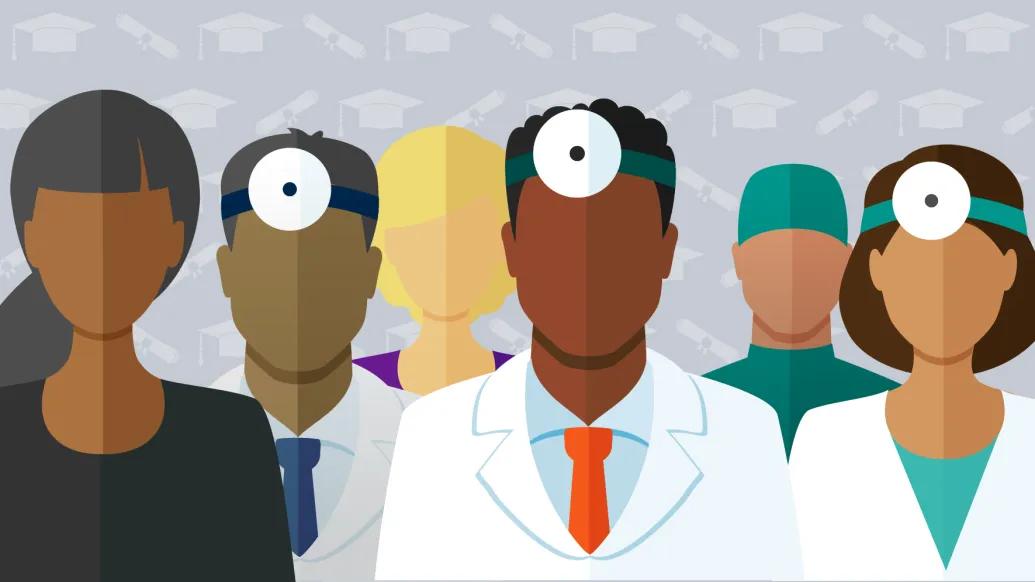
The pipeline of future physicians still doesn't reflect the full spectrum of American society — so experts say institutional support should start earlier.
Twenty years ago, the call went out to medical schools: It was time to "bridge the appalling diversity gap that separates medicine from the society it professes to serve," said the president of the Association of American Medical Colleges.
It wasn't just about equal access to the profession — it was a call to improve public health. Studies clearly show that diversity among doctors means better health for patients of color, better access for the poor and the underserved, and more.
Yet today, medical school classes are only slightly more diverse than they were in 1997. Meanwhile, the country's mix of people with different skin colors, economic backgrounds, and family immigration and education histories has become even more diverse.
What can move the needle on diversity in the physician pipeline?
Starting further up the pipe, says a team of University of Michigan Medical School researchers who have studied the issue.
In a new article in the journal Academic Medicine, the team lays out the case for focusing on first-year college students who have an eye on medical school or another health-related graduate program.
Using evidence from other studies, and from their own evaluation of a U-M pre-med program, they conclude that the support and training a student gets in the earliest years of pre-med studies can make or break his or her chances of going on to medical school or other graduate health sciences training.
It is important to focus on the success of these students, rather than their deficits, as a strategy for improving diversity in medicine.
Starting support freshman year
Many students from groups underrepresented in medicine (URiM) fall out of the pre-med pipeline during college. They do so at higher rates than students from non-URiM backgrounds — despite the fact that both groups indicate the same interest in science at college's start.
Although historically the measure known as URiM focused on race and ethnicity, it now also includes students from lower-income families, or who are the first in their families to go to college.
"We are learning that intentional connections between medical faculty and premedical students are incredibly important," says Adrianne Haggins, M.D., the U-M Medical School researcher who co-authored the new study. "We will be able to improve diversity in medicine only if we are able to create and sustain these links."
The team cites studies of programs for URiM students at Stanford University and the Rutgers New Jersey Medical School.
They also present new data from the Health Sciences Scholars Program (HSSP) at U-M, which incoming freshman from any background can apply to if they have an interest in a medical, nursing, dental, pharmacy or public health career.
SEE ALSO: 1 in 4 First-Year Residents May Meet Criteria for Clinical Depression
Each year, 120 students from a broad range of backgrounds enroll in the HSSP, which brings students together for classes; a living and learning community in a residence hall; counseling; opportunities to interact with health care and research professionals; and a chance to develop their leadership skills and to get academic support.
The program began in 2001, as health-related schools and colleges across U-M collaborated to improve diversity among those seeking admission to their graduate programs.
When high school students apply to HSSP as part of their undergraduate application, admissions officers consider many demographic factors, including parents' income and education. They also target high schools with large proportions of URiM students for recruitment.
In all, 1,065 students took part in HSSP in its first 10 years. Of them, 1 in 5 was African-American, Hispanic or Native American. And of those students, 22 percent were the first in their families to go to college, and more than 10 percent had family incomes under $50,000.
When the researchers surveyed these program alumni in 2015, they overwhelmingly said they would recommend HSSP to others. Already, 15 percent of the entire HSSP alumni group had graduated from or were currently in medical school. Among members of URiM groups, 37 percent were in or had graduated from a graduate program in a health profession — including 11 percent who were in or had finished medical school.
"As the former director of the HSSP, I saw firsthand the vital role of mentorship and role modeling for students from backgrounds that are underrepresented in medicine," says Helen Morgan, M.D., who led the program for several years and is an assistant professor of obstetrics and gynecology and of learning health sciences. "These relationships can set a foundation for success for these promising students to pursue careers in health care and medicine."
The kind of assistance the HSSP offers can help students over hurdles that might otherwise cause them to give up on their goals. For example, a bad grade in chemistry has been shown to have a defeating effect and can cause URiM students to leave the pipeline. So can constrained financial resources.
Paula Ross, Ph.D., a co-author of the new paper and director of advancing scholarship at the U-M Medical School, says, "It is important to focus on the success of these students, rather than their deficits, as a strategy for improving diversity in medicine."
Looking forward
In the end, the U-M team calls for more institutions and education researchers to see the pre-med years as crucial to the future diversity of the physician community. More data on the effects of programs aimed at pre-college and pre-med undergraduates, especially those from URiM backgrounds, is sorely needed, they add.
Once a URiM student completes an undergraduate education that prepares them for medical school, other programs for further assistance exist at medical schools and in residency programs. These multiple touch points can help bolster their chances of success.
"It is critical for the health care workforce to reflect the diversity of those they serve," says Monica Lypson, M.D., MHPE, a professor and former assistant dean at the U-M Medical School. "In order to ensure a diverse workforce, we must look at all aspects of the pipeline. Academic medicine must work to support efforts to diversify the pre-health professional arena. One key way to do that is by providing mentoring, coaching and sponsorship to pre-health-profession students, medical students, residents and junior faculty."

Health Lab
Explore thousands of health news & research stories by visiting the Health Lab homepage for more.
Media Contact

Public Relations
Department of Communication at Michigan Medicine
Stay Informed
Want top health & research news weekly? Sign up for Health Lab’s newsletters today!
Featured News & Stories

Resident stories: Challenges and lessons learned caring for diverse, vulnerable populations in the ER

Digital alerts support timely treatment decisions of critically ill cardiac patients

What’s changing in Medicaid and what can you do?
Studying Period Pain
Who’s at risk for painful periods?