A Win-Win for Science Education: Postdocs in Community College Classrooms
Post-Ph.D. training rarely involves teaching skills — and associate degree programs rarely involve contact with scientists. A new program bridges the divide.
1:00 PM
Author |
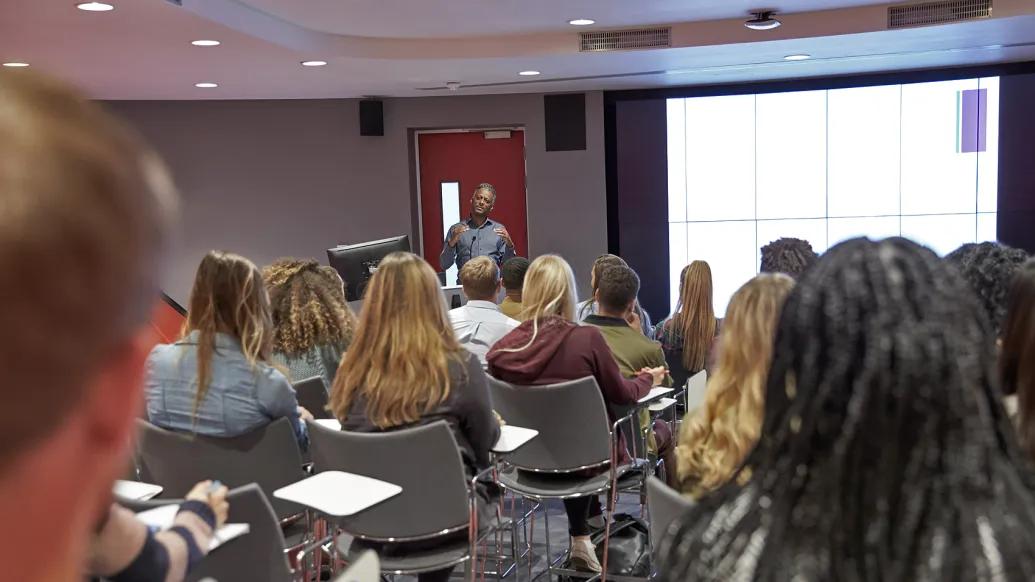
They're at two different ends of the higher-education journey: some just starting out on associate degrees, the others finishing up advanced training after earning a doctorate in biomedical science.
MORE FROM THE LAB: Subscribe to our weekly newsletter
But there's a lot they can teach one another, with the help of their professors.
Now, at sites across the country including the University of Michigan, the two types of learners can come together for science and engineering education. This happens in programs that aim to increase diversity in the population of people seeking scientific careers, and to help young scientists gain new skills.
"For any postdoctoral fellow, having extra training in teaching skills gives them a leg up as they go on the job market," explains Bishr Omary, Ph.D., chair of physiology at the U-M Medical School and one of the leaders of this effort at U-M. "Through this program, they'll not only develop those skills, but have a chance to inspire the next generation of potential biomedical researchers and research staff."
Called Institutional Research and Academic Career Development Award (IRACDA) programs, they focus on postdoctoral fellows who have finished their scientific Ph.D.s and are nearly ready to go out on the job market.
U-M's program involves two nearby colleges that award associate degrees: Henry Ford College and the Wayne County Community College District. The colleges allow U-M Medical School and College of Engineering postdoctoral fellows to co-teach in their classrooms, working alongside their faculty.
The postdocs, who specialize in the fields of physiology and biomedical engineering, will hone their teaching skills with the help of partner college faculty mentors over the course of four years. By planning and teaching a course together, the postdocs can prepare to teach and mentor students when they obtain their first faculty jobs.
Meanwhile, the associate degree students will receive team-based teaching from the U-M postdoc and the partner college's faculty member in their engineering and science classes. The students will also have a chance to learn about scientific careers directly from a working research scientist, and to apply for summer experiences working in the same U-M research laboratory as the postdoc.
The program also aims in part to address a longstanding lack of diversity in scientific careers.
Both of the colleges in the Michigan partnership have a high percentage of students from backgrounds underrepresented in science. Some of the U-M postdoctoral fellows chosen for the program will also be from similar backgrounds, but all those chosen will be committed to careers working with such students.
Through this program, they'll have a chance to inspire the next generation of potential biomedical researchers and research staff.Bishr Omary, Ph.D.
Building a partnership 'beyond expectations'
The program builds on initial seed funding provided by U-M for a pilot program at the two local colleges. Through new federal funding of $3.64 million over five years, U-M will be able to select three postdocs each year for a four-year stint that will involve teaching, research and mentoring by participating faculty.
SEE ALSO: To Achieve Diversity Among Doctors, Start in Pre-Med Years
The new grant makes U-M the 22nd site in a nationwide network of IRACDA centers that the National Institute of General Medical Sciences funds.
Biomedical engineering professor David Sept, Ph.D., who co-leads the program, notes that NIH statistics show that IRACDA fellows were more productive scientifically than traditional postdocs.
In the pilot phase of the U-M program, which provided the data needed to apply for NIH funding, both the mentors at HFC and WCCCD and the participating postdocs expressed how pleased they were with the opportunity.
"The feedback we've gotten from the teaching mentors has been really gratifying," says Sept. "And the postdocs tell us that it really opened up their eyes, and made them feel that they were really making a difference. They enjoyed it beyond their expectations."
He notes that IRACDA fellows and community college faculty will collaborate to review existing curriculum and seek opportunities to include current scientific research to the college courses.
Janice Gilliland, associate dean of the math and science division at HFC says, "Our faculty have a great deal of pedagogical knowledge and classroom experience that they can share with the postdocs while at the same time having the chance to update themselves with current science research."
Chancellor Curtis L. Ivery of WCCCD notes that the program will also help maximize opportunities for the college's students.
Inspiring careers in science
Many students in colleges like HFC and WCCCD know about health professions from exposure to the health care system. But few have learned about the many career options available in academic and industry settings for people with science and engineering training.
In the pilot phase of the program, the U-M fellows found themselves peppered with questions from students who were curious about their research and how they got into a scientific career.
The new program adds to U-M's existing efforts to help postdoctoral fellows prepare for careers in academia, industry, government and more.
Many academic institutions that employ postdocs have launched such efforts because of the increasing competition for faculty positions and research dollars. Diversifying the range of career path training for Ph.D.s in the biomedical sciences, and moving away from seeing academic careers as the 'norm,' is a growing trend at major medical schools.
IRACDA programs can also help advance the careers of faculty from the nonresearch institutions who take part. Although all have doctorate degrees in their chosen fields, and many did postdoctoral training, their choice to focus on teaching in the community college environment means they may have fewer chances to connect with the research world they once trained in.
For more information, visit the U-M IRACDA program's website.

Health Lab
Explore thousands of health news & research stories by visiting the Health Lab homepage for more.
Media Contact

Public Relations
Department of Communication at Michigan Medicine
Stay Informed
Want top health & research news weekly? Sign up for Health Lab’s newsletters today!
Featured News & Stories
Timing is of the essence for RNA during stress

New anti-cancer strategy shows promise in preclinical studies
More babies with hypoplastic left heart syndrome surviving critical period between surgeries
Exploring the mind’s mysteries: 130 years of mental health care & innovation at U-M

How U-M helped bring depression out of the darkness