Does “Pay-to-Play” Put Sports, Extracurriculars Out of Reach?
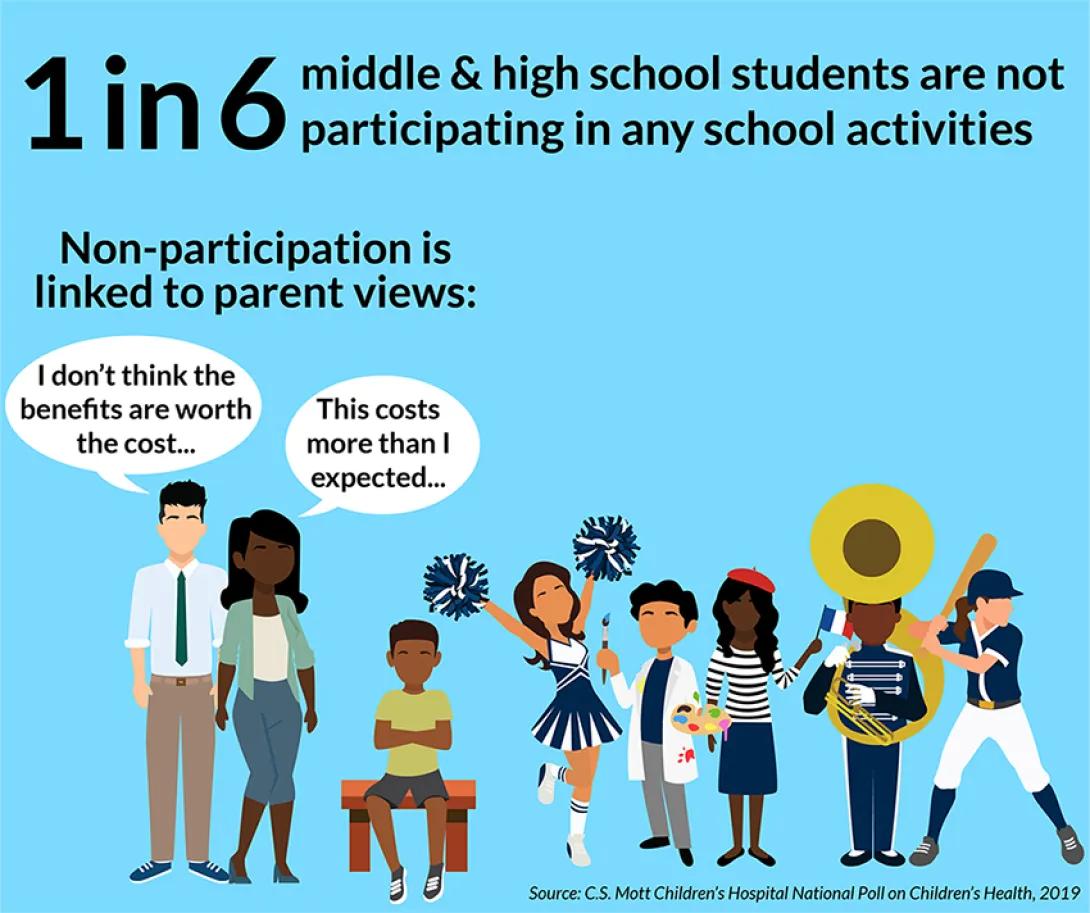
1 in 6 middle and high school students don’t participate in extracurricular activities; students from low-income households have twice the level of nonparticipation as peers from higher-income homes.
7:00 AM
Author |

From choir and cheerleading to soccer and student council, extracurricular school activities keep students engaged — but cost may be among barriers that prevent some children from participating, a new national poll suggests.
Eighteen percent of middle and high school-age children are not involved in any extracurricular activities this school year, according to the C.S. Mott Children's Hospital National Poll on Children's Health at the University of Michigan. And students from households earning $100,000 a year or less experience twice the rate of nonparticipation than peers from families with higher incomes.
LISTEN UP: Add the new Michigan Medicine News Break to your Alexa-enabled device, or subscribe to our daily audio updates on iTunes, Google Play and Stitcher.
"Extracurricular school activities have been shown to boost educational achievement, personal development and social opportunities," says poll co-director Sarah Clark. "But barriers to participation prevent some children from enjoying the benefits that these experiences offer."
About half of students are participating in school sports, ranging from intramurals to varsity teams, during the 2018-19 school year, while more than 40 percent participate in arts activities such as music, theater, or dance.
Roughly half also participate in in a club or other activity, which can include lunchtime or afterschool clubs about a special interest or more formal groups such as student council.
But these activities often come with a cost. Required school participation fees average $161 for sports, $86 for arts, and $46 for clubs and other activities. For sports, 18 percent of students had school participation fees of $200 or more, compared to 12 percent for arts and 5 percent for clubs and other activities.
When combining participation fees with other expenses, such as equipment and travel, the total cost averaged $408 for sports, $251 for arts, and $126 for clubs and other activities.
Too expensive
And the more likely parents were to perceive activities as too expensive for the return, the less likely their kids were to participate, the poll finds.
Twenty-nine percent of parents say the cost of school extracurricular activities is higher than they expected – and nonparticipation was nearly twice as high for their children. Ten percent felt the benefits of school activities are not worth the cost and nonparticipation was three times as high among their children.
MORE FROM MICHIGAN: Sign up for our weekly newsletter
"Parent views about the cost of school activities is linked to the discrepancy in nonparticipation among families," Clark says. "Children of parents who didn't perceive benefits outweighing the cost were least likely to being involved in sports, arts or clubs.
"Most schools strive to offer a range of activities, including some that do not require participation fees," she says. "Many schools also offer waivers or scholarship to make activities accessible to all students."
"Despite these efforts, we are still seeing lower participation among students whose parents perceive the cost is out of reach — perceptions that may be inaccurate," Clark says.
SEE MORE: Tips for Keeping Student-Athletes Safe After Common Injuries
Two thirds of students participating in arts or clubs didn't have a participation fee, compared with only 46 percent of students participating in school sports.
"For required participation fees, as well as total costs, school sports are on average more expensive for families than other types of activities," says Clark.
And parents may not know how to alleviate these costs. Just 7 percent of parents have ever requested a waiver or scholarship for participation fees. Nineteen percent said they didn't know how and 5 percent said they weren't comfortable requesting assistance.
"Parents concerned about the cost of school activities may not be aware of no-cost options, or strategies that would lower or eliminate fees," Clark says. "These missed opportunities for assistance can impede children from pursuing their interests."
Income-related attitudes
The nationally representative Mott poll report is based on responses from 961 parents who answered questions about 1,323 children in middle or high school. Parents expected that over 80 percent of middle and high school-age children would participate in at least one type of school activity for the 2018-19 school year.
The income gap in student nonparticipation is consistent with findings from previous Mott poll reports, and it corresponds with income-related attitudes of parents.
Nonparticipation was higher among boys than girls — 21 percent versus 15 percent. The top reasons for nonparticipation among boys were cost, transportation, and the student having a job. Simply not being interested in extracurricular activities was cited more often for girls.
"School officials may consider increasing awareness about no-cost activities and waivers as well as emphasizing the benefits of these experiences to hesitant parents," Clark says. "We should do our best to help every child have the opportunity to explore different interests, make new friends, develop skills and enjoy a well-rounded school experience."

Health Lab
Explore thousands of health news & research stories by visiting the Health Lab homepage for more.
Media Contact

Public Relations
Department of Communication at Michigan Medicine
Stay Informed
Want top health & research news weekly? Sign up for Health Lab’s newsletters today!
Featured News & Stories
The Alternative to a Doctor’s Office Visit Gains in Popularity During Pandemic

High dose oxytocin protocol linked to lower postpartum hemorrhage rates
4 ways to teach your teen safe driving habits

U-M-led consortium to receive up to $52 million in NIH funding to study why viral respiratory infections affect children differently
4 in 5 parents say having a baby is too expensive