Researchers circumvent radiation resistance in subtype of brain tumors
Low-grade gliomas with mutant IDHI don’t respond to radiation. Rogel researchers found the gene responsible.
10:00 AM
Author |
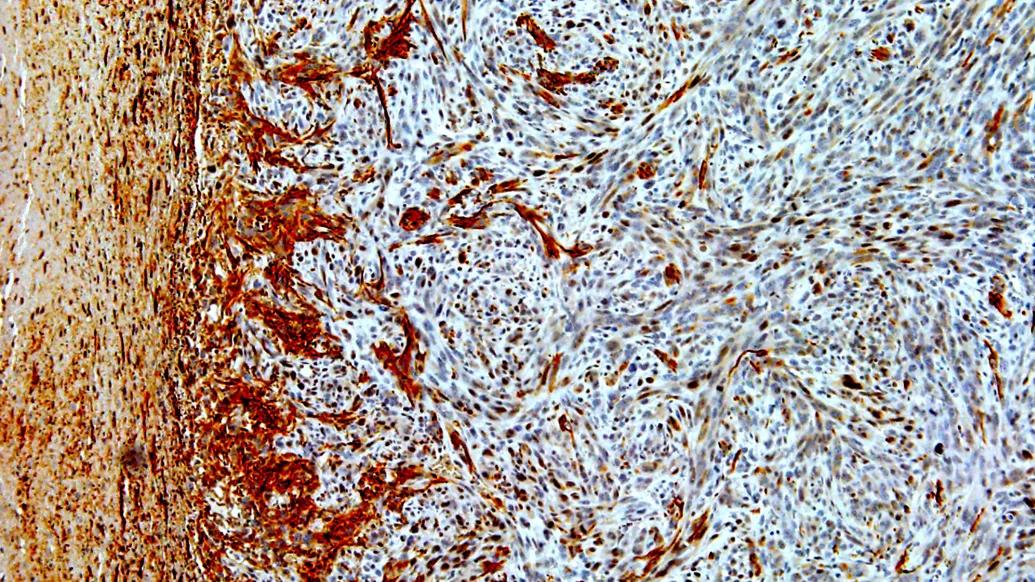
It’s a good news, bad news story. Patients whose brain tumors have a mutated enzyme called IDH1 typically live longer than those without the mutation. But even as these tumors are initially less aggressive, they always come back. A key reason: The tumors are resistant to radiation treatment and are invasive.
In a study, researchers at the University of Michigan Rogel Cancer Center uncovered a gene that is overexpressed in mutated IDH1. Studies in human cells and a novel mouse model both show that this gene, called ZMYND8, plays a critical role in the radiation resistance. When they knocked down the gene, the glioma cells became responsive to radiation treatment.
“These tumors almost always recur, and when they do, the tumors are much more aggressive. This finding gives us a new therapeutic avenue to treat these patients. It’s a very promising and novel therapeutic target,” said Maria G. Castro, Ph.D., R.C. Schneider Collegiate Professor of Neurosurgery at Michigan Medicine. Castro is senior author on the study, published in Clinical Cancer Research, a journal of the American Association for Cancer Research.
SEE ALSO: Glioma subtype may hold the secret to the success of immunotherapies
The researchers used two cell cultures obtained from surgical biopsies of patients with mutated IDH1 glioma. Cells were treated with an inhibitor designed to block a metabolite produced by the mutated IDH1. From there, they screened the RNA and found a gene called ZMYND8.
“After treating with the mIDH1 inhibitor, we found this gene, ZMYND8, was significantly downregulated. It’s overexpressed in mutant IDH1 glioma cells, but when you treat the cells with an inhibitor, ZMYND8 protein expression goes down. And when this gene goes down, the cells become radiosensitive,” said study first author Stephen V. Carney, a Cancer Biology graduate student in the Castro/Lowenstein Lab.
ZMYND8 is known to be a regulator of DNA damage response. Radiation therapy works by damaging DNA. When ZMYND8 protein expression is high, researchers saw radiation resistance. When ZMYND8 was knocked out, the radiation led to DNA damage and increased glioma cell death.
The researchers also developed a new mouse model of mutated IDH1 glioma, which confirmed that knocking out ZMYND8 sensitized the tumors to radiation therapy, leading to increased survival.
“ZMYND8 contributes to the survival of mutant IDH1 glioma in response to radiation. Our study shows that we now have a new way of treating these tumors by using mRNA-based therapeutics in which we can downregulate the expression of ZMYND8 to render the cells radiosensitive,” said study author Pedro R. Lowenstein, M.D., Ph.D., Richard C. Schneider Collegiate Professor of Neurosurgery at Michigan Medicine.
SEE ALSO: Tackling Tumors That Always Come Back: New Brain Cancer Research Could Improve Outcomes
The researchers also combined ZMYND8 knockdown with other cancer drugs, such as PARP and HDAC inhibitors. They found these other drugs synergized to make the cells more responsive to radiation, suggesting potential for combination therapy for patients with mutant IDH1 glioma.
More research is needed, but Castro envisions working with colleagues at the U-M Biointerfaces Institute to design RNA-based inhibitors to target ZMYND8, which could be delivered using nanoparticles specially designed to cross the challenging blood-brain barrier. It’s a technique they’ve already tested in previous research.
Additional authors: Kaushik Banerjee, Anzar Mujeeb, Brandon Zhu, Santiago Haase, Maria L. Varela, Padma Kadiyala, Claire E. Tronrud, Ziwen Zhu, Devarshi Mukherji, Preethi Gorla, Yilun Sun, Rebecca Tagett, Felipe J. Nunez, Maowu Luo, Weibo Luo, Mats Ljungman, Yayuan Liu, Ziyun Xia, Anna Schwendeman, Tingting Qin, Maureen A. Sartor, Joseph F. Costello, Daniel P. Cahill
Funding for this work is from National Institutes of Health grants R37-NS094804, R01-NS105556, R01-NS122536, R01-NS122165, R01-NS124167, R21-NS123879, R01-NS076991, R01-NS082311, R01-NS096756, R01-NS122234, R01-CA243916, T32-CA009676, PA18-906, the Pediatric Brain Tumor Foundation, Leah’s Happy Hearts Foundation, Ian’s Friends Foundation, Chad Tough Foundation, Smiles for Sophie Forever Foundation.
This work was supported by these Rogel Cancer Center Shared Resources: Cancer Data Science, Experimental Irradiation, Flow Cytometry, Preclinical Molecular Imaging, Single Cell Spatial Analysis, Tissue and Molecular Pathology.
Disclosure: None
Paper cited: “Zinc Finger MYND-Type Containing 8 (ZMYND8) is epigenetically regulated in mutant Isocitrate Dehydrogenase 1 (IDH1) glioma to promote radioresistance,” Clinical Cancer Research. DOI: 10.1158/1078-0432.CCR-22-1896
Live your healthiest life: Get tips from top experts weekly. Subscribe to the Michigan Health blog newsletter
Headlines from the frontlines: The power of scientific discovery harnessed and delivered to your inbox every week. Subscribe to the Michigan Health Lab blog newsletter
Like Podcasts? Add the Michigan Medicine News Break on Spotify, Apple Podcasts or anywhere you listen to podcasts.

Health Lab
Explore thousands of health news & research stories by visiting the Health Lab homepage for more.
Media Contact

Public Relations
Department of Communication at Michigan Medicine
Stay Informed
Want top health & research news weekly? Sign up for Health Lab’s newsletters today!
Featured News & Stories

Online resources and coaching helped people seek genetic testing for cancer

The AI is listening: Implications of machine generated clinical notes on health care
Comprehensive DNA sequencing reveals hidden drivers of cancer

Many older adults make Medicare decisions quickly and most don’t change plans, poll finds
‘Molecular glue’ stabilizes protein that inhibits development of non-small cell lung cancer and uterine cancer