Genetic Testing Doesn't Cause Undue Worry for Breast Cancer Patients
Newer genetic tests introduce more ambiguity, but a new study finds patients are not overreacting to uncertain results.
11:00 AM
Author |

Genetic testing for breast cancer has become more complex. Newer tests now evaluate a panel of multiple genes, compared to older tests looking only at BRCA genes.
The new complexity often brings more uncertainty about the results. But, a new study finds that these more extensive tests are not causing patients to worry more about their cancer risk.
LISTEN UP: Add the new Michigan Medicine News Break to your Alexa-enabled device, or subscribe to our daily audio updates on iTunes, Google Play and Stitcher.
"Genetic testing is becoming increasingly more complex, but increasingly more precise. This has led to some ambiguity in test results. The challenge is incorporating this information into the treatment decision without causing unnecessary worry," says lead study author Steven J. Katz, M.D., MPH, professor of general medicine and of health management and policy at the University of Michigan.
A variant of unknown significance
Initially, genetic testing for breast cancer focused exclusively on BRCA1 and BRCA2 genes. Now, newer multigene panel tests look for abnormalities in a dozen or more different genes that play some role in breast cancer risk. By testing more genes, it's more likely a patient will have a positive test or a variant of unknown significance — in other words, something is out of the ordinary but doctors will not know how that impacts cancer risk.
SEE ALSO: Decision Support Tool Boosts Genetic Testing Knowledge in Breast Cancer Patients
The concern is that this greater variation could lead patients to worry too much about their risk of breast cancer recurring when the genetic testing results are ambiguous.
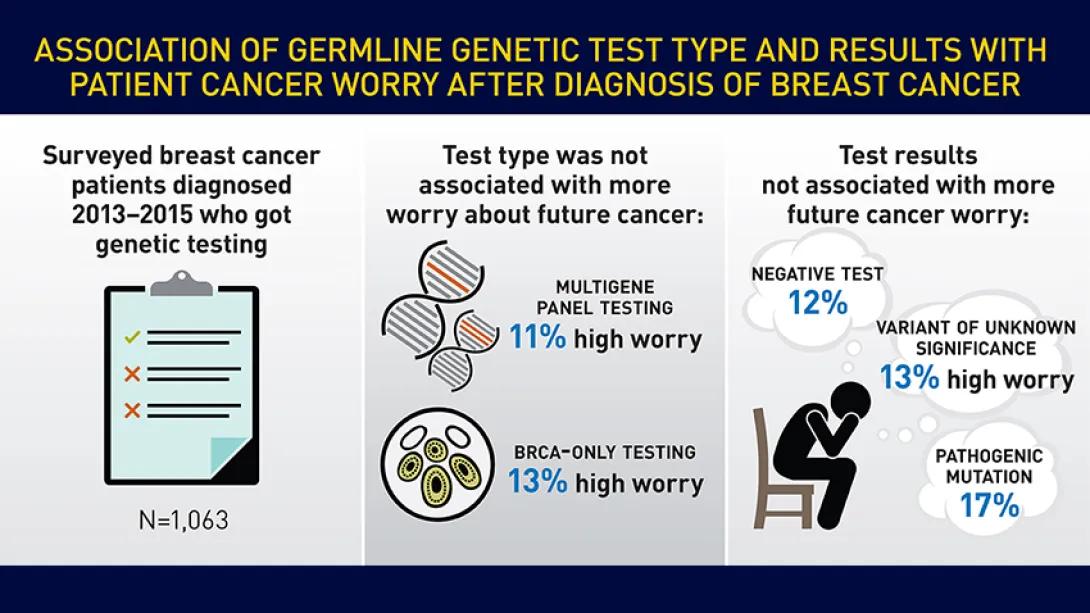
Researchers surveyed 1,063 women treated for early stage breast cancer who had received genetic testing between 2013-2015, the period in which panel testing became more popular. About 60 percent of the patients were tested only for BRCA1 and BRCA2, while 40 percent had the multigene panel test. Patients were asked how much and how often they worried about their cancer coming back and the impact that worry had on their life.
Overall, 11 percent of patients reported that cancer worry had a high impact on their life and 15 percent worried often or almost always. Neither the impact nor the frequency of worry varied substantially based on the type of genetic testing or the test results. The study is published in JCO Precision Oncology.
MORE FROM MICHIGAN: Sign up for our weekly newsletter
"These findings are reassuring," Katz says. "We found that patients did not overreact whether they got the newer panel testing or BRCA-only testing, and they did not overreact to the test results. Their future cancer worry was not different whether they had a negative test or variant of unknown significance."
Genetic counseling
Virtually all of the patients surveyed received some form of genetic counseling.
"Genetic counseling is essential to maximize the benefit of testing for patients and their families," says senior study author Allison W. Kurian, M.D., M.Sc., associate professor of medicine and of health research and policy at Stanford University. "But timely counseling after diagnosis of breast cancer is increasingly a challenge because more patients are getting tested and the results are more complex."

Health Lab
Explore thousands of health news & research stories by visiting the Health Lab homepage for more.
Media Contact

Public Relations
Department of Communication at Michigan Medicine
Stay Informed
Want top health & research news weekly? Sign up for Health Lab’s newsletters today!
Featured News & Stories

Understanding family history key to early detection of pancreatic cancer

Patient with rare form of diabetes finds answers in genetic testing, clinical trials

Intuition pushed mom to keep checking for breast cancer

Online resources and coaching helped people seek genetic testing for cancer

Comprehensive DNA sequencing reveals hidden drivers of cancer