Bacteria May Help Babies’ Digestive Tracts More Than Suspected, Scientists Find
Helpful forms of E. coli may trigger steps that keep infections out, new experiments in dish-grown gut organoids show.
1:00 PM
Author |
Some of the first living things to greet a newborn baby do a lot more than coo or cuddle: They help the little one's digestive system prepare for a lifetime of fighting off dangerous germs.
MORE FROM THE LAB: Subscribe to our weekly newsletter
These things? Not parents, grandparents or siblings but helpful bacteria.
New research suggests such bacteria may help the lining of the newborn gut prepare for the surge of other bacteria that will soon enter the body, and eventually make up the thriving and diverse population of microbes that lives within each of us.
In a new paper published in the journal eLife, a team from the University of Michigan Medical School reports its findings about the impact of a helpful strain of E. coli on the cells that line the gut.
The team concludes that nonpathogenic E. coli serves a crucial function of preparing the gut for the development of the microbiome to come, and the onslaught of pathogenic, or harmful, microbes.
The new results may help explain what past research has shown about the connection between the gut microbiome and the development of the newborn immune system. They may also lead to better understanding of what can protect or rescue premature newborns from the rare but devastating gut infection condition necrotizing enterocolitis, in which bacteria invade the gut wall and cause potentially fatal infection and inflammation.
Our results show that colonization of the immature intestinal tract with E. coli results in intestinal tissue that is more robust to challenge by potentially damaging pathogens or inflammatory substances.Jason Spence, Ph.D.
Mini guts stand in for little guts
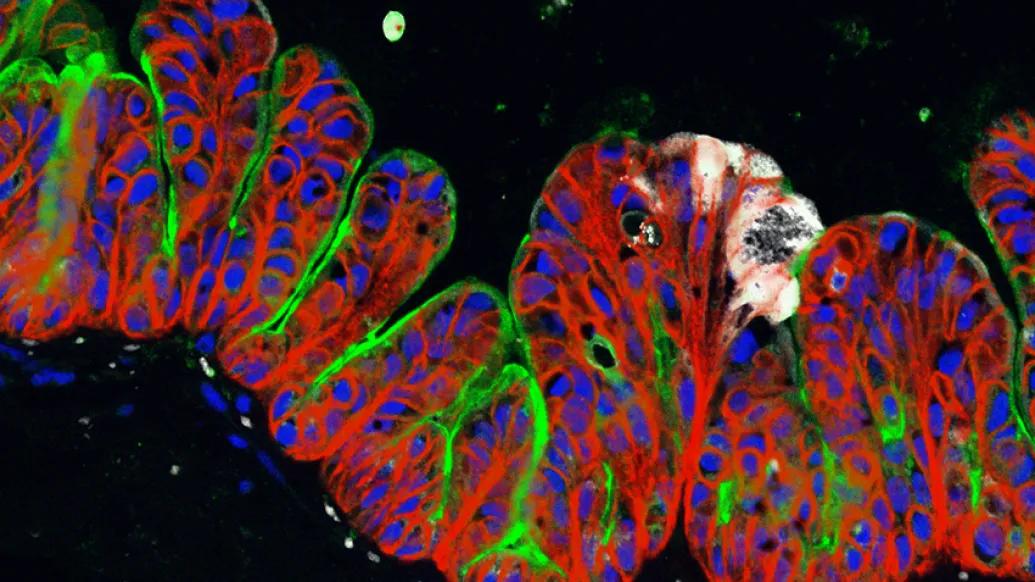
To do the research, the team studied a strain of E. coli related to ones commonly found in newborn babies' stool. The researchers couldn't do their research in actual newborns' intestines, of course. Instead, they used stem cells to grow miniature versions of the gut lining, called human intestinal organoids.
SEE ALSO: Gut Bacteria May Protect Newborns Against Infections, New Mice Study Shows
Each HIO, as they're called, is made up of thousands of cells that the scientists coax to grow, divide and organize into structures that resemble the actual gut. At each HIO's center is a hollow area called a lumen, which mimics the hollow inner portion of the tube-like human intestine.
"We have previously shown that HIOs closely resemble the immature human intestine," says lead author David Hill, Ph.D., a postdoctoral fellow in gastroenterology at Michigan Medicine, U-M's academic medical center. "In this study, we wanted to discover the effects of colonization on the intestine with a nonharmful strain of E. coli, a type of bacteria that is commonly found in the guts of newborn babies."
During growth, they kept these HIOs germ-free, just like the gut of a fetus in the womb. Then, they introduced the helpful E. coli into the hollow center of the organoids. They tracked what happened inside the cells whose surfaces face the center and in the spaces between the cells. They looked at how the cells were altering gene activity over time in response to the introduction of E. coli.
The results were clear. After the scientists introduced the E. coli, the cells facing the lumen began to mature, form tighter connections with one another and produce mucus to coat their surface.
Genes involved in cell-to-cell communication, and the physical structures cells use to link with their neighbors, activated. So did genes involved in making antimicrobial substances and mucus and transporting them to the cell surface, and in adaptation to low oxygen, which is caused by bacterial metabolism and is a hallmark of the mature adult intestine.
This activity led the HIOs to develop better resistance to inflammation-causing stimuli, which meant less damage to the cells lining the lumen.
"Our results show that colonization of the immature intestinal tract with E. coli results in intestinal tissue that is more robust to challenge by potentially damaging pathogens or inflammatory substances," says senior author Jason Spence, Ph.D., an associate professor of internal medicine and of cell and developmental biology at U-M.
Co-senior author Vincent Young, M.D., Ph.D., adds, "We have developed a system that faithfully reproduces the physiology of the immature human intestine, and will now make it possible to study a range of host-microbe interactions in the intestine to understand their functional role in health and disease."
Young is a professor of internal medicine who specializes in infectious diseases and is also a professor of microbiology and immunology at Michigan Medicine and a leader of U-M's Host Microbiome Initiative.
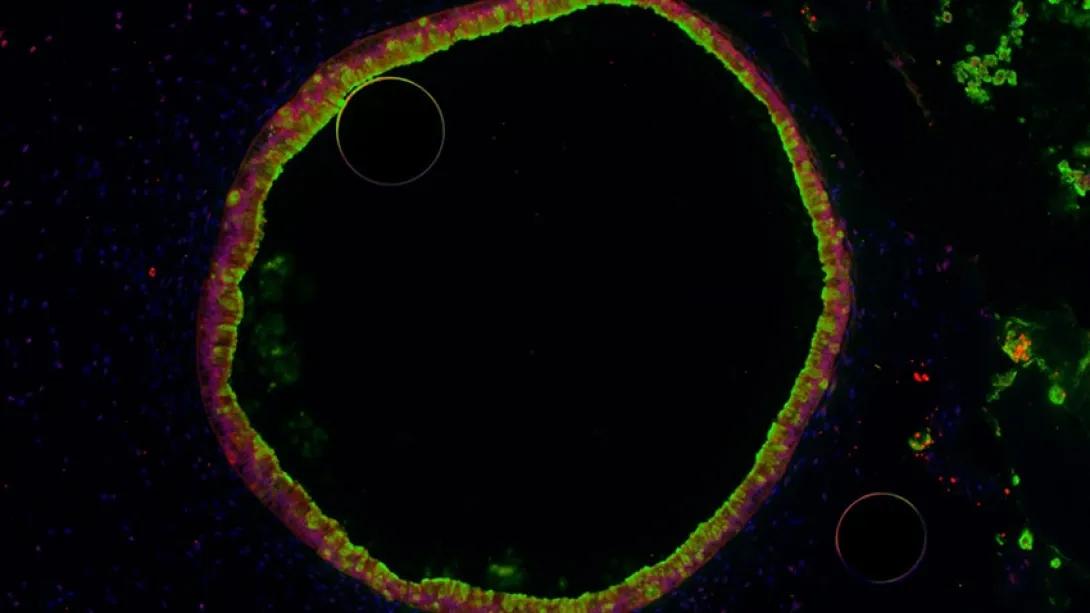
A human intestinal organoid (HIO). This hollow ball of cells grown from human embryonic stem cells can be used to study basic gut development, and the effects of microbes, in a way that mimics the guts of newborn babies.
What's next
The research grew out of cooperation between the Spence lab, which focuses on HIOs, and the Young lab, which focuses on the gut microbiome. The work was made possible by funding from the National Institutes of Health, and by investments the Medical School has made in tools that help with organoid, microbiome and DNA sequencing research.
SEE ALSO: Gut Bacteria Eat Colon Lining When Starved for Fiber
The team is now studying additional strains of nonharmful E. coli and other bacteria that take up long-term residence in the newborn gut, as well as pathogens.
"We hope to examine whether different bacteria produce different types of responses in the gut," says Hill. "This type of work might help to explain why different types of gut bacteria seem to be associated with positive or negative health outcomes."
The Spence team is preparing to launch a "core" service to provide HIOs for other researchers to study.

Health Lab
Explore thousands of health news & research stories by visiting the Health Lab homepage for more.
Media Contact

Public Relations
Department of Communication at Michigan Medicine
Stay Informed
Want top health & research news weekly? Sign up for Health Lab’s newsletters today!
Featured News & Stories
Gut Bacteria May Protect Newborns Against Infections, New Mice Study Shows
Comprehensive DNA sequencing reveals hidden drivers of cancer

Many older adults make Medicare decisions quickly and most don’t change plans, poll finds
What’s the latest on 7-OH and kratom availability and addiction care?

Depression in OBGYN residents needs more attention, study suggests