New training focuses on safety during home health care visits
From the implementation of role-play training to virtual sessions with life-size simulations, training for safety during home care visits is a priority more than ever.
5:00 AM
Author |
In September 2021, a training aimed at keeping health care employees — and patients — safe during home care visits was launched by the University of Michigan Division of Public Safety and Security and U-M Health Post-Acute Care Services.
More than 35 nurses, physical therapists, social workers, wheelchair technicians, delivery drivers and home health care leaders took part in three inaugural sessions of "REACT", short for Rapid Environmental Assessment and Control Training.
First of its kind
The program is a first of its kind in the health care industry, combining classroom learning with virtual and real-life scenario-based training that includes role playing in actual home environments.
During the classroom portion that kicks off the four-hour training, participants learn about different safety mindsets, scanning the environment for potential threats, and the importance of factors such as eye contact and body language.
"There's a saying that in moments of crisis, you don't rise to the occasion, you sink to the level of your training," said Brian Uridge, M.P.A., the director of Michigan Medicine Security. "We want to be sure all employees, especially those going into unfamiliar environments, are armed with knowledge and experience that will help them stay safe."
The program includes a virtual session with full, life-size screens that place participants in four different home care scenarios.
Participants must make real-time decisions in situations like parking for a home visit, walking into the middle of a conflict and witnessing illegal drug use. Each participant experiences the session individually, with a trainer starting their scenario from a nearby computer and then programming in the next set of circumstances based on the participant's reaction to what's happening on the screen.
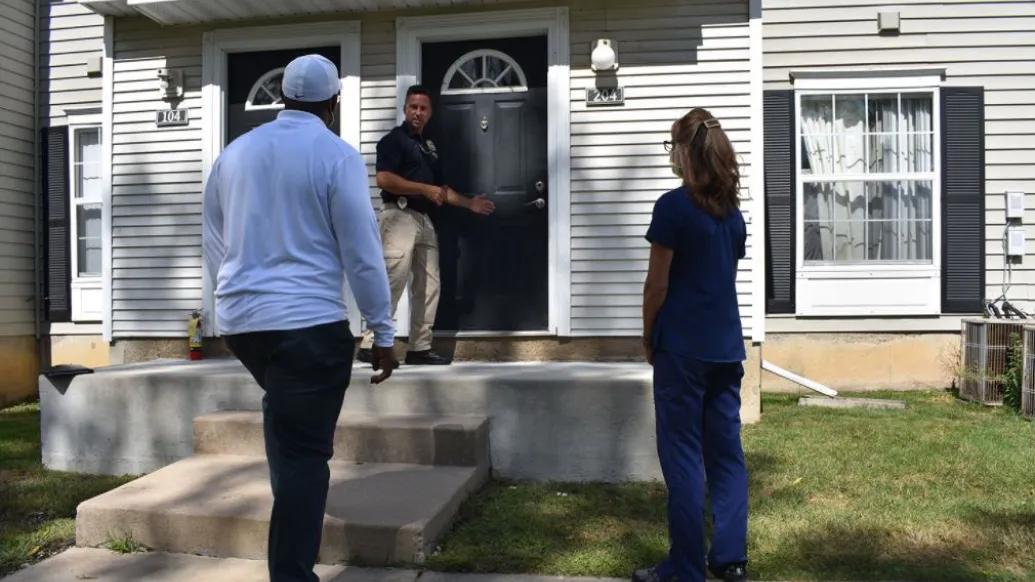
The role-play portion of the training takes place in actual apartments, where members of the Michigan Medicine Security team and nurse educators pretend to be patients and household members who might be present during a home visit. Participants enter the apartment one at a time and are met with unexpected circumstances that test their situational awareness and response. At the end of each session, members of the training team review the situation with the participant and discuss the best ways to stay safe.
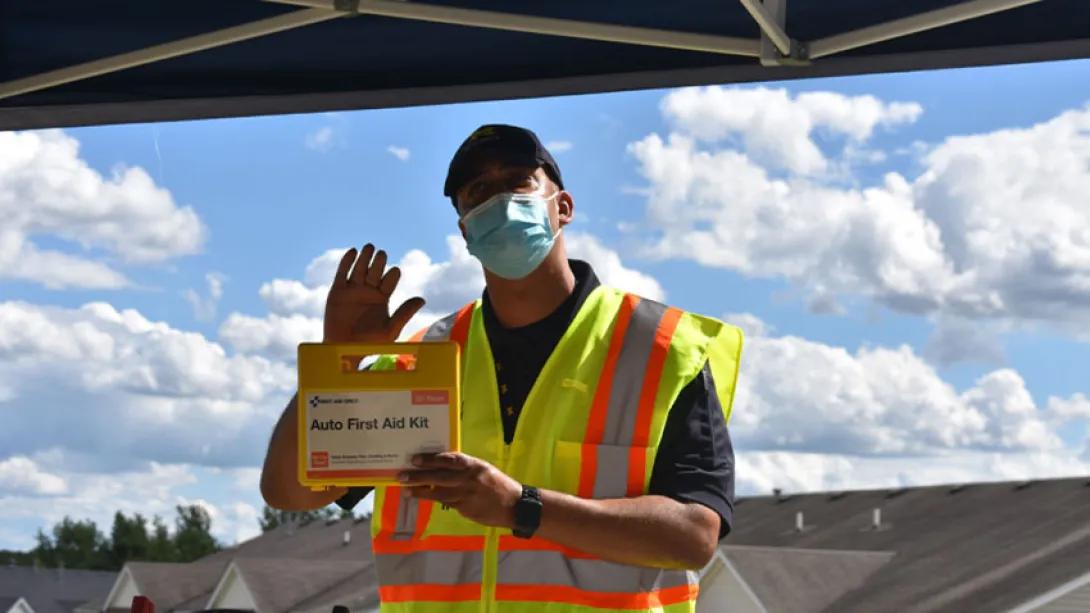
The final portion of the training is a session on vehicle preparedness that provides an overview of items that home health care workers — and others — should keep in their car to ensure readiness and safety in a variety of situations.
Meeting the need with teamwork and innovation
Conversations between security and care leaders revealed an opportunity to partner and create this new training for clinical staff providing in-home health care services.
"Care at Home is the initiative of the year for U-M Health," said Eric Towell, R.N., EMBA, FABC, associate chief operating officer for Post-Acute Care Services. "In addition to our standard home health care services, we are now offering hospital-level care to patients in their homes and working to grow those programs."
More providers, care teams and support staff will be in patient homes.
"We want to ensure the safety of those individuals," Towell said, "and, at the same time, teach them how to respond in situations where a patient may be in danger, like an abusive or neglectful relationship, or the presence of weapons, drugs or an unsafe environment."
The first step in developing the training was gathering information to better understand the need. Uridge says members of the Michigan Medicine Security team accompanied home health care workers on visits and walked them through patient homes, so health care workers could share their biggest safety concerns. Input gathered during these visits served as a foundation for the training.
There's a saying that in moments of crisis, you don't rise to the occasion, you sink to the level of your training.Brian Uridge, M.P.A.
Then, the team looked at existing training programs for important elements to include.
"This program was modeled after law enforcement and military situational awareness training programs that are designed to keep staff safe by helping them identify, assess and de-escalate or avoid situations," Uridge said. "We used principles from Welle de-escalation and situational awareness trainings and the SMART (Specific, Measurable, Attainable, Relevant and Time-bound) concept to develop this training."
The entire training program was designed, and is being delivered, by nurse educators, security and law enforcement working as a team.
"The most exciting part of developing and launching this training has been the collaboration between clinical staff and the security team," Uridge said. "It's a great example of the importance of every voice and the fact that we are better when we work together."
Next steps
Uridge, Towell and their teams look forward to continued collaboration on the training, which Uridge says he hopes to offer to all home health care workers annually.
The security team is also working with nurse educators to develop similar, scenario-based trainings for faculty and staff who work in adult and psychiatric emergency services.
According to Uridge, 75% of all workplace violence occurs in a health care setting, and 41% of that occurs in the emergency department.
"Our goal is to ensure that faculty and staff are trained to assess risk and react to potential dangers, wherever they are," he said. "Whether in a home care environment or clinical setting, it's important for employees to feel safe and have the knowledge and skills to stay safe.".
This piece was additionally edited by Allison Mi.

Health Lab
Explore thousands of health news & research stories by visiting the Health Lab homepage for more.
Media Contact

Public Relations
Department of Communication at Michigan Medicine
Stay Informed
Want top health & research news weekly? Sign up for Health Lab’s newsletters today!
Featured News & Stories
Mobile health app improves heart failure medication use, dosing after hospitalization
5 ways to manage politically induced stress
The AI is listening: Implications of machine generated clinical notes on health care
4 in 5 parents say having a baby is too expensive

What’s the latest on 7-OH and kratom availability and addiction care?