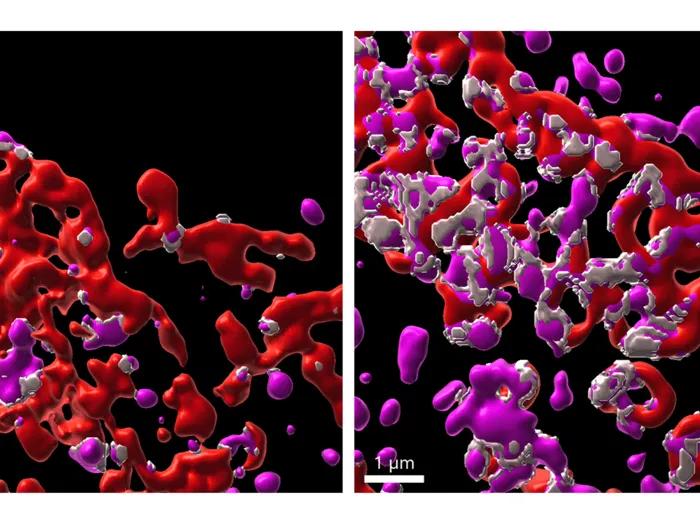
Mathematics enable scientists to understand organization within a cell’s nucleus
A clearer picture of how a cell is organized could help biologists learn how to reprogram a cell to halt cancer or other diseases.
5:00 AM
Author |
Science fiction writer Arthur C. Clarke's third law said "Any sufficiently advanced technology is indistinguishable from magic."
Indika Rajapakse, Ph.D., is a believer. The engineer and mathematician now finds himself a biologist. And he believes the beauty of blending these three disciplines is crucial to unraveling how cells work.
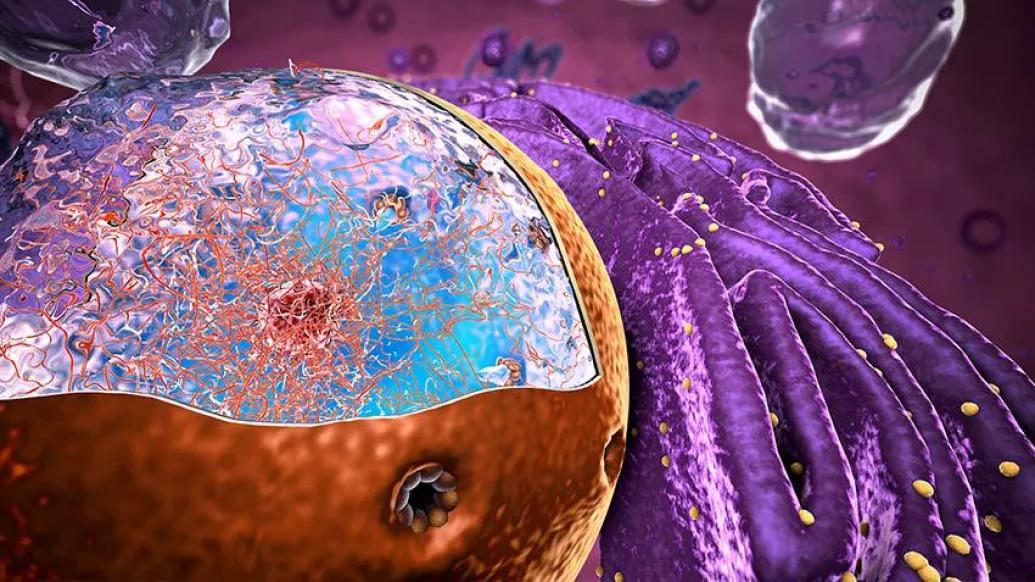
His latest development is a new mathematical technique to begin to understand how a cell's nucleus is organized. The technique, which Rajapakse and collaborators tested on several types of cells, revealed what the researchers termed self-sustaining transcription clusters, a subset of proteins that play a key role in maintaining cell identity.
They hope this understanding will expose vulnerabilities that can be targeted to reprogram a cell to stop cancer or other diseases.
"More and more cancer biologists think genome organization plays a huge role in understanding uncontrollable cell division and whether we can reprogram a cancer cell. That means we need to understand more detail about what's happening in the nucleus," said Rajapakse, associate professor of computational medicine and bioinformatics, mathematics, and biomedical engineering at the University of Michigan. He is also a member of the U-M Rogel Cancer Center.
Rajapakse is senior author on the paper, published in Nature Communications. The project was led by a trio of graduate students with an interdisciplinary team of researchers.
The team improved upon an older technology to examine chromatin, called Hi-C, that maps which pieces of the genome are close together. It can identify chromosome translocations, like those that occur in some cancers. Its limitation, however, is that it sees only these adjacent genomic regions.
The new technology, called Pore-C, uses much more data to visualize how all of the pieces within a cell's nucleus interact. The researchers used a mathematical technique called hypergraphs. Think: three-dimensional Venn diagram. It allows researchers to see not just pairs of genomic regions that interact but the totality of the complex and overlapping genome-wide relationships within the cells.
"This multi-dimensional relationship we can understand unambiguously. It gives us a more detailed way to understand organizational principles inside the nucleus. If you understand that, you can also understand where these organizational principles deviate, like in cancer," Rajapakse said. "This is like putting three worlds together – technology, math and biology – to study more detail inside the nucleus."
The researchers tested their approach on neonatal fibroblasts, biopsied adult fibroblasts and B lymphocytes. They identified organizations of transcription clusters specific to each cell type. They also found what they called self-sustaining transcription clusters, which serve as key transcriptional signatures for a cell type.
Rajapakse describes this as the first step in a bigger picture.
"My goal is to construct this kind of picture over the cell cycle to understand how a cell goes through different stages. Cancer is uncontrollable cell division," Rajapakse said. If we understand how a normal cell changes over time, we can start to examine controlled and uncontrolled systems and find ways to reprogram that system."
Additional authors include Gabrielle A. Dotson, Can Chen, Stephen Lindsly, Anthony Cicalo, Sam Dilworth, Charles Ryan, Sivakumar Jeyarajan, Walter Meixner, Cooper Stansbury, Joshua Pickard, Nicholas Beckloff, Amit Surana, Max Wicha, Lindsey A. Muir
Funding was provided by the National Human Genome Research Institute grant 5T32HG000040-27, Air Force Office of Scientific Research grant FA9550-18-1-0028, Defense Advanced Research Projects Agency grant 140D6319C0020, National Science Foundation grant 2035827
Lindsly, Chen and Rajapakse have submitted a patent application for the computational framework. Muir and Rajapakse are co-founders of iReprogram, Inc.
Paper cited: "Deciphering Multi-way Interactions in the Human Genome," Nature Communications. DOI: 10.1038/s41467-022-32980-z
Live your healthiest life: Get tips from top experts weekly. Subscribe to the Michigan Health blog newsletter
Headlines from the frontlines: The power of scientific discovery harnessed and delivered to your inbox every week. Subscribe to the Michigan Health Lab blog newsletter
Like Podcasts? Add the Michigan Medicine News Break on Spotify, Apple Podcasts or anywhere you listen to podcasts.

Health Lab
Explore thousands of health news & research stories by visiting the Health Lab homepage for more.
Media Contact

Public Relations
Department of Communication at Michigan Medicine
Stay Informed
Want top health & research news weekly? Sign up for Health Lab’s newsletters today!
Featured News & Stories

New questionnaire aims to improve understanding of demand avoidance in children, teens
Timing is of the essence for RNA during stress
New anti-cancer strategy shows promise in preclinical studies

More babies with hypoplastic left heart syndrome surviving critical period between surgeries

How U-M helped bring depression out of the darkness