How to Know If You're Having a Heart Attack

An expert explains the difference between having a heart attack and experiencing chest pain from heart disease, along with the warning signs of each.

3:06 PM

Author | Johanna Younghans Baker

How to Know If You're Having a Heart Attack

Are you having a heart attack or experiencing chest pain that's related to heart disease?

"It's important to understand the difference between the two," says Eryn Smith, M.S., PA-C, a physician's assistant in Michigan Medicine's Frankel Cardiovascular Center, since they may feel similar, but a heart attack requires immediate medical attention.

"Angina, a symptom of heart disease, is when the arteries of the heart are narrowed down, but not completely closed off. This is very different than a heart attack. A heart attack is when the arteries of the heart suddenly close off and the sudden closure causes a sensation of chest pain," Smith explains.

Signs of a heart attack include:

- Uncomfortable pressure, squeezing, fullness or pain in the center of the chest that comes on quickly and won't go away with rest.

- Pain or discomfort in one or both arms, the back, neck, jaw or stomach.

- Shortness of breath with or without chest discomfort.

- Other signs such as breaking out in a cold sweat, nausea or lightheadedness.

(If you're experiencing any of these symptoms, call 9-1-1 immediately.)

Signs of angina include:

- Chest pain, usually present during exertion.

- Pain or discomfort subsides with rest.


More Articles About:

Heart Health Heart disease heart attack Heart Attack Treatment Heart Attack Prevention Heart Disease Risk Factors Diagnosis of Heart Condition Cardiovascular: Diseases & Conditions
Health Lab word mark overlaying blue cells

Health Lab

Explore thousands of health news & research stories by visiting the Health Lab homepage for more.

Media Contact

University Hospital at U-M Health in the spring with flowering trees in foreground and Survival Flight helicopter visible

Public Relations

Department of Communication at Michigan Medicine

[email protected]

734-764-2220

Stay Informed

Want top health & research news weekly? Sign up for Health Lab’s newsletters today!

Subscribe

Featured News & Stories

On the left, a woman sits in a hospital gown with her scar showing on her chest. On the right, two women pose each wearing medals from athletic competition.
Health Lab

New heart, three medals and a shot at the world stage

After a heart transplant for heart failure caused by congenital heart disease, woman won three medals at the Transplant Games and will compete on Team USA in 2027
The Parade Company artist Kennedy Perkins, wearing blue shirt, paints the “Little Victors” sign for the new C.S. Mott Children’s Hospital float in America’s Thanksgiving Parade.
Health Lab

From patient to artist: A project close to her heart

More than two decades after undergoing lifesaving surgery for complex heart conditions -- ventricular septal defect and discontinuous left pulmonary artery -- an artist is bringing hospital’s new Thanksgiving parade float to life
A man sits on a large red tractor. Behind him a bunch of corn is stacked in the back of the vehicle
Health Lab

Michigan man undergoes complex heart repair after last minute surgery cancelation
A complex operation at U-M Health enabled surgeons to remove scar tissue surrounding Scott Roach's heart and successfully repair his failing mitral valve.
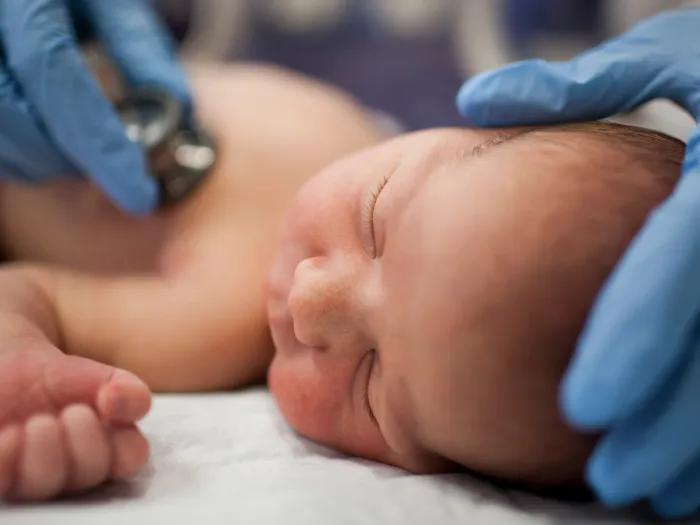
Closeup of newborn baby, whose head is held by a blue medical gloved hand. Blue gloved hand also holds a stethoscope to baby's chest.
Health Lab

More babies with hypoplastic left heart syndrome surviving critical period between surgeries
Collaborative effort helped sustain improvements in survival for babies born with hypoplastic left heart syndrome (HLHS), a serious congenital heart condition that requires multiple surgeries.
A smartphone displaying a red heart with a white EKG line on its screen, set against a teal background.
Health Lab

Mobile health app improves heart failure medication use, dosing after hospitalization
A U-M-led trial found a mobile app improved use and dosing of recommended heart failure medications during the 90 days following a hospital discharge.
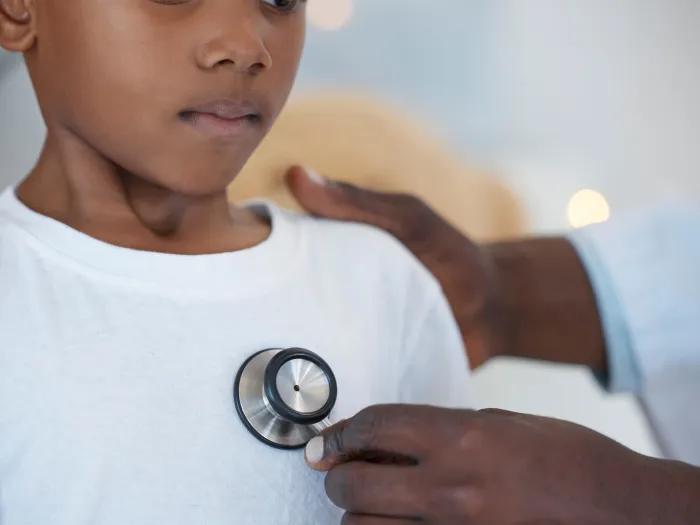
Boy in white t-shirt, just chin showing, with hands holding a stethoscope on his chest.
Health Lab

Distance, insurance, social factors may hinder access to lifesaving heart monitoring for children

New research suggests that social, economic and geographic factors may influence whether patients who undergo the Fontan surgery for complex congenital heart disease receive the recommended lifelong cardiac monitoring.