U-M Team Makes Strides in Tissue Regeneration Research
Groundbreaking new research marrying high-intensity focused ultrasound with genetically modified cells may spur bone and soft tissue regeneration.
7:00 AM
Author |
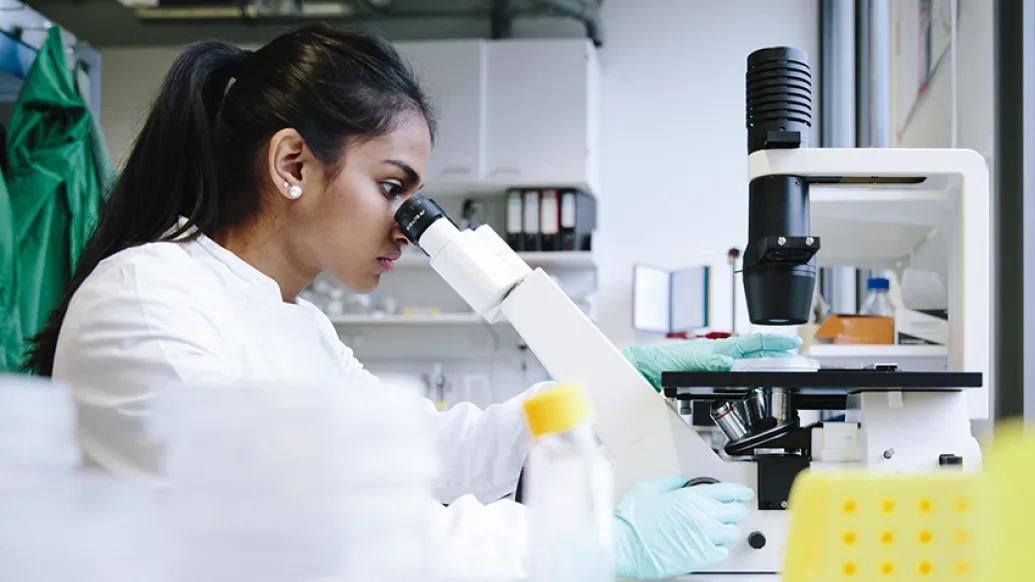
Growth factors, or substances like hormones or vitamins that are required for the stimulation of growth within living cells, play a critical role in tissue regeneration.
Without them, many cellular responses fail to be triggered, hindering tissue repair and development, says Mario Fabiilli, Ph.D., a research assistant professor of radiology at the University of Michigan.
LISTEN UP: Add the new Michigan Medicine News Break to your Alexa-enabled device, or subscribe to our daily audio updates on iTunes, Google Play and Stitcher.
"Because growth factors are produced in precisely controlled ways, however, many researchers run into the challenge of developing effective methods for reproducing their patterns in real time," he says.
This inspired Fabiilli and Renny Franceschi, Ph.D., a professor of periodontics and oral medicine at U-M, to co-lead a team that explored a potential therapy for bone and soft tissue regeneration. Their groundbreaking research was recently published in the journal Biomaterials.
SEE ALSO: Boosting a Key Protein to Help Bones That Won't Heal
The team, consisting of researchers from a broad range of fields including biomedical engineering and dentistry, found that using high-intensity focused ultrasound, or HIFU, a method approved by the Food and Drug Administration for treating various diseases, can spur tissue regeneration when coupled with genetically modified cells that contain a "gene switch."
By design, the gene switch controls expression of a molecule, similar to a growth factor. However, Fabiilli and his team's gene switch was novel because it required both heat shock and a ligand for activation: "When we heated the cells just 5 to 8 degrees Celsius above body temperature in the presence of a specific activating ligand, the gene switch is turned on, thus stimulating gene expression. It was really interesting to observe," Fabiilli says.
The ingenious road to discovery
First, the team developed a scaffold that was both biocompatible — or not harmful to living tissue — and easily heated when exposed to HIFU.
For tissue regeneration, delivered cells are commonly encapsulated within a scaffold, which is implanted at the site of the defective tissue. The scaffold, which mimics the extracellular matrix, provides a 3D microenvironment that supports cellular processes involved in tissue regrowth.
"Hydrogels, which are composed of hydrophilic polymers, are a commonly used class of scaffolds," Fabiilli says. "Due to their high water content, the acoustic attenuation of hydrogels is very low. This means that conventional hydrogels do not heat very efficiently."
To offset this problem, the researchers needed to develop a composite scaffold with an acoustic attenuation similar to soft tissue.
MORE FROM MICHIGAN: Sign up for our weekly newsletter
With this in mind, they developed a composite hydrogel scaffold consisting of fibrin and hydroxyapatite particles. Fibrin, a major component of blood clots, is commonly used for the delivery of cells in tissue regeneration. Hydroxyapatite is the mineral component of bone.
The team then encapsulated cells containing the gene switch, which controlled activation of a firefly luciferase (fLuc) transgene, within the composite scaffolds and the fibrin-only scaffolds. Both versions were simultaneously exposed to varying intensities of HIFU and the activating ligand, which was rapamycin.
SEE ALSO: Stem Cells Provide Greater Insight into Rotator Cuff Disease
Because of the higher attenuation, the composite scaffolds heated more efficiently, which yielded transgene expression. The fibrin-only scaffolds did not demonstrate the same features.
Additionally, the team used bioluminescence imaging to show that fLuc activation could be spatially patterned by moving the focus of the HIFU across the cell-loaded composite scaffolds.
"We were able to maintain that gene expression was controlled within cubic millimeter precision," Fabiilli says.
Further investigation
Fabiilli and his team also showed that gene activation could be controlled in vivo, or within a living organism.
"We incorporated the cells containing the gene switch-controlling expression fLuc into composite scaffolds and then subcutaneously implanted them into mice," Fabiilli says. "And interestingly enough, we observed significantly higher rates of expression (using bioluminescence imaging) in the constructs that were exposed to both HIFU and ligand, versus ligand alone."
Eventually, the team also found that the gene switch could be turned on multiple times, which could be beneficial in promoting tissue regeneration.
"We went back and applied both the HIFU and ligand and observed repeated activation of transgene expression eight days after the initial round," Fabiilli says. "This was absolutely fascinating and gives way to so many more possibilities when it comes to tissue regrowth."

Health Lab
Explore thousands of health news & research stories by visiting the Health Lab homepage for more.
Media Contact

Public Relations
Department of Communication at Michigan Medicine
Stay Informed
Want top health & research news weekly? Sign up for Health Lab’s newsletters today!
Featured News & Stories
Study reveals why a rare mutation behind Dravet syndrome is so deadly

New questionnaire aims to improve understanding of demand avoidance in children, teens
Timing is of the essence for RNA during stress
New anti-cancer strategy shows promise in preclinical studies
More babies with hypoplastic left heart syndrome surviving critical period between surgeries