World’s Smallest Pacemaker Can Help Stop Surgical Complications
The University of Michigan recently implanted its first Micra leadless pacemaker directly into a patient’s heart, eliminating some of the issues associated with older devices.
7:00 AM
Author |
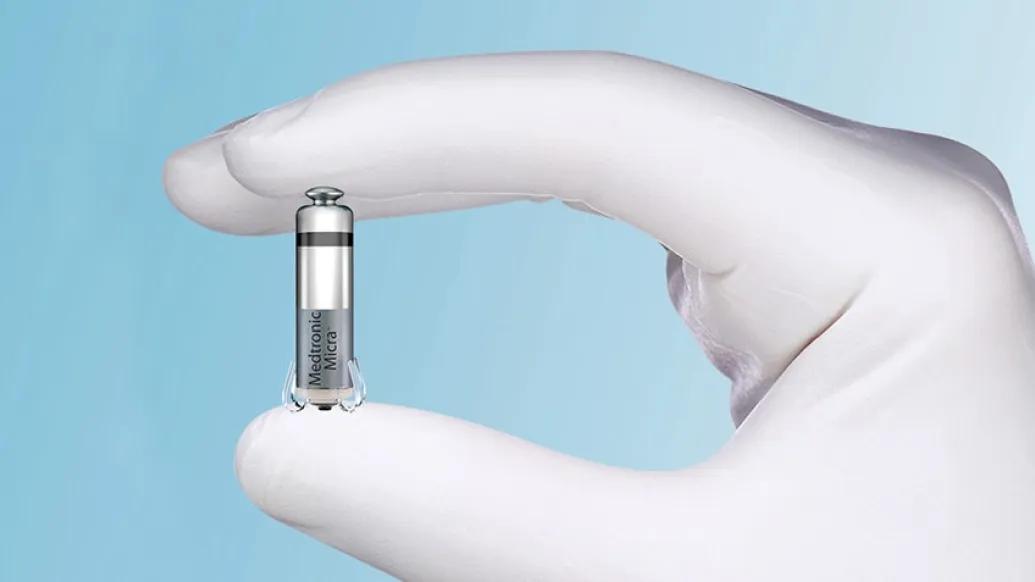
Heart patients in the U.S. are beginning to take advantage of a miniature pacemaker that stimulates a regular heart rhythm without the connecting leads or wires of a conventional pacemaker.
Electrophysiologist Ryan Cunnane, M.D., recently implanted the new leadless Micra Transcatheter Pacing System at the University of Michigan Frankel Cardiovascular Center — a first-of-its-kind procedure for the university that comes as a new generation of miniaturized medical devices is being developed.
SEE ALSO: A Tough Surgery with a 'Transformative Impact' for CTEPH
Medtronic's Micra is one-tenth the size of a traditional pacemaker, or about the size of a large vitamin. The pacemaker is revolutionary not only for its measurements, but also because it is placed inside the heart.
"There's no incision in the chest, and no leads, which means none of the larger device-related complications that go with that," says Cunnane.
How Micra works
The 1-inch device, the world's smallest pacemaker, is implanted directly onto the inside heart wall. Flexible prongs hold it in place. Electrical impulses are then generated to regulate heartbeats in the same fashion as traditional single-chamber pacemakers.
Traditional pacemakers sit in a "pocket" just under the skin below the collarbone with one or more electrodes running directly into the heart. Though complications of this implantation are uncommon, the electrodes can break or become dislodged or infected, requiring subsequent procedures such as lead extractions.
Micra inserts through a vein in the patient's groin and then affixes directly to the heart. No scar or visible bump in the chest results, as from conventional pacemakers.
The leadless device also eliminates potential medical complications arising from a chest incision and from wires running from a conventional pacemaker into the heart.
A clinical trial involving 719 patients implanted with Micra found 98 percent had adequate heart pacing six months after implantation, and complications occurred in less than 7 percent of trial participants, according to the Food and Drug Administration, which approved the device in April.
Who needs a pacemaker?
Cardiac pacemakers treat a too-slow heart rate called bradycardia.
The device stimulates the heart to a normal rhythm so patients feel well and avoid dizziness and fainting.
SEE ALSO: Artificial Placenta Holds Promise for Extremely Premature Infants
Some limitations in how it performs may hinder its use. Micra regulates activity of the lower chambers of the heart from the right side only. Some patients may need more complex support from dual- chamber (which work in both the upper and lower chambers) or biventricular (working in both lower chambers) systems.
Micra is not suggested for patients who have implanted devices that would interfere with the pacemaker, who are severely obese or who have complex congenital heart disease, making it difficult to access the right lower chamber (right ventricle) of the heart.
It also should not be used in patients whose veins cannot accommodate the 7.8 millimeter introducer sheath or pacemaker implant.
Micra has a battery life of about 12 years, which is about the same as traditional pacemakers.
When the battery life expires, Micra can be retrieved. What's more likely is that doctors will leave the device in the heart but permanently turn it off and implant another one, Cunnane explains.
Micra is a result of a 10-year program at Medtronic called "deep miniaturization." The goal a decade ago was to shrink medical devices by up to 90 percent.
Medtronic scientists, engineers and designers succeeded by figuring out how to make a new generation of tiny devices that use a fraction of the energy they once did, the company says.
Micra is one of the first of those new devices to reach patients.

Health Lab
Explore thousands of health news & research stories by visiting the Health Lab homepage for more.
Media Contact

Public Relations
Department of Communication at Michigan Medicine
Stay Informed
Want top health & research news weekly? Sign up for Health Lab’s newsletters today!
Featured News & Stories
A Tough Surgery with a ‘Transformative Impact’ for CTEPH
Reducing infections after heart surgery could save Medicare $441 million per year
Young father survives aortic dissection after delayed diagnosis
C.S. Mott Children’s Hospital first in country to implant expandable heart valve during FDA review phase

Born with half a heart, headed to college with a full life