Why Public Health Worries Don’t Have to Ruin Your Cookie Dough
A U-M public health expert responds to the recent FDA notice on the dangers of raw cookie dough.
1:00 PM
Author |
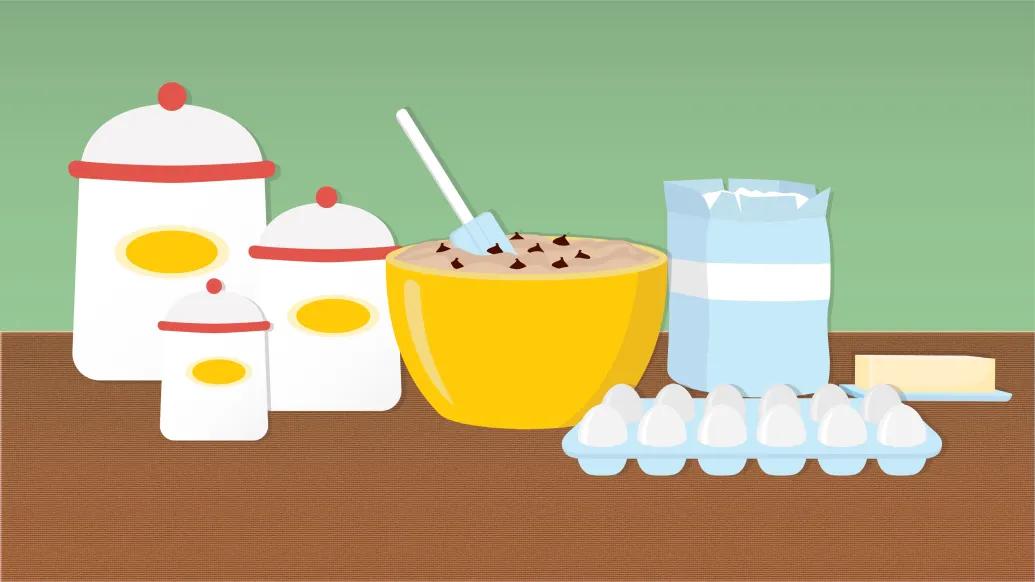
The following three statements are all true: Eating cookie dough can be dangerous, even after we've dealt with any raw eggs. I am a public health faculty member and an expert in health risk communication. My family and I eat raw cookie dough regularly.
If it seems implausible that all three of those statements can be simultaneously true, let me explain.
To start, when most people think about health risks and cookie dough, they think about raw egg. Eggs can be contaminated with salmonella bacteria, and food safety recommendations encourage people to cook eggs until the white and yolk are firm in order to kill any bacteria.
Because of this concern, when my kids and I make cookie dough, we never use regular eggs. Instead, we use eggs that have been pasteurized to kill any harmful bacteria without actually cooking the egg itself. (A great public health innovation, if you ask me!) So, I wasn't worried about the eggs in the cookie dough.
Now, there is another risk to consider in relation to raw cookie dough: the risk of the flour itself. Over the past two months, General Mills, Inc. first initiated and then expanded a voluntary recall of flour found to be contaminated with E. coli bacteria. While contamination of raw flour is rare, it can happen. Wheat grows in fields close to animals. When they "heed the call of nature," as the FDA put it, wheat can become contaminated. In this recent outbreak, 38 people have been sickened since December 2015 and some have been hospitalized because they ate the recalled flour raw, often in the form of cookie dough. One went into kidney failure.
An important safety message – or a half-baked idea?
Such recall notices are extremely important. When we know that a product is contaminated, we can and should make absolutely sure to get rid of it. As soon as I read the recall notice, I checked whether my extra flour was recalled. It wasn't. If it had been, or even if I hadn't been sure, I would have thrown it out, no questions.
However, the U.S. Food and Drug Administration later also published a notice for consumers warning the public about eating cookie dough. Specific statements included: "the bottom line for you and your kids is don't eat raw dough," "don't give your kids raw dough or baking mixes that contain flour to play with" and "don't make homemade cookie dough ice cream."
Not surprisingly, this story got picked up by many news outlets. What was interesting about these stories, however, was not their content but their negative tone. For example, The New York Times stated "F.D.A. Ruins Raw Cookie Dough for Everybody." Another example: InStyle's article was titled, "Buzzkill Alert: Don't Eat Raw Cookie Dough." The first line of the article reads, "Don't shoot the messenger."
Here's the question: Is it appropriate for public health officials to imply that no one should eat cookie dough (something that I, and apparently many others, enjoy) because of this risk?
A right to choose?
I'm the last person to say that communications about public health risks are unimportant. Public health officials have a duty to warn people about the health risks associated with raw egg and even raw flour. When we have evidence that specific people are at risk, public health officials need to actively promote the actions that those people can take to minimize the identified risk. Doing so supports both public health objectives and individual decision-making.
By contrast, when a public health agency unequivocally states "don't eat raw dough" (regardless of whether flour or other ingredients were affected by a recall or not), it is implying (falsely) that no one could rationally disagree.
Well, I'm a public health faculty member, and I disagree.
I know that some public health officials will be horrified by my statement. They will believe that I am undermining their message and giving people permission to put themselves at risk unnecessarily.
But the key word of the previous sentence is "unnecessarily." Whether something is necessary or not is not a scientific judgment. It is a value judgment. An FDA official may personally believe that eating raw cookie dough isn't important and choose to never eat it. That is their choice. At the same time, I can believe that eating cookie dough (made from flour known to be not part of the recall and pasteurized eggs) is something that I enjoy enough that I'm willing to put myself and my children at (a very small) risk to do.
Of life and risk
As public health experts, we don't want people to treat food recalls like math problems and estimate their likelihood of getting sick. If you have affected food, you need to act. Period.
But if I know that my flour is not recalled, then there is no specific reason to believe that the flour is not OK to eat raw. The only risk is the very small, baseline risk – for example, that the flour has been contaminated by a different and as-of-yet unknown source.
We can't pretend that we live our lives without risk. I put myself and my children at risk every time we get into our car. Every time we eat sushi or rare hamburgers. Every time one of us takes medications. Every time we ride a bike or play soccer.
Yet, many of us choose to do those things anyway, while minimizing risk when we can (for example, by wearing seat belts and bike helmets). We choose life and risk over safety and a life a little less enjoyable. It is not irrational to treat cookie dough the same way.
So, to my fellow public health practitioners: Let's keep working on informing the public about health risks that they may not anticipate or appreciate. Motivating people to take immediate action about specific food recalls. Encouraging people to minimize risks.
At the same time, let's all please remind ourselves that our goal is not to minimize all risk, no matter the cost. Our goal is to maximize life. Sometimes maximizing life means warning people that their flour is contaminated and making sure they throw it out. Sometimes maximizing life means letting them enjoy some (carefully prepared) cookie dough without shame.
This article was originally published on The Conversation. Read the original article.

Health Lab
Explore a variety of health care news & stories by visiting the Health Lab home page for more articles.
Media Contact

Public Relations
Department of Communication at Michigan Medicine
Stay Informed
Want top health & research news weekly? Sign up for Health Lab’s newsletters today!
Featured News & Stories
Do You Really Need to Eat Organic?
5 hot weather tips that could save an older adult’s life

Rx Kids linked to reductions in preterm births and low birthweights, fewer NICU admissions
Processed foods may be fueling the rise in binge eating
Supplementing with peptides: Good for extra pep or a needless step?