Who should pay for older adults' care? Caregivers answer differently
Levels of concern about costs of long term care, and access to it, are higher among those who are unpaid caregivers to people over 65, compared with those who aren’t
2:48 PM
Author |
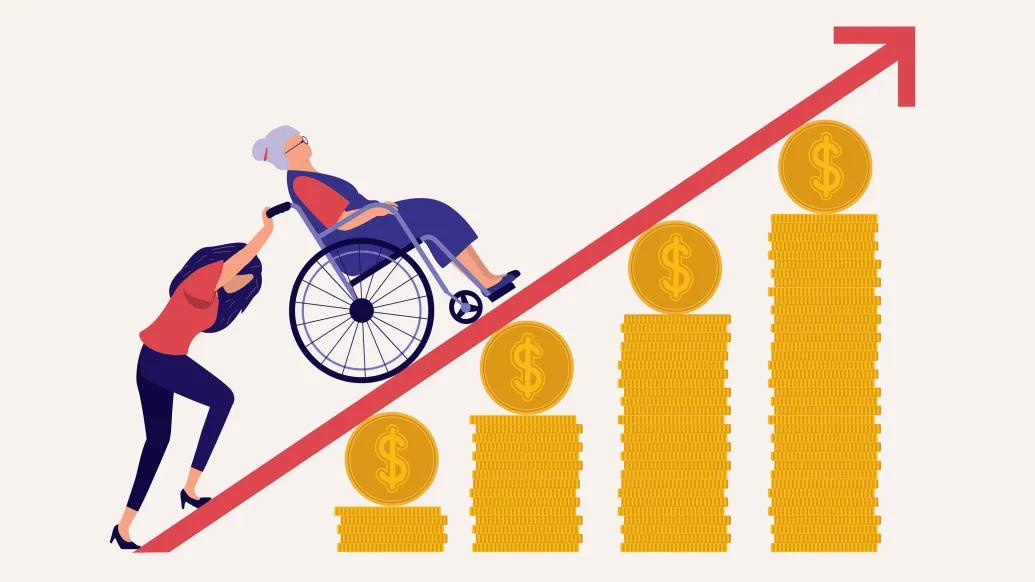
When it comes to opinions about paying for, and getting access to, care for older adults, direct experience appears to matter a lot, a new University of Michigan study finds.
People aged 50 and over who serve as unpaid family caregivers for adults over 65 are more likely than non-caregivers to say that the government should have primary responsibility for paying for the care of older Americans, at 51% vs. 43%.
Non-caregivers were more likely to say that families, or older adults themselves, should have primary responsibility for costs.
More than half of all people aged 50 and over say they are very concerned about the cost of long term care for older adults, including home care, assisted living and nursing home care.
But there were differences by caregiver status here, too.
Nearly two-thirds (64%) of caregivers said they are very concerned about long term care costs, compared with 54% of non-caregivers.
And when it came to access to quality long term care, 50% of caregivers said they’re very concerned, compared with 36% of non-caregivers.
The new paper, published in the Journal of the American Geriatrics Society by a team from the U-M Institute for Healthcare Policy and Innovation, is based on data from the National Poll on Healthy Aging.
The poll of people aged 50 and over, taken in 2024, showed that just under 18% were providing care to a person over 65.
Sarah Patterson, Ph.D., a U-M demographer and sociologist, worked with the poll team on the detailed analyses contained in the new paper. She is a research assistant professor at the U-M Institute for Social Research, in the Survey Research Center.
While the full sample of adults over 50 appeared to be evenly split between seeing government and families as primary payors, when we took caregiver status into account a clear divide emerged."
-Sarah Patterson, Ph.D.
Even after accounting for demographic differences between caregivers and non-caregivers, the gap in attitudes about payment, and concerns about cost and access persisted.
“While the full sample of adults over 50 appeared to be evenly split between seeing government and families as primary payors, when we took caregiver status into account a clear divide emerged,” said Patterson.
“Previous studies have shown lower rates of support for government-first payment among adults age 65 and older, but we find that including adults ages 50 and older increases support.”
“Because caregivers are more likely to be in their 50s and early 60s, this may be both a generational and an experience-based difference in views,” said John Biziorek, a U-M Medical School student who worked on the study during a summer research experience in Patterson’s laboratory group, supported by IHPI.
While the poll did not ask about direct government payments to caregivers, which have been proposed or enacted in some states and are being discussed at the state and national levels, another recent NPHA poll found that direct payments were a top preference among family caregivers who do not feel they have enough support in their caregiving duties.
That poll, and other past work, have found that caregivers often face high personal financial impacts from their caregiving duties, including lost wages and costs for items and services for the person they care for.
Medicare generally doesn’t cover long term stays in nursing homes, nor any time in assisted living centers. It also doesn’t generally pay family caregivers to take care of someone at home, and paid home health care is covered only under specific circumstances.
Medicaid pays for nearly two-thirds of all long term nursing home care in the United States but is only open to adults with low incomes and limited assets; limits vary by state.
National statistics show that 70% of people who survive to the age of 65 will need long term care services in the future, including nursing home or at-home care, or help with medical care and daily tasks such as making and eating meals, dressing and caring for personal hygiene.
The new paper is based on data from a poll of 3,216 adults age 50 and over who were surveyed online and via phone in February and March 2024 through the NORC AmeriSpeak panel. More information about the poll methodology is available on the poll site.
Additional data from the poll, including specifics about caregiving for individuals of any age with a health issue or disability, were released in August 2024.
Additional authors: In addition to Patterson and Bizorek, the study’s authors are Adriana Reyes, Ph.D., an assistant professor at Cornell University; deputy poll director Erica Solway, Ph.D., M.S.W., M.P.H., statistician Matthias Kirch, M.S., senior project manager Dianne C. Singer, M.P.H., research specialist Sydney N. Strunk, M.P.H., poll director Jeffrey T. Kullgren, M.D., M.P.H., M.Sc., and associate poll director J. Scott Roberts, Ph.D.
Funding/disclosures: The study was funded by the National Institute on Aging of the NIH (K99AG073473, R00AG073473), and the poll wave from which the data came was funded by both AARP and Michigan Medicine.
Paper cited: “Older Americans' Attitudes Toward Caregiving Cost Responsibility and Long Term Care Access and Costs by Caregiver Status,” JAGS. DOI: 10.1111/jgs.70385
Sign up for Health Lab newsletters today. Get medical tips from top experts and learn about new scientific discoveries every week.
Sign up for the Health Lab Podcast. Add us wherever you listen to your favorite shows.

Health Lab
Explore thousands of health news & research stories by visiting the Health Lab homepage for more.
Media Contact

Public Relations
Department of Communication at Michigan Medicine
Stay Informed
Want top health & research news weekly? Sign up for Health Lab’s newsletters today!
Featured News & Stories
Caregiving without a net: Poll shows who needs help most

Top 7 tips for choosing Medicare prescription drug coverage for 2027

The AI is listening: Implications of machine generated clinical notes on health care
Many older adults make Medicare decisions quickly and most don’t change plans, poll finds

What’s the latest on 7-OH and kratom availability and addiction care?