What can America do to make health care and health outcomes more equal?
An expert on racial and ethnic differences in health care and health outcomes offers recommendations as part of a national committee
5:00 AM
Author |
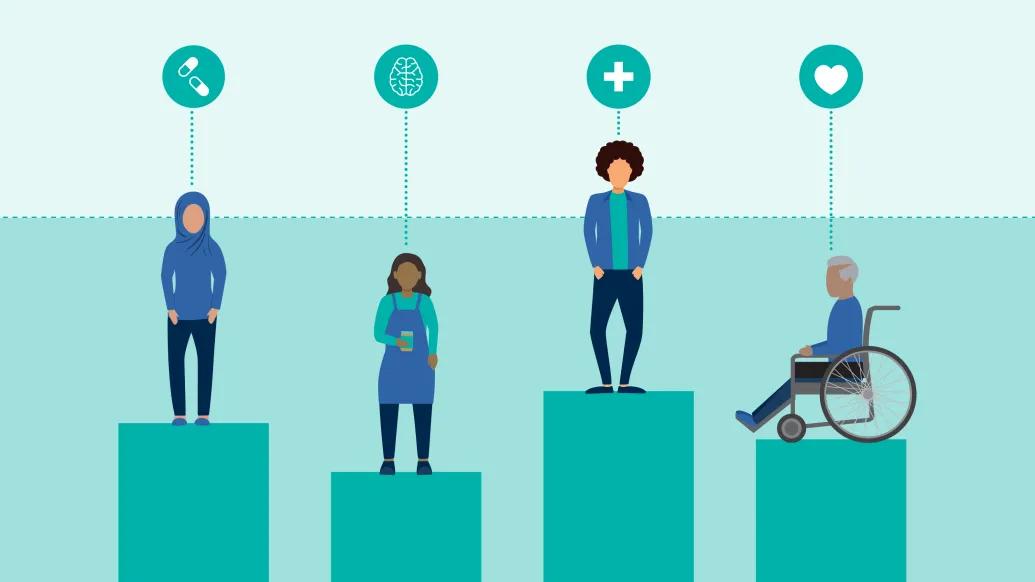
In 2003, Americans learned just how unequal health care in the United States really was.
A major report by an eminent group of experts showed wide gaps in how people from different racial and ethnic backgrounds received care for many different conditions – even if they had the same income or insurance coverage.
Of course, people from Black, Hispanic, Native American and certain other backgrounds had lived that inequality for centuries.
And researchers had documented it since the 1960s.
But the landmark report, titled “Unequal Treatment,” launched the issue into the spotlight for all Americans, and spurred action at many levels.
It helped to inform the Affordable Care Act, including new programs such as Medicaid expansion to reduce the number of people of all backgrounds who lacked health insurance.
Did it make a difference? Has inequality dropped?
To some degree, yes – but much more action is needed, according to a report titled Ending Unequal Treatment, first released late last month by the National Academies of Science, Engineering and Medicine.
We find that racial and ethnic inequities remain a fundamental flaw of the U.S. health care system, and that they’re driven by complex interactions between a variety of forces."
-John Z. Ayanian, M.D., M.P.P.
One of the report’s authors, John Z. Ayanian, M.D., M.P.P., leads a major University of Michigan institute focused on health care research and policy, including health equity.
Back in 2003, he was one of the researchers whose studies helped form the backbone of the first report.
“More than 20 years later, our committee found there’s been some progress, but it’s been uneven and incomplete in eliminating health care disparities and promoting health equity,” he said.
“We also can draw much more of a link between inequities in health care and inequities in health outcomes for individuals and populations.”
In other words, the data now clearly show that inequality harms people’s health.
“We find that racial and ethnic inequities remain a fundamental flaw of the U.S. health care system, and that they’re driven by complex interactions between a variety of forces,” said Ayanian, who’s a professor of internal medicine, public health and public policy at U-M as well as directing the U-M Institute for Healthcare Policy and Innovation.
SEE ALSO: ‘The Immense Burden of Cancer is Not Shouldered Equally’
He added, “We also document specific approaches that have been demonstrated to improve health care equity – for example, community health workers engaging with people who have chronic conditions, health-related social needs or risk factors – but these approaches haven’t been disseminated or implemented widely and over enough time to make a major difference.”
The committee also notes that despite the gains made possible by changes in health policy, other policy developments could raise major new barriers.
So what can be done?
Ayanian describes some of the committee’s key recommendations.
Key recommendations:
- Continuing the efforts started after the first Unequal Treatment report to diversify the workforces for both health care and health services research so they are more representative of the entire U.S. population
- More comprehensive efforts to increase health equity, going beyond the incremental and time-limited changes of the past. For instance, Ayanian points to New York City’s success in substantially increasing colorectal cancer screening among Asian, Black and Hispanic residents, which hasn’t been adopted by other cities or regions
- More research and evaluation to understand inequality more deeply, and to drive improvement. Ayanian and colleagues spoke to the importance of this work in a special panel in early July national AcademyHealth meeting of health care researchers
- Accountability via enforcement of current laws and policies, such as the prohibitions on discrimination under the Affordable Care Act. For instance, helping more people understand the process for filing a complaint, including information in multiple languages so that people with limited English skills can understand how to file a complaint if they believe they’ve received unequal care
- Clearer and more enforceable standards, via the Internal Revenue Service and the Department of Treasury, for nonprofit hospitals to report what they do to address the health-related social needs of people in the communities they serve
- Congressional action to make affordable health insurance available for everyone, including those living in states that have not expanded Medicaid, and immigrants regardless of status
- Congressional action to make Medicaid’s payments to physicians and hospitals equal to the payment amounts they provide for the same services for people with Medicare
- Because of the current lower payment, only about half of physicians accept patients with Medicaid coverage, which contributes to health care inequities because people of color are more likely to qualify for Medicaid due to having lower incomes
- Fully funding the Indian Health Service, which serves Native American and Alaska Native individuals nationwide
- Addressing the gap in Medicaid funding for U.S. territories such as Puerto Rico and American Samoa, which currently have much more limited funding and coverage than those in the 50 states and District of Columbia
- New standards to guide better collection of data on race and ethnicity by all areas of the federal government for both health care workers and patients covered by any source of insurance or no insurance
- Expansion of demonstration projects that are seeking to address health-related social needs
In addition to the report and a related webinar, members of the committee laid out the policy implications and recommendations in a new piece in Health Affairs Forefront.
The report comes at a unique moment, Ayanian notes, because of the disparities that came into sharp focus during the height of the COVID-19 pandemic.
SEE ALSO: Everyone plays a role in improving cancer health equity
Although deaths from COVID-19 have dropped significantly thanks to vaccinations, increased natural immunity, and effective treatment, the pandemic reversed more than a decade of progress in reducing the gap in life expectancy between people of different racial and ethnic backgrounds.
Black and Native American life expectancy was actually catching up to white life expectancy steadily before 2020, and Hispanic Americans actually had achieved longer life expectancy than white Americans by 2018.
But all those advances were reversed in 2020-2021 because COVID-19 led to substantially higher rates of people of color dying prematurely.
The committee behind the report points out the major economic impacts of health care inequity, as well as the injustice it represents.
Said Ayanian, “We hope this report will be a guide for effective changes in policy and practice for years to come, just as the original report was used to motivate such efforts over the past 20 years.”
Paper cited: National Academies of Sciences, Engineering, and Medicine. 2024. Ending Unequal Treatment: Strategies to Achieve Equitable Health Care and Optimal Health for All Washington, DC: The National Academies Press. DOI: 10.17226/27820
Sign up for Health Lab newsletters today. Get medical tips from top experts and learn about new scientific discoveries every week by subscribing to Health Lab’s two newsletters, Health & Wellness and Research & Innovation.
Sign up for the Health Lab Podcast: Add us on Spotify, Apple Podcasts or wherever you get you listen to your favorite shows.

Health Lab
Explore thousands of health news & research stories by visiting the Health Lab homepage for more.
Media Contact

Public Relations
Department of Communication at Michigan Medicine
Related

Same patient. Different visit. Different race and ethnicity?
Stay Informed
Want top health & research news weekly? Sign up for Health Lab’s newsletters today!
Featured News & Stories

Better prenatal care data could help prevent maternal complications, experts say

Many hospitals still don’t do enough to prevent UTIs from catheters

Digital alerts support timely treatment decisions of critically ill cardiac patients

What’s changing in Medicaid and what can you do?

Reducing infections after heart surgery could save Medicare $441 million per year