Virtual reality enhances training for pediatric cardiologists
Multicenter study suggests immersive technology may be valuable educational tool in boosting understanding of complex congenital heart disease
2:00 PM
Author |
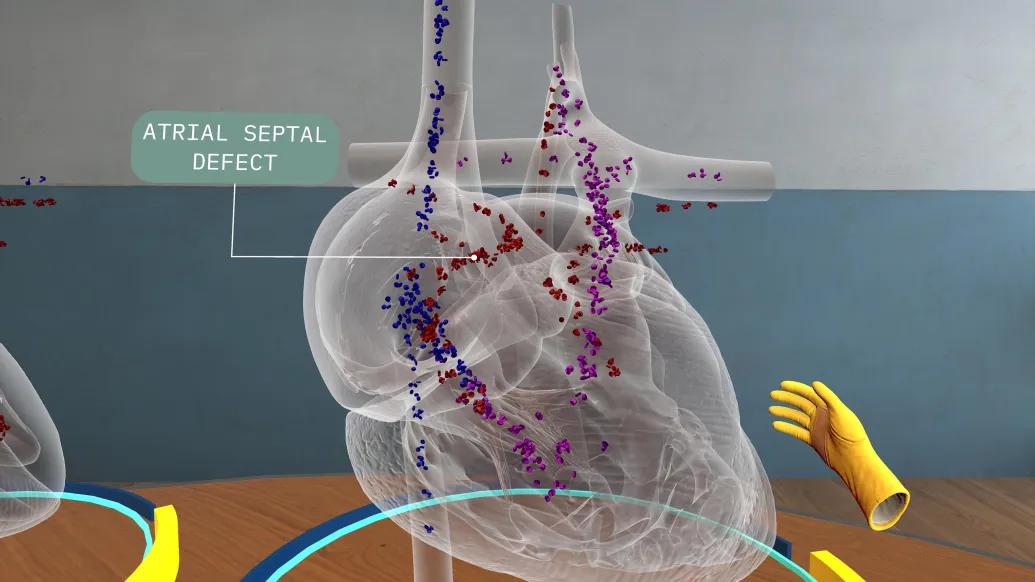
Training in pediatric cardiology requires the ability to visualize the heart’s intricate three-dimensional structures — a skill critical for diagnosing and treating congenital heart defects.
Now, trainees are turning to an innovative tool to strengthen those skills: virtual reality.
A multicenter educational study presented by University of Michigan Health C.S. Mott Children’s Hospital at the American Heart Association Scientific Sessions suggests that VR training improves how pediatric cardiology fellows understand complex congenital heart conditions and the surgeries used to treat them.
“Previous studies have shown that virtual reality can enhance understanding of normal cardiac anatomy and simple congenital heart disease,” said Benjamin Pritz, M.D., an advanced cardiac imaging fellow at the Congenital Heart Center at C.S. Mott Children's Hospital and clinical instructor in pediatric cardiology.
“But less was known about whether it could help teach more advanced cardiac anatomy and physiology. Our results show it can.”
In the study, 56 first-year fellows from 13 pediatric cardiology fellowship programs at major congenital heart centers were divided into two groups, one of which was presented with a virtual learning module focused on hypoplastic left heart syndrome — a severe defect in which the left side of the heart is underdeveloped.
The module guided trainees through the different stages of surgical palliation used to manage HLHS.
Fellows who completed the VR curriculum achieved higher assessment scores compared with those who received traditional instruction.
Survey feedback also echoed the results: more than 90% of participants described the VR tool as easy to use, engaging and effective in deepening their understanding.
“Training in pediatric cardiology requires sophisticated three-dimensional and spatial reasoning,” Pritz said.
“The vast majority of fellows who used the VR program said they would recommend incorporating this type of tool into standard fellowship training.”
Additional authors: Amanda McCormick, Sunkyung Yu, Ray Lowery, David Axelrod, Maria Batsis, David Brown, Ariya Chau, Karim Diab, Matthew Dove, Eunice Hahn, Stephanie Handler, Elizabeth LaSalle, Felina Mille, David Parra, Sonali Patel, Alyson Pierick, Ryan Romans, Arash Salavitabar, David Werho, Hunter Wilson and Sonal Owens
Abstract cited: “Virtual Reality Curriculum Improves Pediatric Cardiology Fellow Understanding of Hypoplastic Left Heart Syndrome Palliation: A Multi-Center Study of the Michigan Anatomic Congenital Heart in 3D (MACH-3)"
Sign up for Health Lab newsletters today. Get medical tips from top experts and learn about new scientific discoveries every week
Sign up for the Health Lab Podcast. Add us wherever you listen to your favorite shows

Health Lab
Explore thousands of health news & research stories by visiting the Health Lab homepage for more.
Media Contact

Public Relations
Department of Communication at Michigan Medicine
Stay Informed
Want top health & research news weekly? Sign up for Health Lab’s newsletters today!
Featured News & Stories

4 ways to teach your teen safe driving habits

Learning Together: Making Space for Growth at Work

U-M-led consortium to receive up to $52 million in NIH funding to study why viral respiratory infections affect children differently

Better prenatal care data could help prevent maternal complications, experts say

Digital alerts support timely treatment decisions of critically ill cardiac patients