Uncovering cellular stress signal triggered by Salmonella
Researchers examined Salmonella enterica serovar Typhi, a bacterium that can lead to typhoid fever
5:00 AM
Author |
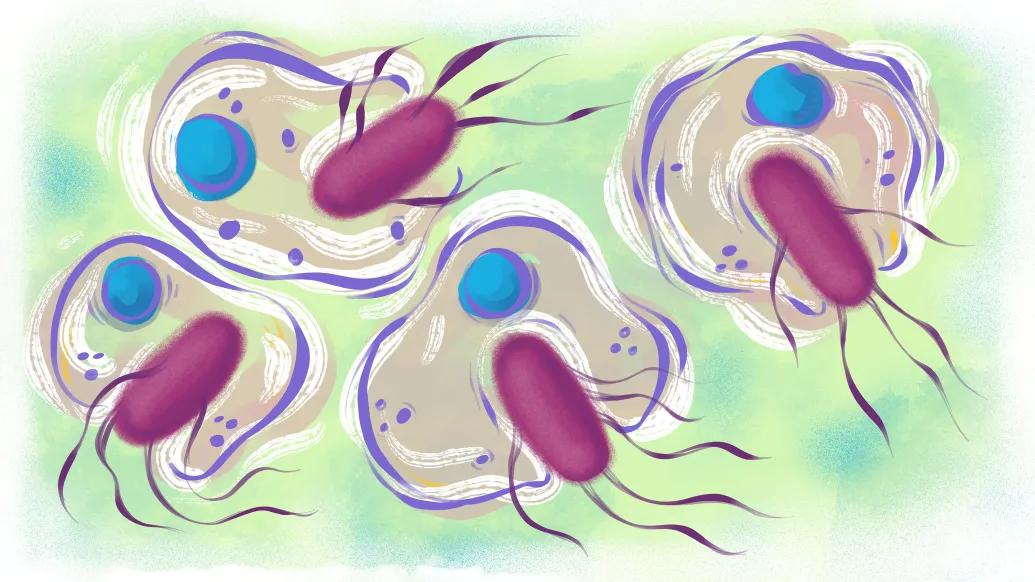
Like people, cells get stressed too, and researchers want to understand how.
In a new paper published in Infection and Immunity, researchers from the O’Riordan lab looked for causes of stress for cells infected with Salmonella.
“Stress at its core is a decision making tool,” said Zachary Powers, PhD, who defended his dissertation in June 2026.
“It allows us to read environmental cues and respond effectively. Stress can happen at a single cellular level as well; [for example] when bacteria invade a cell, this may be sensed by the cell as stress.”
For this study, Powers studied Salmonella enterica serovar Typhi, a bacterium that, when contracted, can lead to typhoid fever, a potentially devastating systemic infection.
The team found that the bacteria camp out inside the cell and rapidly break down one specific amino acid, asparagine.
In addition to being a protein building block, asparagine is a molecule that signals to the cell that it should grow.
When asparagine is degraded, the cell deploys a stress response program.
“The core finding of the research is that it's Salmonella Typhi degrading host asparagine that is triggering cellular stress,” Powers said.
You might recognize when you’re stressed by a pounding heart or sweaty hands. Cells have a different mechanism using a sensor, the kinase GCN2.
The researchers deleted the gcn2 gene from cells and observed how the cells interacted with Salmonella.
They found that the cells lacking GCN2 were worse at their innate immune functions and that, after 24 hours, more of the bacteria survived in the cells.
Cells being able to sense stress promotes their ability to fight off an infection.
“The most impactful finding is that immune cells sense when invading bacteria deplete nutrients and can use this information to aid in controlling Salmonella enterica Typhi infection,” said Mary O'Riordan, Ph.D., Professor of Microbiology & Immunology and principal investigator on the study.
This research may have broader implications beyond infection.
Asparagine is used by some cancer cells, signaling to the cancer that it should grow.
In clinical settings, recombinant bacterial asparaginases can be used to reduce the amount of asparagine present, inhibiting cell growth.
“Zach showed tremendous creativity and determination in taking this project from his original observation, that Salmonella enterica Typhi triggered nutrient sensing pathway, to identifying the key host nutrient sensor and the bacterial factor that triggers this sensor,” O’Riordan said.
Additional authors: Michael J. McFadden, Gi Young Lee, Tracey Schultz, Luiza A. Castro Jorge, Daniel F. Edwards III, Simon Sanchez-Paiva, Jonathan Z. Sexton, Katherine R. Spindler, Jeongmin Song
Paper cited: “Salmonella Typhi asparaginase-dependent activation of GCN2 promotes bacterial killing in murine macrophages,” Infection & Immunity. DOI: 10.1128/iai.00178-26
Sign up for Health Lab newsletters today. Get medical tips from top experts and learn about new scientific discoveries every week.
Sign up for the Health Lab Podcast. Add us wherever you listen to your favorite shows.

Health Lab
Explore thousands of health news & research stories by visiting the Health Lab homepage for more.
Media Contact

Public Relations
Department of Communication at Michigan Medicine
In This Story

Mary O'Riordan, PhD
Professor
Stay Informed
Want top health & research news weekly? Sign up for Health Lab’s newsletters today!
Featured News & Stories

How a common virus's hijack of cell repair processes may promote cancer
The hidden life of parasites like Cyclospora
Your gut is home to an entire ecosystem, and scientists are finding new residents

The AI is listening: Implications of machine generated clinical notes on health care
Comprehensive DNA sequencing reveals hidden drivers of cancer