Tooth infection leads doctors to giant brain aneurysm
A neurosurgical team used tiny, flexible stents to remodel a blood vessel and treat an aneurysm
12:10 PM
Author |

A visit to the doctor for tooth pain uncovered a woman’s “giant” brain aneurysm that required innovative, minimally invasive technology to treat.
Her health care team felt surgery wasn’t a good option, as it would have required removing a large portion of the bony skull and could threaten her vision.
“If it hadn’t been for a tooth ache, they may not have found this until it got much worse,” said Kathy Olsen, 70, of Twin Lake, Mich.
The pain in Olsen’s face started in late January 2024.
It felt, she says, like she had a softball lodged in her left cheek.
At the emergency room in Muskegon, Mich., doctors treated the infection but also ordered a CT scan.
In addition to the dental infection, her provider also noted a concerning incidental finding.
“He told me they found something and needed to do a more thorough scan,” Olsen said.
“That scan found an unusually large aneurysm. He asked me if I had been having headaches or vision problems. I had not, but I was shocked.”
Olsen had an asymptomatic giant cavernous aneurysm of the internal carotid artery.
The aneurysm wasn’t just considered giant: It’s a medical term that means the abnormal bulge in the vessel that supplies blood to the brain and neck is either 25 mm or larger.
Olsen’s aneurysm was located in the cavernous segment of the carotid artery, just behind the eye and about the size of a golf ball.
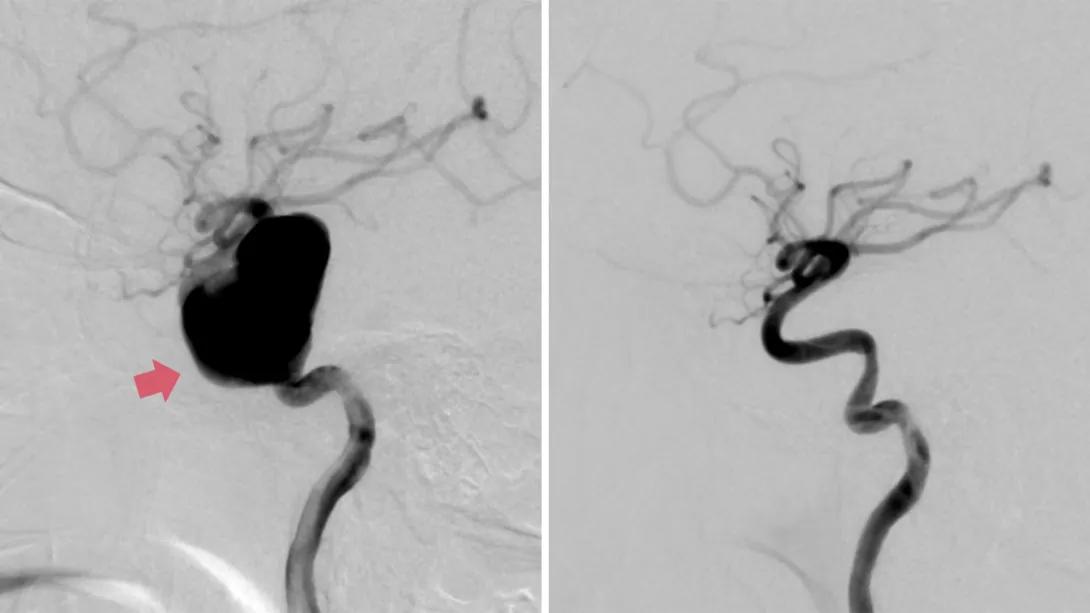
These aneurysms are fairly rare, and the shape makes them challenging to treat.
In mid-February, she underwent a procedure in Grand Rapids to repair the aneurysm which was ultimately unsuccessful.
“The aneurysm was just too big,” she said.
“The doctor tried everything he could. I felt very discouraged. After that, I was referred to University of Michigan Health.”
After careful consideration, U-M Health’s team of neurosurgeons and neurointerventionalists decided to treat the bulging vessel with minimally invasive flow diversion embolization.
Instead of inserting coils into the aneurysm to seal it off, the team elected to place stents into the vessel that would allow blood to bypass it en route to the brain.
“The aneurysm was so large that filling it up with the coil material would have increased the mass effect on the structure,” said Aditya S. Pandey, M.D., chair of the Department of Neurosurgery at U-M Health.
“With flow diversion, we deploy the stent so that it bridges blood flow from normal vessel to normal vessel with no blood flowing to the abnormal region. Over time, it will clot and heal.”
Pandey’s surgical team utilized the Medtronic 4th Generation Pipeline™ Vantage flow diverter. The device, he says, is part of a newer generation of stents that is more flexible and easier to navigate.
The procedure took place on April 25 and lasted more than five hours.
“I know this was not an easy task, but I am amazed at what the medical staff was able to do,” Olsen said.
“When I woke up in recovery, I was told everything went well.”
Six months out, the medical team learned it could not have gone better.
“While flow remodeling stents have become more commonly used in the last several years, it is still very impressive to see complete resolution of the aneurysm and remodeling of the vessel in such a short time span,” said Brian Sifrig, D.O., a neurointerventional radiology fellow at U-M Health.
Pandey described it “almost like a magic trick.”
The aneurysm is completely gone.
In her recovery, Olsen had no headaches. She remains active and spends a lot of time with her children and grandkids.
“I notice everything: the flowers, the trees — I try to appreciate small things even more,” she said.
“I also tell people to go check out the small problems they are having. For me, it was a tooth. You never know when it could be something more.”
Sign up for Health Lab newsletters today. Get medical tips from top experts and learn about new scientific discoveries every week.
Sign up for the Health Lab Podcast. Add us wherever you listen to your favorite shows.

Health Lab
Explore thousands of health news & research stories by visiting the Health Lab homepage for more.
Media Contact

Public Relations
Department of Communication at Michigan Medicine
In This Story

Aditya S Pandey, MD
Professor
Related

Treating a brain aneurysm with the market’s tiniest flow diverter

Woman makes complete recovery after treatment for near-fatal brain aneurysm bleed
Stay Informed
Want top health & research news weekly? Sign up for Health Lab’s newsletters today!
Featured News & Stories
Treating a brain aneurysm with the market’s tiniest flow diverter
Woman makes complete recovery after treatment for near-fatal brain aneurysm bleed

A pediatric epilepsy fundraiser that changes lives
Michigan Alzheimer's Disease Research Center receives $22M to advance efforts statewide
Engineered nanoparticles sensitize gliomas to radiotherapy