
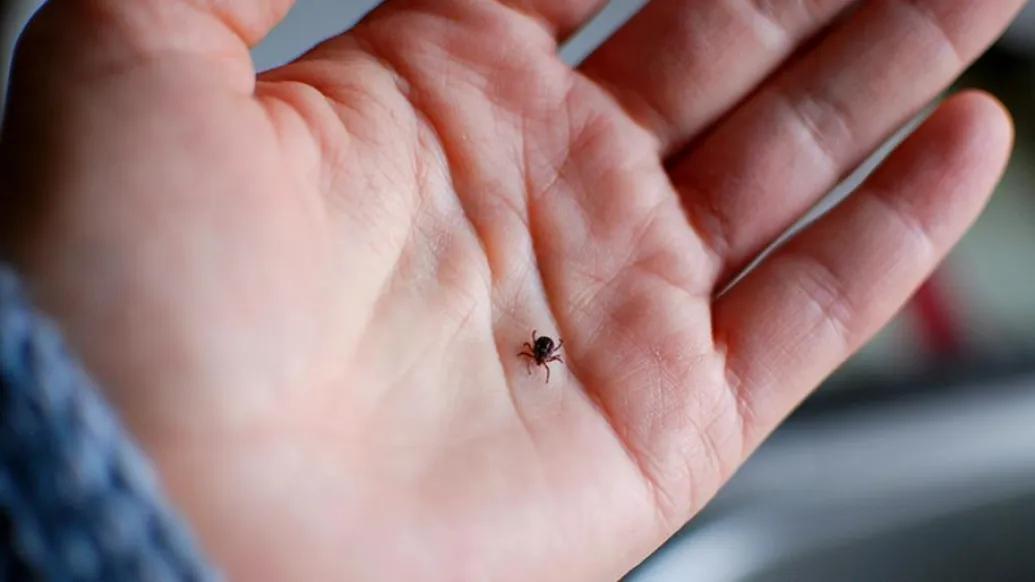
Ticks are tiny, creepy, crawly bugs that need to feed on blood to survive. Ticks can feed on a variety of species including mammals like humans, dogs and deer. They can also feed on other creatures like birds, reptiles and amphibians.
Ticks often stay attached to their host for days (even up to a week) to complete a feeding. When they feed, they tend to become enlarged (though still remain relatively tiny). An adult tick is about the size of a poppy seed.
Ticks can sometimes carry a wide variety of disease-causing germs that can be harmful to humans. Most notably, we worry about illnesses like Lyme disease, Rocky Mountain spotted fever and Tularemia.
Tick life cycle
Just like humans, ticks go through different life stages. Ticks start as eggs and then grow to become larva, then nymphs, and finally adults. They must eat a blood meal at every stage to progress onward. Even as an adult, ticks are tiny, often measuring only a few millimeters.
Ticks in Michigan
Currently, there are three main types of ticks living in Michigan: American dog tick, brown dog kick, and blacklegged tick. Dog ticks are sometimes called “wood ticks” and blacklegged ticks are sometimes called “deer ticks.” Only blacklegged ticks typically carry Lyme disease. American dog ticks and brown dog ticks sometimes carry Rocky Mountain spotted fever and Tularemia.
How do ticks get on my child?
Ticks tend to live in areas with tall grasses or wood/debris. Ticks can’t hop or fly so they locate their hosts through a process called “questing.” They crawl to the edge of a blade of grass, for example, with their front legs extended and wait for their host to brush by so they can attach. Research shows that ticks can predict when hosts are approaching by detecting host body odors or by sensing body heat, moisture, or vibrations. People tend to have the highest risk of being bitten during the spring, summer, and fall months, although adult ticks may be searching for a host any time temperatures are above freezing.
Once ticks get on my child, what happens?
Once ticks hitch a ride on a host, they look for a nice place to cozy up and feed. In humans, ticks tend to hang out in or around the hairline or ears, under the arms, inside the belly button, around the waist, between the legs and behind the knees. If your child has been outside, be sure to check his or her clothing for ticks. It’s also convenient to check his or her body for ticks at shower or bath time.
What to do when you find a tick on your child
In order to ensure you remove the whole tick, the Centers for Disease Control (CDC) recommends the following approach:
- Use fine-tipped tweezers to grasp the tick as close to the skin's surface as possible.
- Pull upward with steady, even pressure. Don't twist or jerk. Do not squeeze.
- If mouth parts remain in the skin, remove them with tweezers or leave them alone and let the skin heal.
Do not use petroleum jelly, credit cards, or matches/flames to remove ticks.
Once you have removed the tick, clean the bite area with rubbing alcohol or soap and water. You can dispose of the tick by submersing it in alcohol, placing it in a sealed bag/container and throwing it in the trash, or flushing it down the toilet. Never crush a tick with your fingers as that can spread disease.
Your child may get redness or a small bump where the tick was removed. This should go away in 1–2 days and is not a sign of Lyme disease.
Tick bites and antibiotics
According to the CDC, routine use of antibiotics to prevent Lyme disease after a tick bite, even in highly endemic areas, is not recommended. Blood tests for Lyme disease at the time of a recognized tick bite also is not recommended.
A tick must bite the skin and remain attached to transmit disease. Specifically, with Lyme disease, the tick must remain attached to the skin for at least 36–48 hours in order to transmit the bacteria. Ticks that are feeding appear much larger and are full of blood.
Tick bite symptoms
After a tick bite, monitor your child closely for the following symptoms:
- Fever or chills
- Aches and pains, such as headache, fatigue, and muscle aches
- Rash, referred to as erythema migrans, that looks like a bull’s-eye:
- Occurs in approximately 70–80 percent of people diagnosed with Lyme disease
- Often begins at the site of a tick bite after approximately 3–30 days
- Expands gradually reaching up to 12 inches or more
- May feel warm to the touch but is rarely itchy or painful
- May also appear on any area of the body
If you notice any of these symptoms, please contact your doctor.
Tick bite prevention
Follow these tips from the CDC when your child is outside:
- Avoid places where ticks live. Avoid shaded, moist areas.
- Cover arms and legs. Wear a long-sleeved shirt and tuck pants into socks.
- Wear a hat to keep the scalp safe. Keep long hair pulled back.
- Wear light-colored clothing to make it easier to spot ticks.
- Wear enclosed shoes or boots. Avoid wearing sandals.
- Stay on cleared trails whenever possible. Avoid brushing against overhanging branches or shrubs.
- Use insect repellent. DEET is effective against ticks and can be used on the skin.
- Large amounts of DEET can be harmful to children.
- Use products with no more than 30 percent DEET.
- Wash DEET off with soap and water when your child returns indoors.
- Products with permethrin can be used on clothing, but cannot be applied to the skin.
- Do a body tick check.
- Examine gear and pets.
- Tumble dry clothes in a dryer on high heat for 10 minutes to kill ticks on dry clothing.
- If the clothes require washing first, use hot water. If they can’t be washed in hot water, tumble dry on low heat for 90 minutes or high heat for 60 minutes.
- After coming indoors, check for ticks:
Additional resources:
- Tick Talk: How to Stop (and Remove) Them (U-M Health Blog)
- Ticks (CDC)
- Lyme Disease (AAP)
- Don’t Let Ticks Make You Sick comic (CDC)
- Tick Checks, the Best Way to Prevent Lyme Disease (University of New Hampshire)
- Tick Management Handbook (Connecticut Agricultural Experimentation Station)
Written and reviewed by Ashley DeHudy, MD
Updated June 2018

Health Lab
Explore thousands of health news & research stories by visiting the Health Lab homepage for more.
Media Contact

Public Relations
Department of Communication at Michigan Medicine
Stay Informed
Want top health & research news weekly? Sign up for Health Lab’s newsletters today!
Featured News & Stories

Safe sleep for babies

Spring and Summer Safety

Summer Camp

Vaccine Safety

PFAS Contamination

