Telehealth didn’t increase Medicare visits, but drove down post-visit costs
Two studies, published as preprints, provide evidence to inform policymakers as Medicare telehealth flexibility decision looms
10:43 AM
Author |
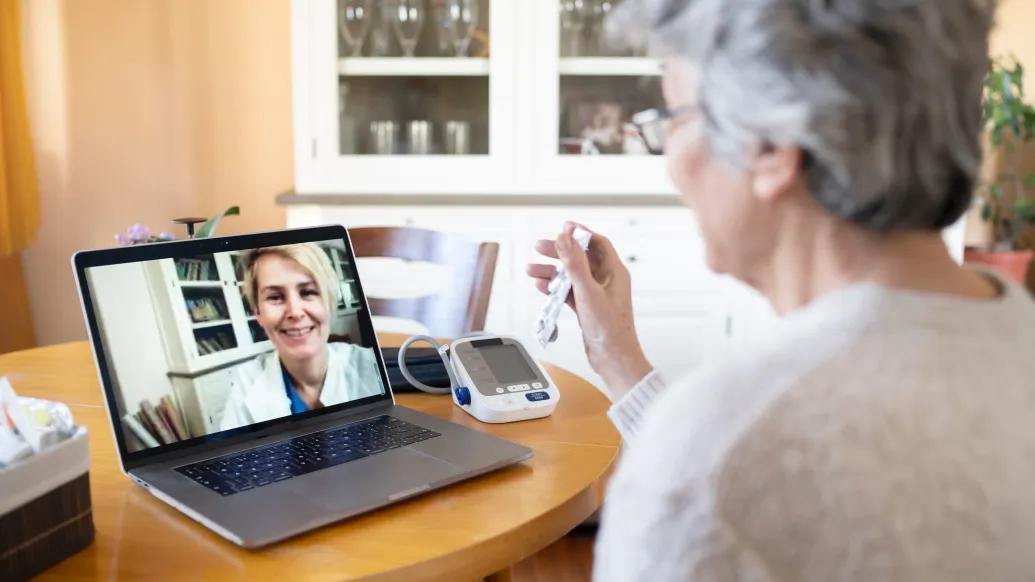
Within weeks, the future of telehealth coverage under Medicare will be decided, as pandemic-era flexibilities either expire or Congress acts to extend them or make them permanent.
That decision will likely affect telehealth coverage under other forms of health insurance, potentially affecting the care of most Americans.
Current Medicare coverage for most telehealth will expire March 31.
Now, two University of Michigan Medical School studies – published as preprints ahead of peer review because of their timely nature – provide key findings about telehealth use and costs that could help inform policymakers.
Together, the findings push back against major concerns about telehealth: They show that widespread use of telehealth has not driven up the total number of visits to diagnose or manage health conditions, and that post-visit total costs are lower for patients who start with a telehealth visit.
Both preprints appear on medRxiv, a public repository, and are being submitted to journals for peer review.
“We hope these findings will be valuable for policymakers as they consider legislation to determine the role of telehealth in Medicare in the near future,” said Chad Ellimoottil, M.D., M.S., the corresponding author of both the new preprints.
“Five years after telehealth suddenly became a routine part of care for most Americans, we show that it has not led to runaway utilization or spending. This kind of in-depth analysis can inform its future.”
Ellimoottil, a urologist, has studied telehealth since before the COVID-19 pandemic prompted policy changes that led to a surge in use.
He serves as medical director of virtual care at Michigan Medicine, the University of Michigan’s academic medical center, and is a member of the U-M Institute for Healthcare Policy and Innovation.
Total visits via telehealth vs. in-person
The preprint published March 6 shows that telehealth has not driven up the total number of visits with providers that older Americans have, in order to manage physical or mental health conditions.
Using data through June 2024 from people over age 65 with traditional Medicare, the researchers show that visits by telehealth substituted for in-person evaluation and management visits, rather than adding to the number of visits.
This study also looks at three types of care where rates of telehealth visits were low, medium or high.
It shows that 38% of mental health visits and just over 6% of primary care visits for this patient population now take place over a video or audio connection, compared with 2% and less than 1% before the pandemic.
The total rates of all mental health and primary care visits – whether held in-person or via telehealth – actually dropped from before the pandemic to today.
The researchers suggest that this may be due to the shortage of providers in both fields.
By comparison, rates of telehealth visits with orthopedic surgeons have been stable at around 1% for several years, and total numbers of visits have been stable.
James D. Lee, M.D., M.P.H., a National Clinician Scholar at IHPI and general internal medicine physician, is the lead author of this study.
He notes that Medicare telehealth coverage for mental health visits has been made permanent but will still require occasional in-person visits after March 31.
“With data from five years of use, we can see how providers are incorporating telehealth into their practices, and it has not led to a skyrocketing of total utilization, but rather flexibility for patients and providers alike to use virtual options where they make sense,” said Lee.
Costs of care after telehealth vs. in-person visits
The second study, published in February, looks at the total costs to Medicare in the 30 days after a person with traditional Medicare had an appointment to evaluate or manage a health condition, either via telehealth or in person.
This analysis looked at data from July 2020 through the end of 2022, from more than 30 million people over age 65.
On the whole, costs paid by Medicare were $82 lower per person for patients who had their initial visit for a condition via telehealth, compared with people seen in person.
Those with initial telehealth visits also had fewer lab tests and medical imaging visits in that post-visit month.
The reduced costs were despite the fact that those having initial telehealth visits were sicker on average, and slightly more likely to have return visits of any kind after their initial visit (16% vs. 14%).
“Looking at the entire episode of care after a telehealth visit or an in-person visit is important,” said senior author Michael P. Thompson, Ph.D., “because of concerns that the inability to examine a person physically could drive up additional care – and costs. But we did not see this effect in the data.”
Thompson is also a health care researcher in the U-M Health Department of Cardiac Surgery.
Other studies have looked at six-month downstream spending, but Ellimoottil and colleagues note that it’s harder to tell from the available data which post-visit costs are directly related to the issues addressed in the index visit.
From his own experience helping urologists begin to incorporate telehealth into their practices, Ellimoottil notes that often patients have “tests of convenience” when they go to a clinic in person and it’s easy for the clinician to order a urinalysis or blood test from a sample that can be taken that same day.
By contrast, patients seen by telehealth have to make it to a testing location after their virtual visit.
Reducing excess testing is a key goal for Medicare to reduce unnecessary spending and contain cost growth.
A U-M team recently reported results from an effort to reduce pre-surgery testing in patients having common operations.
Additional authors: In addition to Ellimoottil, Lee and Thompson, the studies’ authors are Ashwin Kulkarni, Ziwei Zhu, Rodney L. Dunn, Chiang-Hua Chang, Elena Chun, Hechuan Hou, Terrence Liu and Jeffrey S. McCullough.
Funding/disclosures: Both studies were funded by grants from the Agency for Healthcare Research and Quality (R01HS028397, K08HS027632). All data in the study are publicly available through the Chronic Conditions Data Warehouse (www2.ccwdata.org).
Papers cited:
“Association Between Telehealth Use and Downstream 30-Day Medicare Spending,” DOI: 10.1101/2025.01.31.25321423
“Telehealth and Outpatient Utilization: Trends in Evaluation and Management Visits Among Medicare Fee-For-Service Beneficiaries, 2019-2024,” DOI: 10.1101/2025.03.05.25323449
Note: Because this article is based on preprints, it received additional review under Michigan Medicine’s Research News Standards and Principles.
Sign up for Health Lab newsletters today. Get medical tips from top experts and learn about new scientific discoveries every week.
Sign up for the Health Lab Podcast. Add us wherever you listen to your favorite shows.

Health Lab
Explore a variety of health care news & stories by visiting the Health Lab home page for more articles.
Media Contact

Public Relations
Department of Communication at Michigan Medicine
In This Story

Michael P Thompson, PhD
Associate Professor

James Lee, MD, MPH
Clinical Instructor
Related
Keep telehealth alive and well, experts tell Senate subcommittee
Pre-op visits by video? Most surgeons say no – but open to post-op telehealth
Stay Informed
Want top health & research news weekly? Sign up for Health Lab’s newsletters today!
Featured News & Stories
Michigan’s Medicaid expansion improved both health and finances

5 hot weather tips that could save an older adult’s life

Rx Kids linked to reductions in preterm births and low birthweights, fewer NICU admissions

LGBTQ+ people over 50 face more aging-related challenges
Michigan firearm data now available in near real-time