With telehealth coverage on the brink, study shows it hasn’t driven up total visits
Data from 60 million Medicare participants shows even in medical specialties that use virtual care most, total number of visits was stable or declined through mid-2024
1:07 PM
Author |
With another Congressional deadline looming this month for most telehealth coverage under Medicare, a University of Michigan study adds more data to the debate.
In fact, among non-surgical medical specialties and mental health providers, the total number of visits stabilized and even declined slightly through June 2024, the most recent period available to analyze.
The data come from more than 60 million people who had nearly 539 million appointments during a five-year period.
The findings could help inform policymakers who must vote by January 30 to either temporarily renew or permanently extend Medicare telehealth coverage standards that have been in effect since March 2020.
If they don’t meet that deadline, older and disabled Americans with traditional Medicare coverage could find themselves receiving messages like they did last fall, when there was a lapse in telehealth coverage during the government shutdown that began October 1.
Such letters told them that if they had a telehealth visit during that time, they may be responsible for paying the entire cost, or that their appointment was being converted to in-person or being canceled or rescheduled.
Just before Thanksgiving, Congress authorized retroactive payment for telehealth visits that patients with traditional Medicare had decided to keep during the shutdown.
But the budget agreement only provided for coverage of future care under current standards through the end of January 2026.
New findings could inform telehealth policy
The findings, published in the peer-reviewed publication Health Affairs Scholar by a team from the U-M Institute for Healthcare Policy and Innovation, build on findings that the researchers published as a preprint nearly a year ago during a prior period of uncertainty about Medicare coverage of telehealth.
The new analysis includes data from January 2019 through June 2024 and breaks down telehealth and in-person visit trends for surgical, non-surgical and behavioral (mental) health care.
Telehealth was possible only under very limited circumstances in Medicare before March 2020.
That month, the COVID-19 pandemic prompted a rapid emergency pivot to virtual care.
One of the things that is paralyzing the policy debate is uncertainty and concern about whether covering telehealth in parity with in-person care would be associated with runaway utilization. But we don’t see that here."
-James D. Lee, M.D., M.P.H.
Since then, such care has become routine for most people.
In fact, the study shows that telehealth now accounts for 44% of all behavioral health visits and 9% of primary care visits among beneficiaries in traditional Medicare.
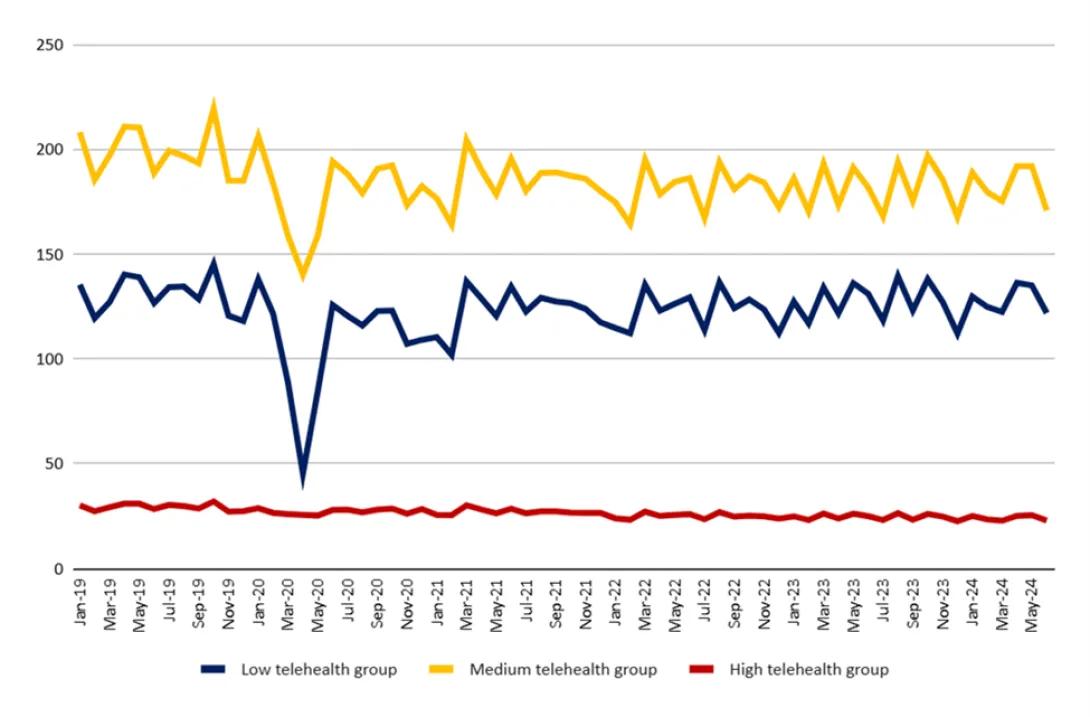
However, despite this sustained adoption, the study finds that overall healthcare visits have remained stable or declined over time.
The researchers used a special type of statistical analysis to look at visit patterns among specialties with high, medium and low telehealth use.
They found that even in fields where telehealth was widely adopted, the total number of visits, including in-person and virtual visits, stayed steady or even declined over time. Contrary to some predictions, overall visits didn’t climb higher as telehealth became more popular.
Lead author James D. Lee, M.D., M.P.H., said that it’s important to look at the overall trajectory of both telehealth and in-person visits in order to inform policymakers who want to balance care access and flexibility with budgetary responsibility.
“One of the things that is paralyzing the policy debate is uncertainty and concern about whether covering telehealth in parity with in-person care would be associated with runaway utilization. But we don’t see that here,” said Lee, who is a National Clinician Scholar at IHPI and a Clinical Instructor in the U-M Medical School’s Department of Internal Medicine in the Division of General Medicine.
Lee and senior author Chad Ellimoottil, M.D., M.S., led the analysis.
They didn't include asynchronous patient portal messages, which providers can bill Medicare for under a separate code if they spend a substantial amount of time addressing the patient’s concern.
They also cannot include any visits that patients had with providers who did not bill traditional fee-for-service Medicare, such as mental health providers who patients may have paid for out of their own pocket.
Because half of Medicare beneficiaries have chosen Medicare Advantage plans, which bill Medicare differently, their data aren’t included either.
The fact that the new analysis shows a declining trend for total visits for behavioral health and primary care is also of interest, Lee says.
This may reflect the well-known shortage of primary care and behavioral health providers in the United States, including reduction in capacity as burned-out providers reduce the number of appointments they offer.
Additional authors: In addition to Lee and Ellimoottil, the authors are Elena Chun, M.S., Chiang-Hua Chang, Ph.D., Hechuan Michelle Hou, M.S., former NCSP scholar Terrence Liu, M.D., M.S., Rodney Dunn, Ph.D., Jeffrey McCullough, Ph.D., and Michael Thompson, Ph.D.
Funding/disclosures: The study was funded by the Agency for Healthcare Research and Quality, and the support that Lee receives for his National Clinician Scholars Program fellowship from IHPI and the VA Office of Academic Affiliations.
Paper cited: “The volume of outpatient office visits did not increase for specialties that were more likely to adopt telehealth,” Health Affairs Scholar. DOI:10.1093/haschl/qxaf227
Sign up for Health Lab newsletters today. Get medical tips from top experts and learn about new scientific discoveries every week.
Sign up for the Health Lab Podcast. Add us wherever you listen to your favorite shows.

Health Lab
Explore thousands of health news & research stories by visiting the Health Lab homepage for more.
Media Contact

Public Relations
Department of Communication at Michigan Medicine
In This Story

Chad Ellimoottil, MD, MS
Associate Professor
Related

Telestroke patients more likely to receive treatment, but with greater delays
Telehealth didn’t increase Medicare visits, but drove down post-visit costs
Stay Informed
Want top health & research news weekly? Sign up for Health Lab’s newsletters today!
Featured News & Stories

Learning Together: Making Space for Growth at Work

Top 7 tips for choosing Medicare prescription drug coverage for 2027

Comprehensive DNA sequencing reveals hidden drivers of cancer

‘Molecular glue’ stabilizes protein that inhibits development of non-small cell lung cancer and uterine cancer

Many older adults make Medicare decisions quickly and most don’t change plans, poll finds