Teens need private time with doctors, but many aren’t getting it
Most parents see value in confidential teen health visits but many still struggle to step back, national poll suggests
10:21 AM
Author |

While most parents say it’s important for health care providers to speak privately with teens during medical visits, far fewer are putting that belief into practice, according to a national poll.
Just a third of parents report that their teen had one-on-one time with a health care provider during their most recent checkup, according to the University of Michigan Health C.S. Mott Children’s Hospital National Poll on Children’s Health.
“Adolescence is a time of physical, emotional and social changes and teens may have questions about sensitive topics like puberty, mental health, reproductive health or peer pressure,” said Mott Poll Co-Director Sarah Clark, M.P.H.
“Preventive care visits are a key opportunity to talk about these health issues in confidence. Many parents recognize the value of privacy, but they also have mixed feelings about being less involved.”
The nationally representative report is based on responses from nearly 1,170 parents of children ages 13 to 17 surveyed in February 2026.
Parents see value in privacy, but concerns remain
While 68% of parents agree that providers should talk privately with teens during health care visits, many also express hesitancies about confidentiality.
Top concerns include worries that a teen may receive advice or treatment the parent would not approve of, a desire to know what their teen is discussing and a belief that it is the parent’s responsibility to closely monitor their teen’s health care.
Evidence shows that when confidentiality is assured, teens are more likely to share important health information that can support preventative care."
-Sarah Clark, M.P.H.
Nearly all parents also say they should have access to their teen’s full medical records until age 18.
At the same time, nearly two thirds say they understand that state laws set limits on parental access to confidential teen health information.
Experts say these concerns may create barriers for young people seeking care for issues such as mental health, sexual and reproductive health and substance use.
“Evidence shows that when confidentiality is assured, teens are more likely to share important health information that can support preventative care,” Clark said.
“Teens need a safe space to talk honestly about their questions, feelings and experiences.”
Parents whose teens didn’t have private time with a provider most often said it was because the provider didn’t offer it, their teen was uncomfortable speaking privately or they themselves were not comfortable.
Just one in five parents recall health care providers discussing confidential services for teens while only 11% remember any discussion about limits on what parents can see in their teen’s patient portal.
Health systems and states vary in their laws and policies around confidential care, especially for reproductive health and mental health services, Clark notes.
Health care professionals can help explain these policies and their purpose to families.
“Providers may be missing opportunities to normalize private conversations as a routine part of adolescent care and encourage teens to share concerns more openly,” she said.
“Clear communication from providers may help families better navigate the balance between supporting teen independence and maintaining appropriate parental involvement.”
Teens often take a limited role in visits
Medical visits during teen years, Clark says, also helps young people begin to take a more active role in managing their own health.
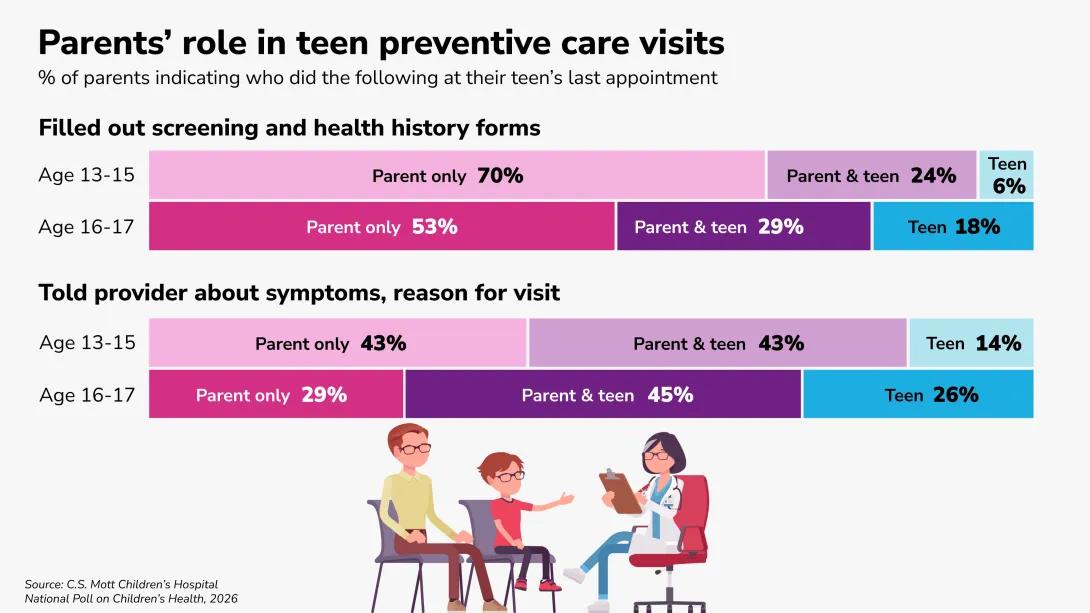
In most cases, parents who attended their teen’s most recent preventive care visit say they completed health screening and history forms themselves.
Just 12% say their teen completed the forms while 26% say they completed them together.
When asked about discussing the reason for the visit and any health concerns, 36% of parents say they handled it themselves, 20% say their teen did and 44% say they shared that responsibility.
“It can be hard for parents to shift from doing everything for their child to sharing responsibility with their teen,” Clark said. “But adolescence is an important time for young people to start taking ownership of their health.
“When parents step back, they’re helping teens build the skills and confidence they need to manage their own health care over time.”
Sign up for Health Lab newsletters today. Get medical tips from top experts and learn about new scientific discoveries every week
Sign up for the Health Lab Podcast. Add us wherever you listen to your favorite shows

Health Lab
Explore thousands of health news & research stories by visiting the Health Lab homepage for more.
Media Contact

Public Relations
Department of Communication at Michigan Medicine
In This Story

Sarah J Clark
Research Scientist
Stay Informed
Want top health & research news weekly? Sign up for Health Lab’s newsletters today!
Featured News & Stories

Better prenatal care data could help prevent maternal complications, experts say

Pain, psychological factors and physical function closely linked in people with systemic sclerosis

Many hospitals still don’t do enough to prevent UTIs from catheters

Nerf gun accident causes retinal detachment in pediatric patient
Pediatric patient treated for rare kidney cancer