Surgeons and General Motors engineers partner to prevent automotive crash injuries
A unique fellowship brings together experts in medicine and automotive technology to learn from each other and improve vehicle safety systems
5:00 AM
Author |
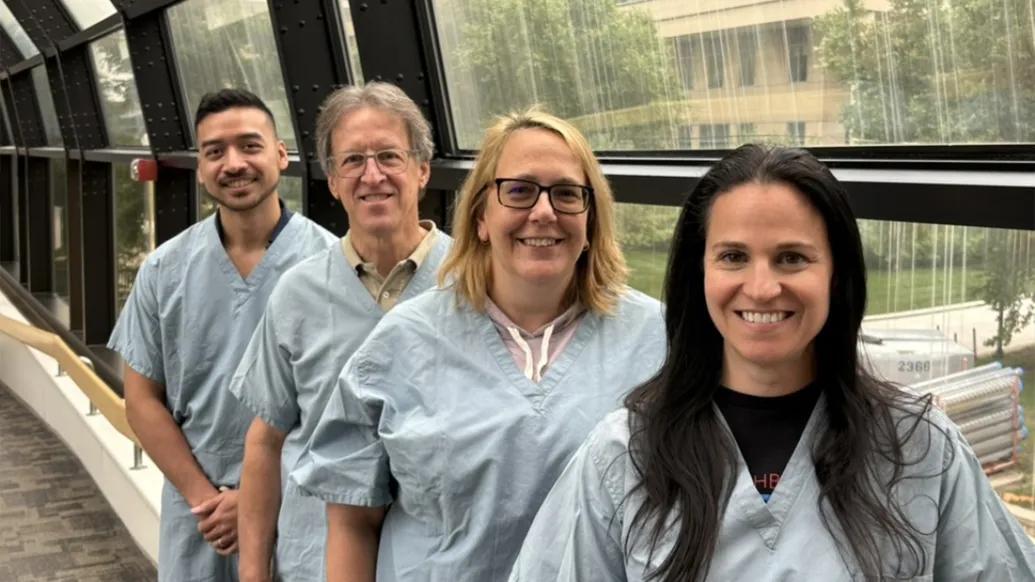
Acute care surgeons and automotive manufacturers have something in common: They want to minimize traumatic injuries after a car crash.
With that in mind, collaborating is a natural choice.
The International Center for Automotive Medicine is a research center within Michigan Medicine where medical professionals and automotive engineers partner on work to improve automotive safety and preventing injuries.
ICAM accomplishes its mission through three core avenues: cross-disciplinary education, computational biomechanics and policy making.
An example of the center’s education efforts is a fellowship that gives automotive safety engineers exposure to a medical perspective on automobile crash injuries.
ICAM’s assistant medical director, acute care surgeon Raymond Jean, M.D., and engineering director, research scientist Sven Holcombe, Ph.D., took over as the co-directors of the fellowship this year, alongside medical director, Mark Hemmila, M.D., continuing its roughly two-decade legacy.
A brief history of ICAM
Prior to ICAM’s founding, Michigan Medicine was a medical center for the Crash Injury Research and Engineering Network.
CIREN is a federal program managed by the National Highway Traffic Safety Administration that provides funds for research investigating car crashes to understand what factors contribute to injury outcomes.
Acute care surgeon Stewart Wang, M.D., Ph.D., founded ICAM in 2010 to elevate and expand upon the research that he and his team had been previously providing as a CIREN center.
ICAM’s projects investigate a broad spectrum of factors associated with automotive injuries, including data on vulnerable road users and vehicle occupants, injury severity prediction algorithms and the ICAM fellowship.
ICAM’s research has helped improve vehicle safety systems, including validating how effective certain features are, according to Kristen Cunningham, M.P.A., ICAM’s director.
“One success story is that it was discovered that an airbag that the manufacturer was not sure was helpful actually did protect people from injury,” Cunningham said.
A success like that is a credit to ICAM’s network of collaborators, which also revealed an opportunity for education.
“One of the things that became very apparent is that the safety engineers wanted some experience in terms of what we see from the medical side of these trauma cases,” said Jean.
So, Wang created the fellowship program and has partnered with General Motors, other manufacturers and tier-one suppliers for about 20 years, and has trained nearly 100 fellows to date.
Breaking down the fellowship
The year-long program gives participating engineers basic instruction in trauma medicine and crash investigation.
The goal is to provide a medical perspective and help the engineers understand what they are trying to protect through regular crash case reviews and guest lectures from industry experts.
There are also hands-on exposures, such as the anatomy lab, where the fellows get an opportunity to see what a real body looks like, understand its physiology and how injuries can occur.
“It’s been helpful for them to conceptualize a lot of the injuries we talk about that they’re trying to prevent,” Jean said.
Alongside this medical education, the fellows get to cut their teeth on the academic research process through a capstone project.
They conduct literature reviews, analyze data and try to answer a safety question, like how comorbidities factor into injury severity or how stature affects injury outcomes.
Research into future innovations
It’s common for questions that pop up during fellowship case reviews to lead to research collaborations.
Jean notes a recent study that began as a question during a case review with the fellows: Do emergency automotive notification systems like OnStar help reduce transportation time to a hospital in the event of a crash?
Together they conducted a retrospective study with data collected from case reviews and General Motors to validate that these systems do actually reduce time of transport.
For Jean, these findings highlight an exciting future where artificial intelligence can be used to make safer cars, as well as the need for continued collaboration with the automotive industry.
“Using AI to take the data that’s in your car and predict the severity of a car crash and how urgently an injury needs attention is where I see the future of automotive safety going, and industry partnerships are going to play a crucial role in this,” Jean said.
Learning for mutual benefit
The fellowship is designed to bridge the gap between different perspectives on what factors cause injury in a car crash.
Jean’s background in engineering puts him in a unique position where he can speak both languages, but for the engineers and surgeons like Wang, this partnership is a valuable education.
“As an occupant performance engineer, it’s easy to get immersed in data, but this program brought that data to life. Studying real-world crashes and human anatomy deepened my understanding and gave renewed purpose to my work,” said Leslie Sajovec, a current ICAM fellow and Vehicle Safety Performance Integration Engineer at General Motors.
Rashawndra Outlaw, a 2021-2022 ICAM fellow and Technical Expert at General Motors, feels similarly about the fellowship’s impact on her career and opportunities for innovation.
“Through the program, I gained the ability to identify key body regions vulnerable to injury based on crash types and occupant factors. I also learned to assess injury severity using the Abbreviated Injury Scale (AIS) coding system,” said Outlaw.
Helping engineers understand injury severity and causation illustrates why Wang felt it was important to create the fellowship.
An added benefit? A more well-rounded perspective on the car crash injuries he saw as a surgeon.
“The chance to marry the injuries I was seeing in the emergency department and link it to the crash through photos, road evidence and to reconstruct what happened demystified injury causation. Once we better understood injury causation, I could partner directly with the engineers to improve the design of vehicle safety systems,” said Wang.
Wang, Hemmila and Jean feel privileged to take part in this work with the fellows and help prevent more serious automotive injuries.
The feeling is mutual for the fellows – some of them have continued to work with ICAM after completing the fellowship.
It’s a testament to the value of ICAM’s model of collaboration, which Jean thinks is made even richer because its home is in Michigan Medicine.
“Being close to Detroit – the automotive center of not only the United States, but also the world – you have the ability to bring together the best and brightest in terms of automotive safety. We’re fortunate enough to be considered the academic brain for that,” said Jean.
Interested in supporting ICAM's work? Donate here.

Health Lab
Explore thousands of health news & research stories by visiting the Health Lab homepage for more.
Media Contact

Public Relations
Department of Communication at Michigan Medicine
In This Story

Raymond Alexander Jean, MD, MA, MHS, FACS
Clinical Assistant Professor

Stewart C Wang, MD, PhD
Professor Emeritus/a
Stay Informed
Want top health & research news weekly? Sign up for Health Lab’s newsletters today!
Featured News & Stories

4 ways to teach your teen safe driving habits
Comprehensive DNA sequencing reveals hidden drivers of cancer

Many older adults make Medicare decisions quickly and most don’t change plans, poll finds
‘Molecular glue’ stabilizes protein that inhibits development of non-small cell lung cancer and uterine cancer

4 in 5 parents say having a baby is too expensive