Studying neurons using neurons
Researchers are finding new ways to study neuron function, using a new platform that computes with human neurons
5:00 AM
Author |
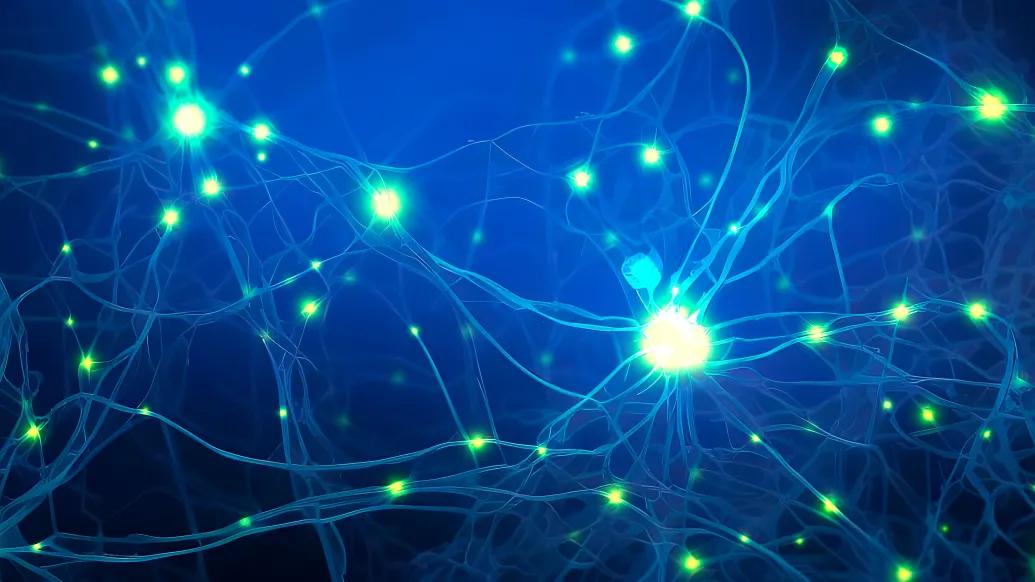
The labs of Anne Draelos, Ph.D., Assistant Professor of Biomedical Engineering, and Joshua Welch, Ph.D., Associate Professor of Computational Medicine and Bioinformatics at the University of Michigan Medical School are exploring a new technology that leverages the biological capabilities of human neurons for artificial intelligence.
In your body, collections of neurons work together, responding as a group to stimuli.
For instance, visual input is taken from your eyes and interpreted by neurons. Scientists, like Draelos and Welch, want to understand how collections of neurons behave.
“We want to understand the human brain and the genetics of human disease and brain function,” Welch said.
One major way to do this is by studying neurons.
“From a health perspective, this could be beneficial for designing stimulations to encourage certain kinds of connectivity where connections are weak,” Draelos said.
“For example, we may be able to design stimulations to inhibit problematic neural activity. For neurological disorders like epilepsy, we could use stimulation to encourage activity in a brain network to move away from patterns leading to seizures.”
The platform these researchers are exploring, created by the biotechnology firm Cortical Labs, has been able to stimulate collections of neurons to get responses.
The company trained neurons to play the video game Pong.
This novel idea, training biological neurons like you would a computer, gives researchers a new way to study them.
The technology uses pluripotent stem cells to grow the neurons; these stem cells are grown from adult donors and genetically altered to become different cell types.
These neurons are then grown in a grid pattern on a plate and attached to the device.
The device gives the neurons signals, stimulating and activating them.
The neurons interpret these signals, then respond in kind.
The Welch lab was able to train this system to predict the movement of the C. elegans worm, a model organism that is used in many research labs.
“It's a new computing paradigm,” Welch said.
“Instead of running circuits through silicon chips with logic gates, which is what computers do, can we use the physical activation properties of biological neurons to compute things?”
The answer? Not yet.
This technology is in its beginning stages, with a few proven applications.
But there is potential to learn so much more.
“The technology is still pretty new,” Draelos said.
“I think what you can do with this system is pretty unexplored and there are barriers to overcome. But I think it's very promising to investigate. And if it works, like we hope it does, then I think it will be a widely impactful and long-term technology.”
Sign up for Health Lab newsletters today. Get medical tips from top experts and learn about new scientific discoveries every week.
Sign up for the Health Lab Podcast. Add us wherever you listen to your favorite shows.

Health Lab
Explore thousands of health news & research stories by visiting the Health Lab homepage for more.
Media Contact

Public Relations
Department of Communication at Michigan Medicine
In This Story

Anne Draelos, PhD
Assistant Professor

Joshua Welch, PhD
Associate Professor
Stay Informed
Want top health & research news weekly? Sign up for Health Lab’s newsletters today!
Featured News & Stories

The AI is listening: Implications of machine generated clinical notes on health care

Comprehensive DNA sequencing reveals hidden drivers of cancer

Many older adults make Medicare decisions quickly and most don’t change plans, poll finds

‘Molecular glue’ stabilizes protein that inhibits development of non-small cell lung cancer and uterine cancer

What’s the latest on 7-OH and kratom availability and addiction care?