Study identifies key features of cancer cell response and resistance to treatment
Researchers develop a cellular atlas of prostate cancer using mouse models. Their findings reveal why some prostate tumors respond to therapy while others become resistant.
1:00 PM
Author |
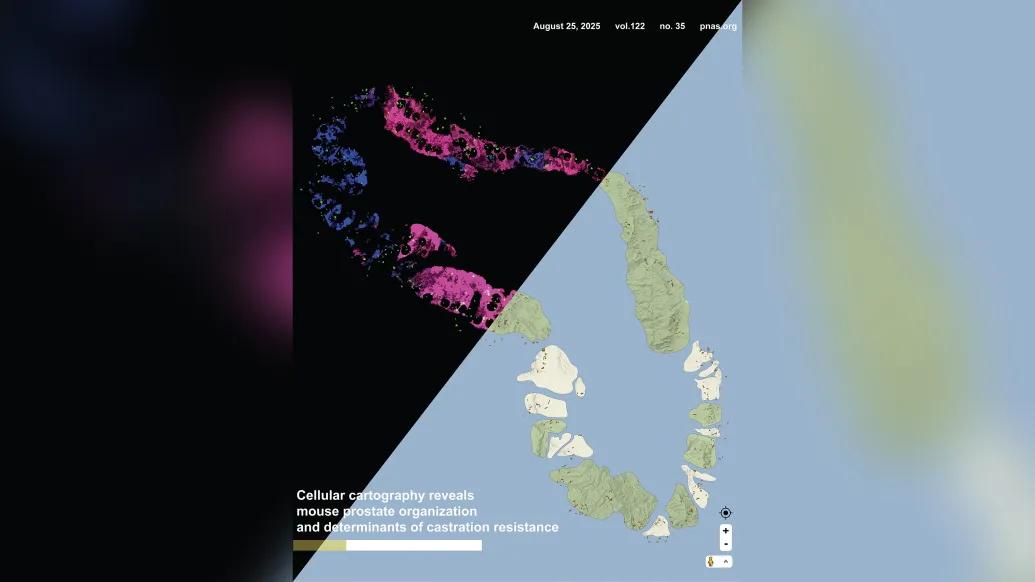
Prostate cancer is one of the leading causes of cancer-related death in men.
Most patients who are diagnosed during earlier stages usually respond well to treatment.
In some, however, the disease progresses to an aggressive, lethal form.
In a new study published in the Proceedings of the National Academy of Sciences, University of Michigan researchers identified cellular features that determine whether tumor cells respond to treatment.
The resulting cellular atlas reveals potential therapeutic targets that could help counter treatment resistance.
Advanced prostate cancers are usually treated with androgen deprivation therapy.
There are no cures for patients who are resistant to this therapy, largely because the underlying mechanisms are unclear.
To understand resistance, researchers have previously relied on genetically engineered mouse models for both benign and malignant prostate cancer.
None of these have captured the full progression of human disease.
In the current study, the team used multiple contemporary approaches, including single-cell RNA sequencing, single-cell multiomics and spatial transcriptomics, to create a cellular atlas.
By sequencing mouse prostates, they identified different cell types and their locations in the prostate, which ones were driving the disease and how they were doing so.
“This is the first time anyone has used these three tools to get an integrated view of prostate cancer treatment response and resistance,” said Sethu Pitchiaya, assistant professor of urology and a member of Rogel Cancer Center.
“By comparing our results to publicly available human sequencing data, we were able to draw parallels to the human prostate and disease.”
The comprehensive cellular atlas provides researchers with a new framework to understand how prostate tumors evolve under therapy, according to Arul Chinnaiyan, M.D., Ph.D., S.P. Hicks Professor of Pathology and Urology and investigator at the Howard Hughes Medical Institute.
The team found that androgen deprivation therapy reshapes the cellular interactions in mouse prostates, triggering pathways that are useful for dealing with stress and new cell development.
The activity of over 20 genes, including ones from the AP-1 and Klf family, were elevated.
Although mouse and human prostate differ architecturally, the same genes were also elevated in patients who had undergone androgen deprivation therapy, specifically those who were resistant to it.
The team is interested in extending this framework to sequence human tissue samples and build a comprehensive list of indicators of therapy response and therapeutic targets.
While many of the proteins they identified from this study are difficult to drug, the team is exploring new ways to do so.
“This study not only reveals the hidden diversity of prostate cell types but also pinpoints the programs that allow cancer cells to survive androgen deprivation therapy,” Chinnaiyan added.
“These insights provide a roadmap for developing next-generation therapies aimed at preventing or overcoming treatment resistance in advanced prostate cancer.”
Additional authors: Hanbyul Cho, Yuping Zhang, Jean C. Tien, Rahul Mannan, Jie Luo, Sathiya Pandi Narayanan, Somnath Mahapatra, Jing Hua, Greg Shelley, Gabriel Cruz, Miriam Shahine, Lisha Wang, Fengyun Su, Rui Wang, Xuhong Cao, Saravana Mohan Dhanasekaran and Evan T. Keller.
Funding/disclosures: The study was supported by Department of Defense Idea Development Award W81XWH1910424, Prostate Cancer Foundation Young Investigator Award 18YOUN20, NCI Prostate SPORE Career Enhancement Award, NCI Outstanding Investigator Award R35CA231996, NCI Early Detection Research Network U2C-CA271854, NCI Prostate SPORE grant P50CA186786 and NCI P01 award P010939000.
Tech transfer(s)/Conflict(s) of interest: Chinnaiyan is a co-founder of and serves as a Scientific Advisory Board member for LynxDx, Esanik Therapeutics, Medsyn and Flamingo Therapeutics. He is a scientific advisor or consultant for EdenRoc, Aurigene Oncology and Tempus.
Paper cited:“Cellular cartography reveals mouse prostate organization and determinants of castration resistance,” Proceedings of the National Academy of Sciences. DOI: 10.1073/pnas.2427116122.

Health Lab
Explore thousands of health news & research stories by visiting the Health Lab homepage for more.
Media Contact

Public Relations
Department of Communication at Michigan Medicine
In This Story

Sethu Pitchiaya, PhD
Assistant Professor
Related
Study shows new approach to target deadly form of prostate cancer
Genome’s Dark Matter Sheds Light on Prostate Cancer Challenge
Stay Informed
Want top health & research news weekly? Sign up for Health Lab’s newsletters today!
Featured News & Stories
Online resources and coaching helped people seek genetic testing for cancer
Comprehensive DNA sequencing reveals hidden drivers of cancer
‘Molecular glue’ stabilizes protein that inhibits development of non-small cell lung cancer and uterine cancer

Many older adults make Medicare decisions quickly and most don’t change plans, poll finds

What’s the latest on 7-OH and kratom availability and addiction care?