Spinal implant eliminates patient’s 'all-consuming' pain without need for a fusion
The implant is designed to relieve pressure while preserving mobility
5:00 AM
Author |
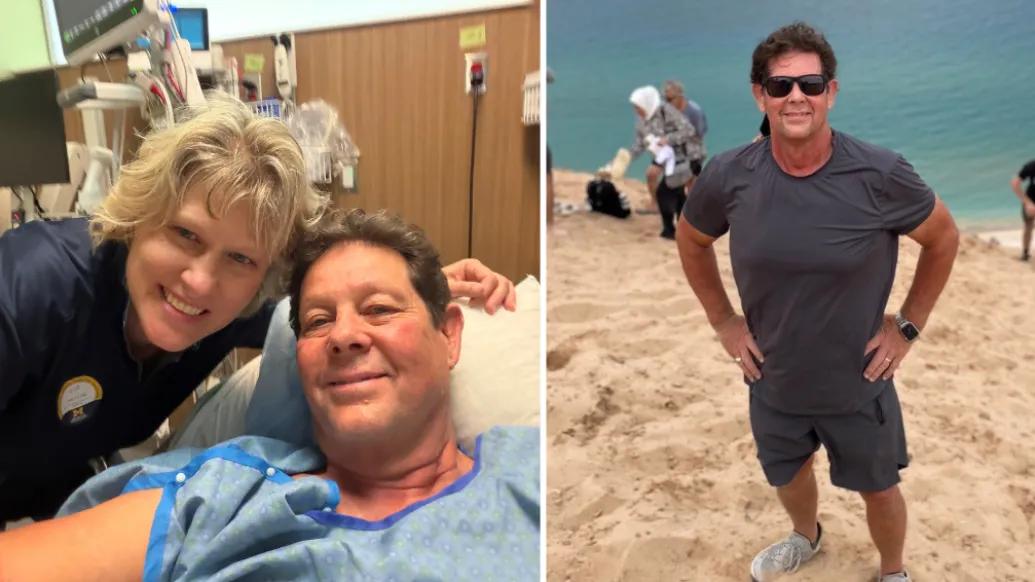
After enduring years of chronic lower back pain that limited his mobility, a Michigan man says he has "zero pain" thanks to an innovative spinal implant that relieved pressure and resolved instability without the need for traditional fusion surgery.
The mechanical implant, called the Premia Spine TOPS system, is designed to stabilize the lower spine while preserving natural range of motion following lumbar decompression surgery.
The procedure, performed at University of Michigan Health, allowed Todd Frass, 62, to stand up straight and walk pain-free for the first time in years.
“I am a completely different person,” said Frass, who lives in the Grand Rapids area.
“The issues that were all-consuming in my daily life — my back pain, weakness, sciatica — all of them are gone.”
Frass had degenerative spondylolisthesis, a condition that typically develops after age 50 as wear and tear weakens the spine's supporting structures.
One of the vertebrae in his lumbar spine had slipped out of alignment. This caused spinal stenosis, a narrowing of the spinal canal that compressed nearby nerves in his lower back.
Over the course of six years, Frass sought several treatment options from different specialists: steroid injections, nerve blocks, physical therapy, and medications.
His pain only got worse.
“I got to the point where I was bent over, hobbling around and using a walker at home,” Frass said.
“There were two occasions when I had to go to the emergency room because the pain flared up so badly.”

Out of alternatives, Frass looked at spinal fusion surgery which involves permanently connecting vertebrae to prevent movement between the bones.
During the procedure, the surgeon places metal screws and rods to stabilize the spine. Bone graft is then placed between the vertebrae, allowing them to fuse together over time into a single, solid bone.
Frass was hesitant, however, to schedule the surgery.
Although fusion is a highly effective and time-tested treatment for spinal stenosis and instability, he was seeking options that could address his symptoms while preserving more natural movement in the spine.
Online research led him to the TOPS System, which received approval from the U.S. Food and Drug Administration in 2023 to treat degenerative spondylolisthesis and spinal stenosis in the lumbar spine.
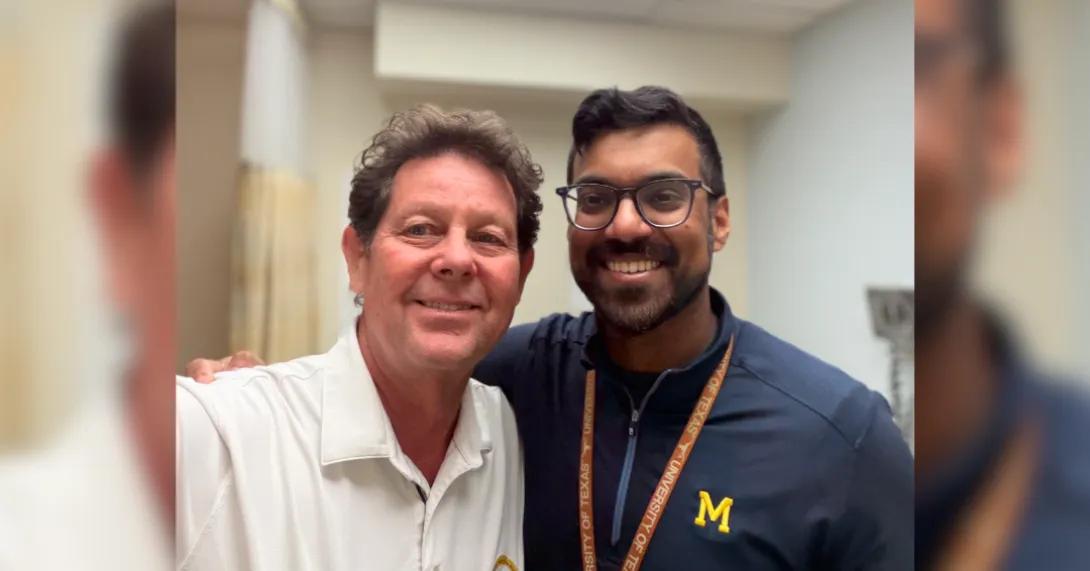
The company that created TOPS connected Frass with Jacob Joseph, M.D., a neurosurgeon in the U-M Health Comprehensive Spine Program.
“The goal with this procedure is to allow a patient to avoid a fusion and preserve spinal motion,” said Joseph, who is Co-Director of the U-M Health Adult Spine Deformity Program.
“I’ve seen patients have less pain and return to work and recreational activities much more quickly [with TOPS]. Mr. Frass was clearly someone who lived an active lifestyle and was motivated to seek innovative solutions."
Frass underwent the TOPS procedure, also called lumbar facet arthroplasty (joint replacement) surgery, in March 2026.
He went home one day after surgery and returned to work — walking without pain — four days later.
“For years, I would ask Todd to go for a walk, and the answer was usually no; when he said yes, our destination was often truncated with a turnaround halfway,” said Ann Frass, Todd’s wife of 37 years.
“Now, he’s asking me to go for walks or bike rides, and he has a new level of energy because he’s finally pain-free! We believe Todd got the best care possible, and we feel very blessed.”
Spine surgery is gaining popularity in the United States, with volumes rising significantly from 2013 to 2022.
Nearly three-quarters of cases are spinal fusions.
Not everyone with a lumbar spine issue is a candidate for TOPS.
The system isn't intended for patients with significant disc problems, certain types of vertebral slippage, spinal deformities, infections, severe bone loss, or other conditions affecting the spine or nervous system.
As of July 2026, the TOPS procedure is performed by few spine surgeons in the United States.
Joseph is the only neurosurgeon in Michigan trained to offer it and is one of the leaders nationally in implanting the TOPS device.
“Motion preservation is one of the most exciting advances in spine surgery because it allows us to maintain natural spinal movement in carefully selected patients,” Joseph said.
“However, spinal fusion remains an outstanding operation and continues to be the best treatment for many spinal conditions. The real advancement is not replacing fusion but expanding our ability to tailor treatment to each patient’s needs.”
Less than six months after his surgery, Frass regularly bikes and plays pickleball. He can hold his grandchildren and is preparing to return to weight training.
“I felt so great that Dr. Joseph had to emphasize that I should not try to do too much too soon,” he said.
“This procedure has changed my life, and I am living proof."

Health Lab
Explore thousands of health news & research stories by visiting the Health Lab homepage for more.
Media Contact

Public Relations
Department of Communication at Michigan Medicine
In This Story

Jacob R Joseph, MD
Clinical Associate Professor
Related
How a complex, 14-hour surgery saved a woman’s ‘hopeless’ spine
Car crash survivor avoids paralysis after less invasive spine surgery
Stay Informed
Want top health & research news weekly? Sign up for Health Lab’s newsletters today!
Featured News & Stories
Engineered nanoparticles sensitize gliomas to radiotherapy

A concussion expert and football father discusses why he values teamwork over zero-risk
University of Michigan implants first-in-human Paradromics wireless brain-computer interface, designed to restore communication

Helping an employee-turned-patient overcome a brain tumor

Sanjay Gupta recounts his U-M years and shares life lessons for medical school commencement