Specialized local care gives baby with severe heart condition a stronger start before surgery
Newborn with a complex congenital heart defect receives coordinated, specialty care close to home while gaining strength
5:00 AM
Author |

As a mother of two, Katrina Pepaj was expecting a routine ultrasound during her third pregnancy.
Instead, the scan changed everything.
Her baby boy had two large holes in his heart.
“I didn’t know what to do or what the future would hold,” she said.
“I just leaned into my faith.”
Care close to home
Pepaj was referred to a pediatric cardiology team from University of Michigan Health C.S. Mott Children’s Hospital that partners with Trinity Health Oakland to provide specialized care locally.
Mott pediatric cardiologist Clint Cochran, M.D., reviewed her fetal scans and confirmed the diagnosis: her son, Jakob, had an atrioventricular septal defect, a complex heart defect that would require surgery.
With a five-year-old and a five-month-old at home near Troy, Pepaj hoped to deliver locally and avoid frequent hour-long drives for appointments.
She was relieved when Cochran assured her that would be possible.
“Life keeps going even in the middle of something like this,” she said.
“It was so helpful to have Dr. Cochran close by.”
Throughout her pregnancy, teams at Trinity Health Oakland and C.S. Mott Children’s Hospital coordinated the family’s care, aligning on a delivery and postnatal plan that prioritized both safety and proximity.
“We did everything we could to keep their care as close to home as possible for as long as possible,” Cochran said.
Buying time to grow stronger
Jakob arrived five weeks early in June 2025, weighing five pounds, eight ounces, and was admitted to the neonatal intensive care unit at Trinity Health Oakland with breathing difficulties.
Doctors also discovered physical differences not visible on fetal imaging, including an extra finger on each hand and an extra toe on one foot, prompting a genetics referral.
The immediate goal was to help Jakob grow strong enough for heart surgery.
After a month in the NICU, he went home on heart failure medication and partial tube feedings, returning to cardiology every one to two weeks.
We did everything we could to keep their care as close to home as possible for as long as possible.”
-Clint Cochran
An AVSD, which involves two holes in each chamber, forces the heart to work harder than normal, Cochran explains. Babies often burn extra calories just breathing and eating, making weight gain difficult. For Jakob, every ounce mattered.
“Our goal was to delay surgery safely so he could grow and be in the best possible condition,” Cochran said.
“That meant adjusting medications and nutrition sometimes week to week.”
Together with Cochran, the nursing team and dietician ensured feeds were fortified and medications were carefully managed.
But after a couple of months, daily vomiting and stalled weight gain signaled it was time to transition his care to Mott for closer monitoring and surgical preparation.
Jakob spent three weeks there before surgery.
For Pepaj, the hospital team’s support made an overwhelming situation manageable.
“I had two other kids who still needed their mom,” she said.
“I couldn’t be there 24 hours a day, but I always knew someone was with him and taking great care of him.”
During that admission, genetic testing also confirmed that Pepaj and her husband, Martin, both carry a recessive gene for Ellis-van Creveld syndrome, a rare condition associated with extra digits, heart defects and growth challenges.
Jakob had inherited it.
“We couldn’t believe we both had a gene for something we’d never heard of,” Pepaj said. “But it explained so much.”
A dramatic difference
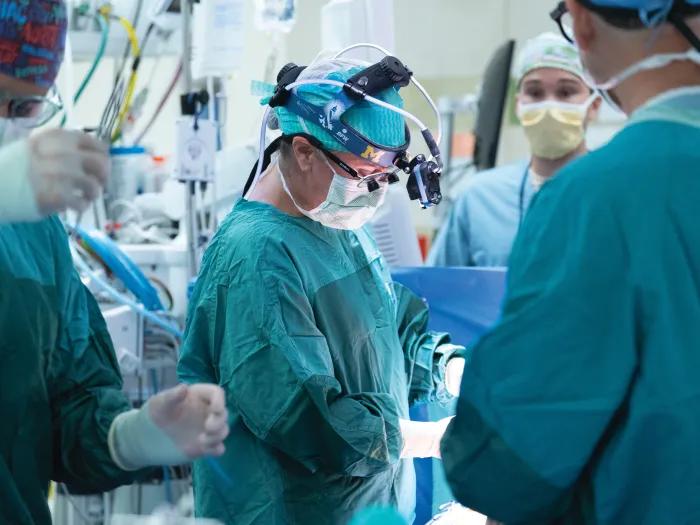
At just over three months old, Jakob underwent surgery to repair his heart with a team led by pediatric heart surgeon Jennifer Romano, M.D.
The improvement was almost immediate. Before surgery, most feedings ended in vomiting.
Afterward, he was able to keep down a full bottle.
“When the heart no longer has to compensate for the defect, you often see babies feed better and gain weight more consistently,” Cochran said.
“That was exactly what we hoped for.”
Just a week later, Jakob went home.
He still had a feeding tube but didn’t rely on it for long.
Within a month, he pulled it out himself. After consulting the care team, Pepaj offered him a bottle.
“He drank the whole thing in 35 minutes and then took a nap,” she said.
“It felt like such a turning point.”
At six months old, Jakob weighed 12 pounds, eight ounces.
Though still small, he's steadily gaining weight and now enjoys oatmeal with banana purée, peanut butter, mashed avocado and even stuffed peppers with rice and meat.
“It’s night and day compared to before surgery,” Pepaj said. “In the beginning, I wondered if we would ever get here.”
Now, the family is planning their first vacation as a family of five, including Jakob’s older brothers, David and Luka.
“It was scary sending our baby into open-heart surgery,” Pepaj said.
“But seeing how he’s thriving now, it was absolutely the best decision for him. Trinity and Mott made it as smooth as possible.”
Sign up for Health Lab newsletters today. Get medical tips from top experts and learn about new scientific discoveries every week
Sign up for the Health Lab Podcast. Add us wherever you listen to your favorite shows

Health Lab
Explore thousands of health news & research stories by visiting the Health Lab homepage for more.
Media Contact

Public Relations
Department of Communication at Michigan Medicine
In This Story

Clinton D Cochran, MD
Clinical Assistant Professor
Related
The dangerous intestinal disease fatal to premature babies and vulnerable infants
Stay Informed
Want top health & research news weekly? Sign up for Health Lab’s newsletters today!
Featured News & Stories
Rheumatologist finds contentment and community through family farm
U-M alumni return from Central Asia to seek treatment for their child at Mott
Young father survives aortic dissection after delayed diagnosis
C.S. Mott Children’s Hospital first in country to implant expandable heart valve during FDA review phase

Weighing TAVR vs. SAVR for aortic stenosis treatment