A smarter helmet for the smallest patients
How a U-M Health team redefined care for babies with positional head deformities
5:00 AM
Author |
The University of Michigan is home to some pretty distinctive helmets.
But thanks to the University of Michigan Health Orthotics and Prosthetics Center, the winged, maize-and-blue design millions see on the football field on fall Saturdays is far from the most innovative helmet found on campus.
The other?
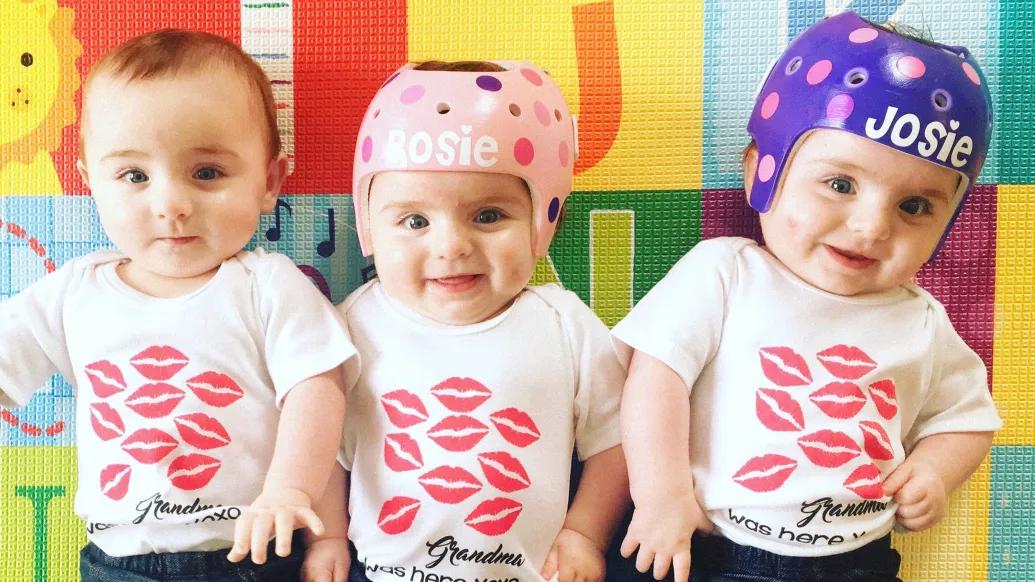
The unique helmet invented at Michigan Medicine and used to treat plagiocephaly, a flattening of the head frequently seen in babies who spend a lot of time in the same position.
The condition has been more common since the 1990s, when doctors began recommending babies sleep exclusively on their backs to help prevent sudden infant death syndrome.
While SIDS deaths declined sharply as a result of the warnings, sleeping in the same position all of the time also increased the number of babies with head flattening.
Historically, babies with the condition wore non-adjustable helmets that gently reshaped their heads as they grew, over a period of several months.
SEE ALSO: Study shows baby helmets yield high success rate | University of Michigan Health
But because the helmets weren’t adjustable, each baby had to be fitted multiple times – and their parents usually had to pay for multiple helmets before the three- to six-month treatment was complete.
That’s where Michigan Medicine came in.
U-M Health orthotists – medical professionals trained specifically to design and build braces and splints – reinvented the old-style headgear, creating a custom, two-piece (or “bi-valve”) adjustable helmet.
In the process, the team also made the helmet lighter and gave it a lower profile than the traditional models.
Thus, the Michigan Cranial Reshaping Orthosis was born.
“This helmet can be expanded with the baby’s skull growth, so you don’t have to have multiple helmets,” said Ammanath Peethambaran, the now-retired orthotist who led the team that designed the new helmet in 1998.
“Physicians and parents all embraced the design. … It’s very economical light weight, low profile design and easy to don and doff Usually only one helmet is needed for the whole treatment time.”
At first, orthotists fit babies for the helmets by taking a mold of their heads using plaster of Paris, Peethambaran says, but that presented obvious challenges.
“It was so difficult because they’re so young, difficult to keep their head steady and may cause stress on them” Peethambaran said.
“It was stressful for parents and the baby – and for me as a practitioner, too.”
So Michigan’s orthotists came up with another innovation: using a laser scanner to map the baby’s head.
That way, technicians could create a 3D model of the baby’s head and design the helmet using that.
No Plaster of Paris required.
Today the number of children who have used the helmets in Michigan and around the country easily exceeds 10,000, with a success rate of 95%.
Peethambaran says U-M Health fitted an average of about 30 babies every month before he retired about five years ago.
SEE ALSO: Triathlete’s prosthetic hand gets him back to living his best life | University of Michigan Health
Orthotists in Japan, have also adopted the Michigan Cranial Reshaping Orthosis as there preferred helmet.
Peethambaran says there’s a reason that Michigan Medicine is known for taking an innovative approach.
“When we do research work, it isn’t 8-to-5 kind of work. It takes time and energy along with daily clinical duties. But all the support, financially and time-wise, is given by the University and our department, whenever we need it,” he said.
“Design-wise, I had the whole department helping me on it. They were always backing me to get this done. I enjoyed having that kind of teamwork in my department.”
Despite retiring after a career at Michigan lasting nearly 28 years, Peethambaran still works with his old teammates to solve problems.
Recently he was helping Michigan Medicine put the finishing touches on its next big improvement to the Michigan Cranial Reshaping Orthosis – a 3-D printed version that promises to make the process of helping babies even smoother.
“The results are so good, and to see those results is very, very satisfying to me, particularly because of the population we were helping – they’re little babies.
There is nothing more satisfying than seeing the infants discharged with a perfectly symmetrical head shape.”
Sign up for Health Lab newsletters today. Get medical tips from top experts and learn about new scientific discoveries every week.
Sign up for the Health Lab Podcast. Add us wherever you listen to your favorite shows.

Health Lab
Explore thousands of health news & research stories by visiting the Health Lab homepage for more.
Media Contact

Public Relations
Department of Communication at Michigan Medicine
Stay Informed
Want top health & research news weekly? Sign up for Health Lab’s newsletters today!
Featured News & Stories

Pediatric patient treated for rare kidney cancer

E-Bikes are everywhere, but most parents say they don’t know enough about them

Who’s at risk for painful periods?

Talent show brings joy to kids at children’s hospital

U-M alumni return from Central Asia to seek treatment for their child at Mott