Simple muscle ultrasound may detect early prediabetes
The future of diabetes screening could be a common handheld device
5:00 AM
Author |
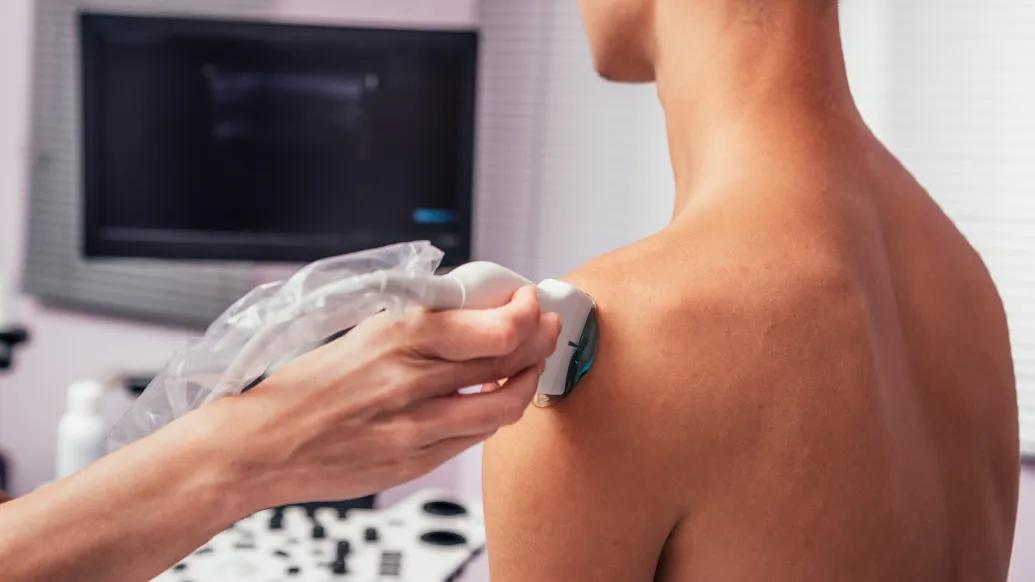
A simple ultrasound of a patient’s thigh or shoulder muscle may detect insulin resistance before it progresses to type 2 diabetes or even prediabetes.
In a study, Michigan Medicine researchers performed muscle ultrasounds on 25 patients who were also evaluated for insulin resistance.
Two trained research assistants independently analyzed these ultrasound images and identified increased muscle echo intensity in all eight subjects with insulin resistance and all seven with “impaired insulin sensitivity.”
The paper noted a “potential 100% accuracy in identifying individuals with these conditions.”
“We perform a large number of shoulder ultrasounds and noticed that many patients' muscles appear unusually bright,” said Steve Soliman, D.O., RMSK, FAIUM, FAOCR, director of MSK ultrasound and the MSK radiology fellowship at the University of Michigan and lead author on the paper.
“We found it interesting that most of these patients have type 2 diabetes. Seeing this pattern, we often thought, 'This patient must have diabetes.' More importantly, many were unaware of their condition until we verified with their electronic records and confirmed with their bloodwork that they indeed had type 2 diabetes or prediabetes.”
Interestingly, while some patients showed no signs of prediabetes or diabetes in previous blood tests, their muscle ultrasounds appeared bright.
Subsequently, upon short term follow up, these patients often also developed prediabetes or type 2 diabetes.
As a result, Soliman saw the potential for noninvasive muscle ultrasound as a predictive tool for detecting the development of type 2 diabetes or prediabetes, potentially even earlier than current methods.
This noninvasive tool could also detect insulin resistance, which can precede type 2 diabetes by many years, or even decades.
This latest paper notes that 232 million people with type 2 diabetes and 438 million people with prediabetes are undiagnosed globally, representing 50% and 81%, respectively, of those total patient populations.
In the United States, nearly 100 million people remain undiagnosed, disproportionately affecting underserved communities.
By the time diabetes is diagnosed, half the patients already suffer irreversible complications.
Previous research by Soliman at Henry Ford Hospital/Wayne State University had indicated that muscle ultrasound could detect type 2 diabetes and prediabetes.
In this current study, subjects did not have diagnosed type 2 diabetes or prediabetes but had their insulin sensitivity measured using an insulin clamp technique.
Although muscle ultrasounds could detect insulin resistance and impaired insulin sensitivity, muscle echo intensity (indicative of brightness) and M values (the primary measure of insulin sensitivity from the clamp test) were not directly correlated.
This may suggest that while ultrasound brightness indicates insulin resistance, it doesn't measure its degree.
Researchers also posit that this result may be secondary to the relatively small sample size and are actively recruiting more participants to continue the analysis.
The exact reason why muscle brightness on ultrasound might indicate insulin resistance is less clear than the finding that it does.
Initial muscle biopsy findings suggest this brightness may indicate excessive fat accumulation and possibly fibrosis, potentially affecting muscle health and function.
And while more research is needed to determine exactly what causes the image to appear as it does, researchers hope this method’s predictive power could improve early detection of undiagnosed cases of type 2 diabetes and prediabetes, and potentially identify earlier stages, allowing for prevention.
Artificial intelligence/machine learning and portable ultrasound devices may make it possible for primary care practitioners to perform this screening in a way that is, in the words of the study, “simple, noninvasive, inexpensive, and radiation-free.”
Many patients don't have regular physical exams or proper screenings and may only visit urgent care or the emergency for acute issues.
In theory, this technique could allow for screenings in those settings, as well as at drugstores or community health events.
“Clinicians increasingly use these point-of-care and handheld ultrasound devices, sometimes called ‘the stethoscope of the future,’ for rapid diagnosis of various conditions,” Soliman said.
“This information could be automatically analyzed by these noninvasive devices. A medical assistant or clinician with little to no training could easily use this device on a patient’s upper arm or thigh, as routinely as checking weight or blood pressure, and potentially flag patients as 'high risk' or 'low risk' for further testing.”
Additional authors: Olivia K. Chugh, Jacob E. Leuteneker, Becca Tuska, Wen Ye, Ph.D., Tao Zhang, Thomas Rode, M.S., Suzette M. Howton, R.D.N., Eric D. Buras, M.D., Ph.D., Jeffrey F. Horowitz, Ph.D.
Funding/disclosures: NIH DK133298 and DK131724
Paper cited: “Muscle Ultrasound: A Novel Noninvasive Tool for Early Detection of Developing Insulin Resistance and Lower Muscle Mass in Obesity,” Journal of Ultrasound in Medicine. DOI: 10.1002/jum.16741
Sign up for Health Lab newsletters today. Get medical tips from top experts and learn about new scientific discoveries every week.
Sign up for the Health Lab Podcast. Add us wherever you listen to your favorite shows.

Health Lab
Explore a variety of health care news & stories by visiting the Health Lab home page for more articles.
Media Contact

Public Relations
Department of Communication at Michigan Medicine
In This Story

Steven B Soliman, DO, RMSK, FAIUM, FAOCR
Clinical Associate Professor
Stay Informed
Want top health & research news weekly? Sign up for Health Lab’s newsletters today!
Featured News & Stories

Medicare's New GLP-1 Bridge Program

Researchers create new path to target hard-to-drug prostate cancer protein
How new care models, within a new building launch, are helping optimize patient care
Path forward for glioblastoma treatment
Studying neurons using neurons