Shortages of Technetium, Used in Stress Tests, May Harm Heart Patients
As supply problems for the key element loom, a study of a recent shortage suggests patients will be more likely to receive riskier and more expensive tests.
1:00 PM
Author |
Nearly 15 million times a year, Americans with heart trouble climb onto a treadmill to take a stress test that can reveal blockages in their heart's blood vessels. It's a major factor in deciding what doctors should do next for them.
SEE ALSO: Why Does Dying Cost More for People of Color?
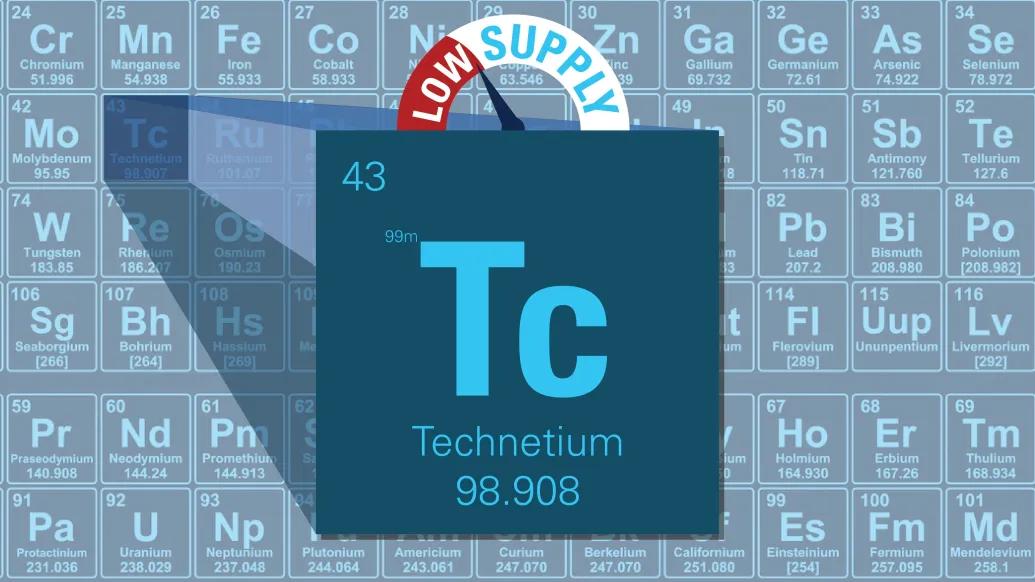
But beginning in October, many patients may not be able to get the best possible test because of a looming shortage of a crucial short-lived radioactive element.
Called technetium-99m or Tc-99m, it's one of the best ways to test for blockages from outside the body. But one of the key sources for U.S. patients will stop producing it in October. And the situation may worsen, depending on what happens in the global nuclear realm.
This means many heart patients could end up getting less precise stress tests, or more invasive, riskier and more costly heart imaging instead, according to University of Michigan Medical School research recently published in JAMA Cardiology.
Researchers led by heart imaging specialist Venkatesh Murthy, M.D., Ph.D., examined data from 2 million Medicare participants who needed heart scans in the four years surrounding a six-month technetium shortage in 2010. The shortage happened when two Canadian plants responsible for much of the U.S. supply went offline.
As hospitals tried to compensate for the shortage, more patients had less precise, thallium-based scans that may have prompted doctors to send them for follow-up using a costly invasive heart-imaging procedure. In fact, the study finds, more than 5,700 additional patients ended up having such procedures — called coronary angiography — during the shortage, exposing them to more risk and radiation.
Murthy recently presented the findings and more to a summit of nuclear experts who are grappling with the issues related to Tc-99m production. He also shared results from a small Canadian study of the 2010 shortage, showing similar patterns.
The National Academy of Sciences also recently published a report on the issue, which adds fuel to the U-M team's warnings and lays out what's known about long-term options for easing the shortage. The NAS report warns of a "substantial (>50 percent) likelihood of severe … supply shortages after October 2016."
"Even under the best of circumstances, this material has quite a complicated supply chain, especially considering the regulations around transporting radioactive materials," says Murthy. "But we rely on Tc-99m as part of stress tests to ensure that we only send the patients for further study and treatment who will benefit the most."
I worry that this issue is not high on the radar, and that there could be a shock to the system if we do not solve the molybdenum supply issue.Venkatesh Murthy, M.D., Ph.D.
Weighing costs versus benefits
His study, conducted with U-M cardiologist Brahmajee Nallamothu, M.D., M.P.H., and team at the U-M Institute for Healthcare Policy and Innovation, looked at the type of stress test known as SPECT myocardial perfusion imaging, which can use Tc-99m or, less precisely, thallium-201.
SEE ALSO: Hospitals Sending Most Heart Patients to ICUs Report Worst Results
They also looked at the use of other heart-imaging techniques including PET (short for positron emission tomography), coronary angiography and stress echocardiography.
During the 2010 shortage, the percentage of SPECT MPI scans done with Tc-99m dropped from 65 percent to 49 percent with thallium used as a substitute. Meanwhile, the rate of patients who went for an invasive coronary angiography within 90 days of having a SPECT MPI scan increased by nearly 10 percent.
Although they can't tell for sure from the data, the researchers say this suggests that patients who had the thallium scans were sent for further testing using the invasive angiography technique because the initial scan gave a false positive for serious blockage. The Canadian study showed a jump in the false positive rate when thallium scans were substituted for Tc-99m scans during the shortage.
Murthy also notes that thallium is less expensive than Tc-99m even when it's widely available. He fears that cost-conscious decisions about purchasing the tracers, as well as worries about a consistent supply, may be driving the overall decline in Tc-99m use that's been seen since the 2010 shortage. But cost-benefit decisions, even as the price of Tc-99m rises when supply shrinks, should include the cost of follow-up tests after a false-positive thallium scan, he says.
The source of the problem
The shortage issue centers on the supply chain for Tc-99m's "parent" element, molybdenum-99, or Mo-99. Right now, it can only be made by processing uranium in a nuclear reactor or particle accelerator. One of those reactors — at Chalk River in Ontario, Canada — will shutter in October.
A steady supply of Mo-99m, which has a half-life of about three days, is needed to make enough technetium to meet world demand. Because Tc-99m's radioactive half-life is just six hours, it must be made from Mo-99 at or near the place where the heart patients get their stress tests. U-M's own hospital receives a shipment once a week.
The U.S. and Russia are the only sources of the highly enriched uranium currently used to make Mo-99 at sites in Canada and Western Europe. But U.S. nuclear policy calls for an end to shipments of HEU outside the country in a few years. Nuclear arms control efforts, aimed at reducing the proliferation of materials that could be used in making weapons, are complicated by regular shipments of highly enriched uranium around the world.
Meanwhile, researchers are seeking alternatives for noninvasive heart imaging with other radioactive substances, or ways to make Mo-99 using low-enriched uranium.
Murthy and his colleagues at the University of Michigan Cyclotron Center have begun making a radioactive form of ammonia using an even smaller cyclotron that went online earlier this year at the U-M Health System. The ammonia can be used in PET heart imaging — a technique that's more accurate than SPECT imaging. In the JAMA Cardiology study, traditional PET imaging accounted for less than 1 percent of all heart imaging in 2012.
"I worry that this issue is not high on the radar, and that there could be a shock to the system if we do not solve the molybdenum supply issue," says Murthy.
"We seem to be increasingly relying on a substance, thallium-201, that should mostly be used as a backup option. Anything that decreases the accuracy of stress testing in the long run could reduce the use of a highly useful and widespread tool for imaging the heart. We need to make informed decisions about this issue."
Murthy discloses that he owns stock in General Electric, Mallinckrodt and Cardinal Health, which are involved in radioactive isotope and cyclotron production. He has consulted for Bracco Diagnostics and Ionetix, which are also involved in radioactive isotope production.

Health Lab
Explore thousands of health news & research stories by visiting the Health Lab homepage for more.
Media Contact

Public Relations
Department of Communication at Michigan Medicine
Stay Informed
Want top health & research news weekly? Sign up for Health Lab’s newsletters today!
Featured News & Stories
Top 7 tips for choosing Medicare prescription drug coverage for 2027

Gene editing is coming for common diseases. Are we ready?

Many older adults make Medicare decisions quickly and most don’t change plans, poll finds
What’s the latest on 7-OH and kratom availability and addiction care?
Better prenatal care data could help prevent maternal complications, experts say