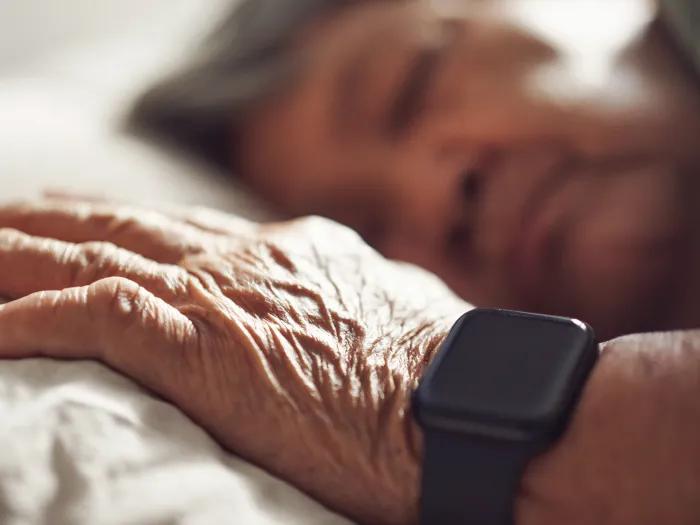
The science behind waking up on the wrong side of the bed
Fitbit data used to monitor mood cycles in new study
11:30 AM
Author |
It’s always darkest before the dawn for many people, and now, a University of Michigan and Dartmouth Health study has investigated the science of waking up on the wrong side of the bed.
The study, which uses the Fitbit data of more than 2,500 training physicians (interns) across two years, found that the interns’ self-reported mood cycles hit their lowest point nearing 5 a.m. and highest point around 5 p.m. Lack of sleep made these mood swings more intense, leading to worse moods and bigger changes in mood throughout the day.
The study, published in the journal PLOS Digital Health, analyzed data from 2,602 medical interns over a two-year period. The researchers measured the interns’ continuous heart rate, step count, sleep data and daily mood scores. The researchers also estimated circadian time and time awake from minute-by-minute wearable heart rate and motion measurements.
“We discovered that mood follows a rhythm connected to the body’s internal clock, and the clock’s influence increases as someone stays awake longer,” said Danny Forger, senior author of the study and a professor of mathematics and of computational medicine and bioinformatics at the U-M Medical School.
“The study highlights the significant role our body’s clock plays in mood and introduces wearable technology as an exciting new way to explore these factors in mental health issues.”
Mood check
The medical interns, part of the Intern Health Study, a multicenter study across the United States involving first-year physicians, also completed a once daily assessment. The interns could complete the assessment at any point in the day, and the assessment consisted of a single question: How was your mood today?
“Mood naturally cycles with lowest point in the morning and highest in the evening independent of sleep deprivation. Sleep deprivation is a separate process that further decreases mood,” said Benjamin Shapiro, lead author of the study and psychiatrist at Dartmouth Health.
“So someone awake all night at 5 a.m. should have an even lower mood than if they just woke up at 5 a.m. However, on a typical day their mood at 5 a.m. will still be lower than that in the evening.”
Time awake
The researchers then plotted the participants’ mood scores against their circadian phase and against their time awake. They found that mood peaked at 5 p.m. and dipped to its lowest at 5 a.m. They also found that mood deteriorated the longer the participants were awake.
“The field of psychiatry has known that sleep and circadian rhythm play an important role in mental health. However, these findings have only been shown in small samples and in artificial laboratory settings,” Shapiro said. “This study generalizes these findings to everyday life across a large number of participants.”
The researchers say their study only looked at a generalized model of mood in medical interns, and that individual variation of mood is more complex and dependent on factors such as social dynamics, schedules and temperaments. Also there were minimal individuals who stayed awake more than 18 hours during a day. Finally, the researchers did not use validated emotional rating scales such as the Depression Anxiety Stress Scale or clinical screening tools.
We discovered that mood follows a rhythm connected to the body’s internal clock, and the clock’s influence increases as someone stays awake longer.’
Wearable trackers
But the researchers did show that noninvasive tools such as Fitbits or other smart watches could be useful in tracking mood disorders and circadian rhythms.
“Rather than requiring invasive blood draws or temperature monitoring, we are able to obtain similar data from an everyday Fitbit,” Shapiro said. “This opens the door for mental health clinicians to utilize circadian rhythm metrics in everyday clinical practice.”
Citation: Unraveling the interplay of circadian rhythm and sleep deprivation on mood: A Real-World Study on first-year physicians, PLOS Digital Health, https://doi.org/10.1371/journal.pdig.0000439
Sign up for Health Lab newsletters today. Get medical tips from top experts and learn about new scientific discoveries every week by subscribing to Health Lab’s two newsletters, Health & Wellness and Research & Innovation.
Sign up for the Health Lab Podcast: Add us on Spotify, Apple Podcasts or wherever you get you listen to your favorite shows.

Health Lab
Explore thousands of health news & research stories by visiting the Health Lab homepage for more.
Media Contact

Public Relations
Department of Communication at Michigan Medicine
Related

Irregular Sleep Connected to Bad Moods and Depression, Study Shows
Stay Informed
Want top health & research news weekly? Sign up for Health Lab’s newsletters today!
Featured News & Stories

New algorithmic tool enables to scientists to see cells “talk” to one another

Why you might be having sleep problems
Michigan Medicine notifies patients of unauthorized access to patients’ medical information via health information exchanges
The link between sleep and mental health

Path to Medicine: Pit Stops on the Way to Medical School