Sanjay Gupta recounts his U-M years and shares life lessons for medical school commencement
The CNN correspondent and best selling author has deep roots in Ann Arbor
5:00 AM
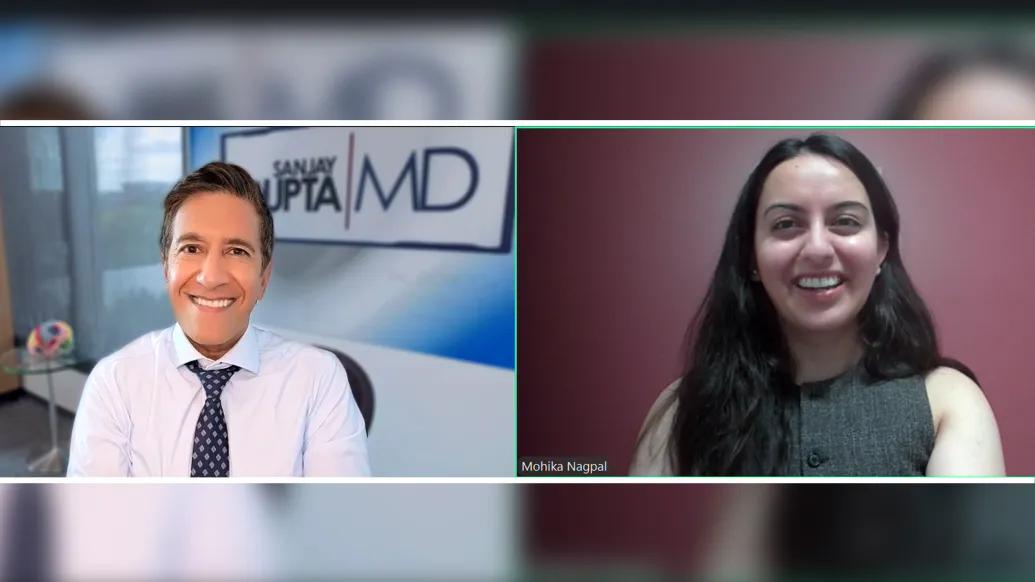
Written by Mohika Nagpal
This year’s University of Michigan Medical School commencement will feature a keynote address from CNN Chief Medical Correspondent Sanjay Gupta (B.S. 1990, M.D. 1993, Residency 2000.)
Here, Gupta speaks about how his time at U-M launched his award-winning career, what advice he would give the graduates and where he likes to visit in Ann Arbor.
Beyond clinical reasoning and the medical sciences, what do you remember taking away from medical school?
Gupta: I think the biggest thing for me, beyond the obvious, was the people that I became friends with and that I have stayed friends with.
We attended each other's weddings and were there for the birth of each other's children; these are my best friends.
And I think it's one of those things you realize when you're going through medical school: Those bonds are pretty unique bonds. They’re hard to forge in other places in society.
Where on that journey was the seed for medical journalism and storytelling planted?
Gupta: I'll never forget, I was taking a class, and one of the assignments was to write a paper about healthcare policy, specifically looking at an issue in health care.
In this case, it was all-cause mortality and comparing it to 14 countries like the United States, which was a big topic for college/medical students at the time.
But I remember thinking it's so interesting to look at the United States from a health care perspective and then compare it to other countries — what works, what doesn't work.
Hardly anybody was writing about it at the time. (This is the early 1990s.)
So, I started to write more about it, in large part because there weren't a lot of people writing about it. I could get published pretty easily.
I think the bug sort of came to me at that point, and it really was healthcare-policy related, but writing about it from a soon-to-be clinician's perspective.
A lot of people that had been writing about it were policy people. They were economists. But to see it and write about it from the inside of a hospital, I thought was pretty interesting.
Why did you choose Michigan in the first place?
Gupta: I have loved Michigan since I was a kid, and it was one of those places that I always aspired to go to if I could get in.
My dad went there. There were a lot of people in our community who had gone there.
I used to go visit Ann Arbor with my dad when I was young and see how much joy that place brought him.
So, there were all these long-standing relationships between me and Ann Arbor and the University of Michigan.
I’m also from Michigan, and when I was thinking about residency, my parents were both dealing with medical challenges at that time.
I'm the oldest son, and the idea of wanting to stay closer to home was very much on my mind.
There were a lot of reasons for me to want to be at Michigan and stay at Michigan.
Do you have any Ann Arbor favorites that you want to shout out?
Gupta: I recently did this sort of minidocumentary — a bunch of us did this — called My Happy Place. People pick their happy places, and mine was Ann Arbor.
I came and spent a week just with this film crew, going around all my happy places.
I'm a big sports fan, so I spent a lot of time in the Big House, Chrysler Arena, and went to a lot of hockey games at Yost.
I lived in several dorms when I was there, crossing over the Diag, studying in the law school, eating at Zingerman's.
I will tell you: My dad came to Michigan in the winter of 1966.
He came as an international student. And right in front of the Michigan Union there used to be this big vent, and it generated heat.
Back in the winter, there was never any snow around it because it was always warm there. So, my dad arrives, and it's winter, and the Student Union was not open.
He had no idea where to go, or what to do. It was freezing outside.
I think it was a holiday and he's from India. He ends up sleeping on that vent.
And when I was younger and we'd go there, he'd always tell me that story: “Look, this is where I slept, my first night in the United States.”
Years later, I gave the commencement address at the Big House for the undergrads.
And the night before that, my dad and I pulled up to State Street.
We got out of the car.
And literally on one side of the car is that grate and on the other side is the dinner that we're now going to, because I’m going to give the commencement address the next day.
No words needed to be said.
I'm like, “Dad, I know exactly what you're thinking.”
Do you have advice for graduating medical students, or a piece of advice you could have given yourself when you were graduating from medical school?
Gupta: It’s such a big transition time in life — there are so many things that are happening — there is a tendency for people to have life become procedural.
I think one thing that I wished I had done more at that stage was probably just reflect on everything that I had just gone through.
It's such a monumental experience to finish medical school, and especially so at a place like Michigan.
Just spend time really reflecting on it and taking notes and connecting with people.
Really make sure that the friendships that you've made are friendships that you're going to keep.
The other thing I would say is that you've gone to a great medical school. You will have doubts.
You will have doubts about how good you are, whether or not you can do the job that you're intending to do.
You absolutely can.
Do you have any advice or pointers for me and others who are interested in public communication and might want to do what you do someday?
Gupta: I think it's a great field.
When I started doing this kind of work, there weren't a lot of people like me, and frankly, I think there are a lot of people within medicine who were skeptical of being able to combine these two worlds.
It feels very different now.
I do think residency, like medical school, is a pretty special time.
Even if you're getting involved in medical journalism or medical communications later on in life, it makes a lot of sense to be fully dedicated to your residency.
People will value you more if you're a fully trained and very proficient doctor.
I never wanted to give up medicine. I love being a doctor.
Sign up for Health Lab newsletters today. Get medical tips from top experts and learn about new scientific discoveries every week.
Sign up for the Health Lab Podcast. Add us wherever you listen to your favorite shows.

Health Lab
Explore a variety of health care news & stories by visiting the Health Lab home page for more articles.
Media Contact

Public Relations
Department of Communication at Michigan Medicine
Stay Informed
Want top health & research news weekly? Sign up for Health Lab’s newsletters today!
Featured News & Stories
University of Michigan implants first-in-human Paradromics wireless brain-computer interface, designed to restore communication
Helping an employee-turned-patient overcome a brain tumor

Beyond the White Coat: Finding Your Voice at the Patient’s Bedside
Alum reconnects to his roots through Doctors of Tomorrow scholarship fund
Getting to know the new Medical School dean, Thomas J. Wang, MD