Sam’s Michigan Answer: A medical school that sees him as a champion
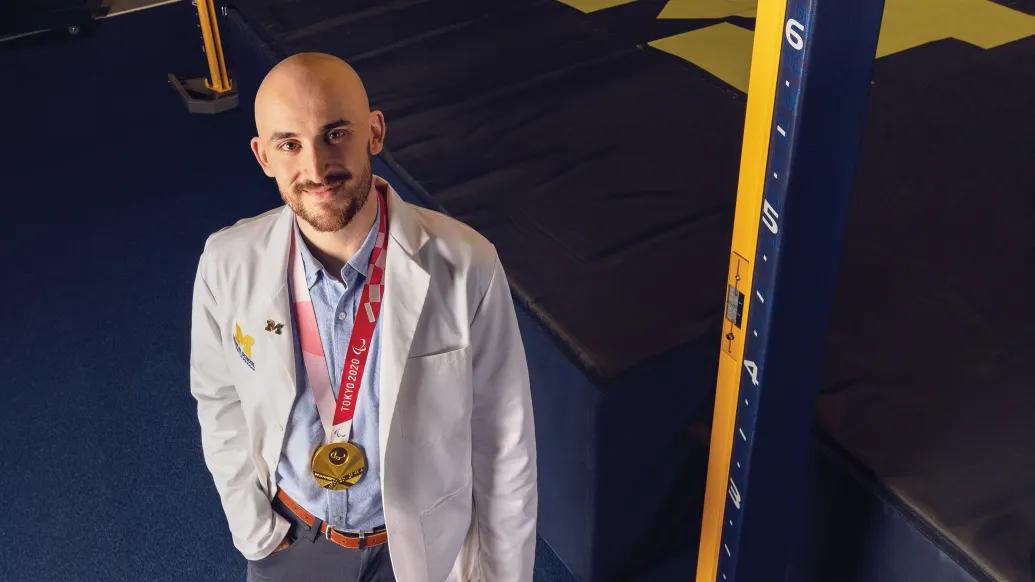
It had been raining on Sam Grewe for hours. His shoes were soaked. The custom-made prosthetic leg below his right thigh was beginning to fail.
And the massive Olympic stadium, which usually was filled with fans shouting their encouragement, was ghostly quiet under pandemic restrictions.
And yet, as Sam stood contemplating his third and final attempt at clearing 1.88 meters, a height that could win him the Paralympic gold medal, he only had one phrase running through his mind…
“Why not me? Why not right now?”
With that mantra powering him, he exploded toward the bar and pushed off into the air. He closed his eyes and…
“I kind of blacked out for the jump, woke up on the mat and the bar was still there,” Sam recalls with a smirk.
He had just won a gold medal, completing a journey that started 10 years earlier with a cancer diagnosis that eventually would lead him around the globe through world championships, Olympic stadiums and to his current adventure: medical school at the University of Michigan.
“In seventh grade, I started to experience a sharp pain in my right knee. I assumed it was growing pains, but it got worse. And when these kinds of bumps started to form, we decided, ‘Let’s go get it checked out.’”
An x-ray showed a fist-sized tumor on his distal femur. A subsequent biopsy revealed it was osteosarcoma, a prevalent form of bone cancer in children.
After 21 sessions of chemotherapy failed to eliminate the tumor, and with his body breaking down from the taxing treatment, Sam made one of the hardest decisions anyone, especially a 13-year-old, would have to make.
“I’m in middle school. I’m not going to be pumped to cut my leg off. That’s crazy. But after a few weeks of thinking about what I wanted my life to look like, what I wanted my lifestyle in the future to be, it became clear that going through with the amputation would be the best chance of doing those things. I wanted to return to sports, and I wanted to be active throughout my life.”
Sam proceeded with above-the-knee amputation and rotationplasty, where his ankle was joined to his thigh to function as his new knee.
And after two years of rehabilitation, he did return to sports—basketball, lacrosse and something new and exciting.
“My dad heard of an adaptive sports competition taking place outside of Chicago. It was for track and field, and I’d never done anything Paralympics-wise. I pretty quickly fell in love with high jump, and within the next year I was on the national team and won a world championship in Doha, Qatar.”
But as Sam resumed excelling in sports, he realized his hospital journey had sparked a completely different passion.
“I spent two years in the hospital. During that time, I got to experience so many of the intangibles of medicine. You know, what goes into making a really good doctor, a really great healthcare worker beyond just bedside manner. The compassion that goes on behind the scenes.”
Sam packed those observations away as he focused on high school and his new love for competing in the high jump.
But after graduation, he decided a career in medicine was something he would like to pursue. With a bachelor’s degree at Notre Dame completed, he turned to choosing a medical school.
“I kind of looked back to my time in the hospital and realized I had never interacted with a single healthcare worker with a disability.”
Sam’s observation was astute. Students with disabilities continue to be an underrepresented group at medical schools nationally. It’s a fact that Sam began to personally research and one that solidified his interest in attending the University of Michigan Medical School.
“Michigan is really, really passionate about diversity, equity and inclusion, and I think one of the best things is disability is included in that conversation. So many other institutions don’t recruit people with disabilities. We are 20% of the population and yet only 1% of new physicians identify with having a disability.”
As part of a 5-year plan launched in October 2020, Michigan Medicine hopes to continue to shift the climate of DEI both for patients and students like Sam. By working directly with the disability community to develop practical tools, create protocols and provide practical information, Michigan Medicine is positioned as a leader to diversify the next generation of physicians, nurses, health professionals and scientists.
This openness to making sure Sam was recognized and included is not something he felt everywhere he applied.
“When I was interviewing at some other schools, everything just seemed like it was the way it’s always been. ‘Why do we need to change now?’ They’re traditional. They’re set in stone. Michigan is ready to adapt. They’re ready to grow. They’re ready to change to the needs of their students.”
One of easiest and most effective ways Michigan has made sure Sam’s voice is heard is by continually asking for his feedback and ideas.
Steven E. Gay, MD, MS, Interim Associate Dean of Medical Student Education, eagerly shares why this is so important.
“We look for learners here at the University of Michigan Medical School who will uniquely contribute to the field of medicine. This is based on the context of their journey to medicine that they exhibit through their diversity, their passion for being a part of the world around them and how they hope to make positive change as they continue their journey. It is not for us to define it for them, but to give them all that they may need to realize it.”
In July of 2021, Sam and his long-time girlfriend Mady (also an incoming medical student at Michigan) had their official white coat ceremony, which symbolized the beginning of medical school. A few weeks later he left for the Paralympic Games in Tokyo.
When asked what felt more remarkable: getting to wear his white coat for the first time or slipping that gold medal over his head, Sam answers carefully.
“I mean they’re both just so special, and it didn’t always seem possible for either of them to take place. The white coat ceremony was just kind of a full circle moment. I’ve spent a significant portion of my life as a patient and now to take that official step into filling the role and moving to the other side of the bed… it’s just so cool.”

Health Lab
Explore a variety of health care news & stories by visiting the Health Lab home page for more articles.
Featured News & Stories

The Race to Uncover the Hidden Causes of Idiopathic Pulmonary Fibrosis

Beyond the White Coat: Finding Your Voice at the Patient’s Bedside
Alum reconnects to his roots through Doctors of Tomorrow scholarship fund
Medicine, music, and crossword puzzles
Getting to know the new Medical School dean, Thomas J. Wang, MD