Routine blood test leads to life saving osteosarcoma diagnosis
Mike Nagle’s osteosarcoma was detected during routine lab work, before he ever had symptoms. Now, after chemotherapy and extensive surgery, he reflects on his journey as one of miracles
5:00 AM
Author |

As Mike Nagle tells it, his story is one of miracles.
In early 2021, after delaying labs because of the risk of COVID-19, Nagle underwent routine lab work to check his kidney function, which revealed microscopic hematuria, or red blood cells in the urine.
In the first of many decisions that would set the tone for his treatment, Nagle decided to be aggressive.
“They said I could either retest in 60-90 days or I could go right away to a cystoscopy and CT scan. I chose the latter,” he said. The test results revealed evidence of cancer, but scans were unable to find the precise source.
“Prostate, bladder, kidneys; it all looked fine,” he said. However, doctors did find a bone lesion on Nagle's left pelvic bone, indicating either metastatic cancer or primary bone cancer.
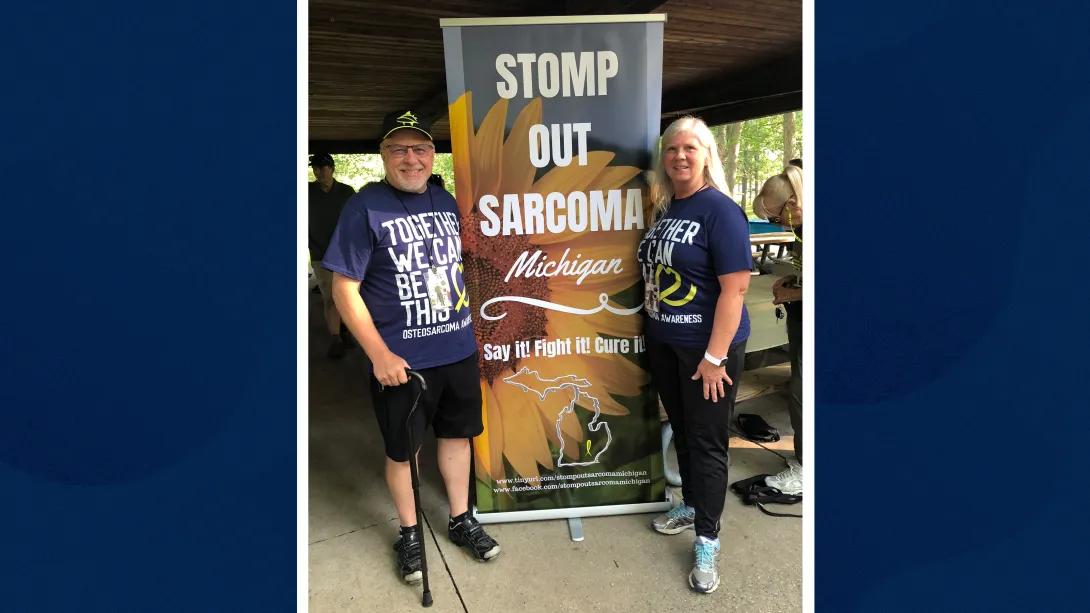
Nagle saw orthopedic oncologist Geoffrey Siegel, M.D., assistant professor of orthopedic surgery at Michigan Medicine, during a rotation at a U-M clinic in Bay City.
Siegel diagnosed the lesion as a high-grade osteosarcoma, an aggressive and rare form of bone cancer, though Nagle showed no signs of symptoms – no muscle weakness, pain or numbness. With no symptoms to alert him to any problems, Nagle is grateful for the initial routine bloodwork given the severity of his diagnosis.
“This kind of cancer is so aggressive,” he said. “My lesion doubled in size in five weeks.”
Nagle went on to receive intensive chemotherapy to shrink the tumor before surgery. He credits his faith for guiding him through that time.
“During chemo, my days were never measured by how I felt as much as how I lived, because no matter how I felt, I wanted to live in a way that honored God. That was that was really freeing for me.”
To manage his symptoms from treatment, Nagle also relied on his community to help tackle the social isolation that can accompany feeling unwell.
“I was intentional about building bridges and not putting up walls,” he said.
This strategy helped when interacting with his care team too.
During treatment, Nagle dealt with uncomfortable gastrointestinal symptoms and felt at a loss for how to find relief.
He connected with Nancy Burke, R.D.N, registered dietician with the Rogel’s Nutrition Services, who Nagle calls a “godsend.”
The solution turned out to be simple.
“I’d been told to eat fiber like oatmeal to help, but Nancy informed me that was the worst thing I could do. She explained the difference between soluble and insoluble fiber, and told me to switch to bran cereal instead. I did and it helped right away. I didn’t have another issue since then,” he said.
“It was relatively simple but for me it was a gamechanger.”
"My Progress is a Miracle”
In September 2021, after finishing chemotherapy, Nagle underwent surgery to remove 70% of his pelvic bone.
Doctors informed him he’d likely have chronic back pain the rest of his life and there was a chance his leg would need to be amputated.
Ahead of surgery, Nagle, who worked for the research company ProQuest, researched the surgery.
He found a biomedical engineer who worked with veterans undergoing reconstructive surgery and reached out about the possibility of a prosthetic.
“He told me, you don’t want to ask about a prosthetic,” Nagle explained.
“He said, what you need to ask your surgeons is ‘are you going to 3D print my pelvic bone to plan the surgery?'”
The engineer told Nagle that using 3D printing could help identify tricky arteries and nerves to avoid and reduce the overall amount of time in surgery, leading to a better outcome.
Nagle hadn’t yet relayed the news to Siegel when he had his second MRI, revealing that the lesion had grown again.
“Dr. Siegel called me and told me to get a CT scan right away. He told me he was sending the MRI image to get a 3D printed model of my pelvic bone. It was surreal.”
The 3D printed model led to a titanium prosthetic, which required a trial surgery given how new the treatment is.
For Nagle, the toughest part of surgery was knowing that afterwards he’d experience pain and discomfort that he had never experienced before or since the diagnosis.
For most patients, surgery can help alleviate symptoms, but Nagle had no symptoms related to the bone lesion.
“Dr. Siegel tried to prepare me as much as he could but after the surgery, I lay there thinking, what did I just do,” Nagle remembered.
A few months later, Nagle began physical therapy where the therapist told him success meant that he’d one day walk with a walker.
But Nagle was determined to regain more of the mobility he lost with surgery.
Now, he walks with a cane.
“My progress is a miracle,” he said. “It’s gone way beyond what anybody ever expected.”
He attributes this miracle first to his faith.
“Through it, I’ve learned to push the envelope when people say something is impossible. I’ve learned to advocate for myself, to ask questions, to challenge the doctors, respectfully, when necessary. And it’s taught me to trust my instincts. I’m grateful to be where I am.”
Sign up for Health Lab newsletters today. Get medical tips from top experts and learn about new scientific discoveries every week
Sign up for the Health Lab Podcast. Add us wherever you listen to your favorite shows

Health Lab
Explore thousands of health news & research stories by visiting the Health Lab homepage for more.
Media Contact

Public Relations
Department of Communication at Michigan Medicine
Stay Informed
Want top health & research news weekly? Sign up for Health Lab’s newsletters today!
Featured News & Stories
Specialized care helps patient navigate rare liposarcoma diagnosis

New oral nanomedicine boosts effectiveness of cancer immunotherapies
Blood-based multi-cancer screening tests: Ready for primetime?
Medical students develop novel technological solutions for unmet patient needs

Gratitude inspires gift to improve survivorship care