Researchers zero in on therapeutic target for aggressive uterine cancer
A common mutation in a rare cancer subtype leads researchers to an already-approved drug that shows promise against uterine serous carcinoma.
10:00 AM
Author |
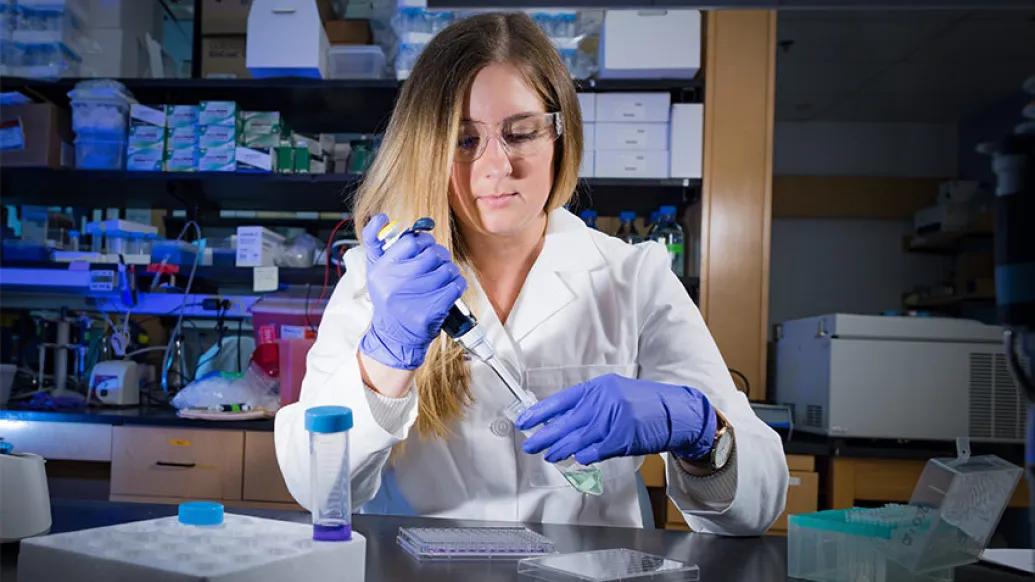
A team of scientists led by the University of Michigan Health Rogel Cancer Center has found that a class of United States Food and Drug Administration-approved drugs can effectively stop a highly aggressive type of uterine cancer in its tracks, paving a quick path toward new treatment strategies for a deadly cancer with limited therapeutic options.
Collaborating with researchers from Case Western Reserve University and Memorial Sloan Kettering Cancer Center, the team showed that ribonucleotide reductase, or RNR, inhibitors target two mutations in the gene that encodes the tumor suppressor PP2A, present in up to 40% of uterine serous carcinomas.
The team reported its findings in Cancer Research.
Uterine cancer is the most common gynecologic cancer with more than 60,000 cases diagnosed each year in the U.S. The endometrioid subtype is most common and in general responds well to targeted immunotherapies. By contrast, the uterine serous subtype has few genetic mutations that would make it a candidate for targeted therapies, and patients face rapid disease progression and a dire prognosis.
"While uterine serous carcinoma represents only 10% of uterine cancers, it accounts for the majority of deaths. We showed that the PP2A mutation is common in uterine serous carcinoma, and we found a potential new treatment option for these patients," said first author Caitlin O'Connor, Ph.D., a research fellow in the Division of Genetic Medicine at Michigan Medicine. "We can rapidly translate this bench work to patients."
PP2A is a tumor suppressor, stopping cancer growth much like the brakes on a car. In previous studies, the team showed that about a third of uterine serous carcinomas harbor two mutations that disable the brake, said senior author Goutham Narla, M.D., Ph.D., chief of genetic medicine at Michigan Medicine. "We asked ourselves, how can we take advantage of these mutations?"
To start, the researchers ran a high-throughput screen of 3,200 drug compounds against uterine serous cell samples from patients with recurrent cancer. The results showed that a family of anti-cancer drugs called ribonucleic reductase inhibitors killed cancer cells that harbored the mutations.
Researchers then narrowed their focus to one of the drug screen hits, the RNR inhibitor clofarabine, and tested it in a mouse model of uterine serous carcinoma. RNR inhibitors interfere with the growth of tumor cells by blocking the formation of DNA. Consistent with the cell-based data from the drug screen, clofarabine shrank the tumors in mice.
To further explore RNR inhibition as a potential therapeutic strategy for uterine serous carcinoma, the team did a retrospective analysis of patients treated with the RNR inhibitor gemcitabine as a later-line therapy for this subtype, compared to patients with the endometrioid subtype. "We found that the uterine serous carcinoma-type patients actually did better than the endometrioid patients," O'Connor said.
There is currently only one first-line chemotherapy for uterine serous carcinoma: carboplatin, Narla noted. "This type of uterine cancer has a short progression, and it's a particularly lethal form, so we want to find a drug that will work earlier on in disease progression and find a molecular way to target the cancer. We believe we may have that here," he said.
The research team is now planning to begin a clinical trial of gemcitabine in patients with uterine serous carcinoma. They also plan to extend this work to other cancers that harbor the PP2A mutations, including lung, colon and ovarian cancer.
Additional authors include Sarah E. Taylor of Case Western Reserve University; Kathryn M. Miller and Dmitriy Zamarin of Memorial Sloan Kettering Cancer Center; Fallon K. Noto of Hera BioLabs, Inc.; Lauren Hurst, Terrance J. Haanen, Tahra K. Suhan, Kaitlin P. Zawacki, Jonida Trako, Arathi Mohan, Jaya Sangodkhar and Analisa DiFeo of the University of Michigan.
The research was supported by grants from the National Institutes of Health (R01 CA-181654, R01 CA-240993, T32 CA-009676), and funding provided by the Rogel Cancer Center.
O'Connor and Narla are named inventors on a U.S. provisional patent application concerning compositions and methods for treating high grade subtypes of uterine cancer. O'Connor, Suhan, Zawacki and Sangodkar are consultants for RAPPTA Therapeutics. Narla is chief scientific officer of, reports receiving commercial research support from and has ownership interest in RAPPTA Therapeutics and is an adviser to Hera BioLabs. Zamarin reports research support to his institution from Astra Zeneca, Plexxikon, and Genentech, and personal/consultancy fees from Synlogic Therapeutics, GSK, Genentech, Xencor, Memgen, Immunos, Celldex, Calidi, and Agenus, and is an investor on a patent related to use of oncolytic Newcastle Disease Virus for cancer therapy.
Paper cited: "Targeting ribonucleotide reductase induces synthetic lethality in PP2A-deficient uterine serous carcinoma," Cancer Research. DOI: 10.1158/0008-5472.CAN-21-1987

Health Lab
Explore thousands of health news & research stories by visiting the Health Lab homepage for more.
Media Contact

Public Relations
Department of Communication at Michigan Medicine
Stay Informed
Want top health & research news weekly? Sign up for Health Lab’s newsletters today!
Featured News & Stories

The AI is listening: Implications of machine generated clinical notes on health care

Liver cancer can be preventable. Do you know the treatable risk factors?

$3.9 million NIH grant to fuel U-M effort to develop first targeted therapy for fatal childhood brain disorder

15 years of data will help uncover how flu spreads—and how to reduce its impact

Bigger data reveals the second, third and fourth switches controlling a gene