Researchers identify cellular pathways that drive precancerous lesions to form pancreatic tumors
Decreased NADPH production, which powers cellular processes, results in cancer progression
5:00 AM
Author |
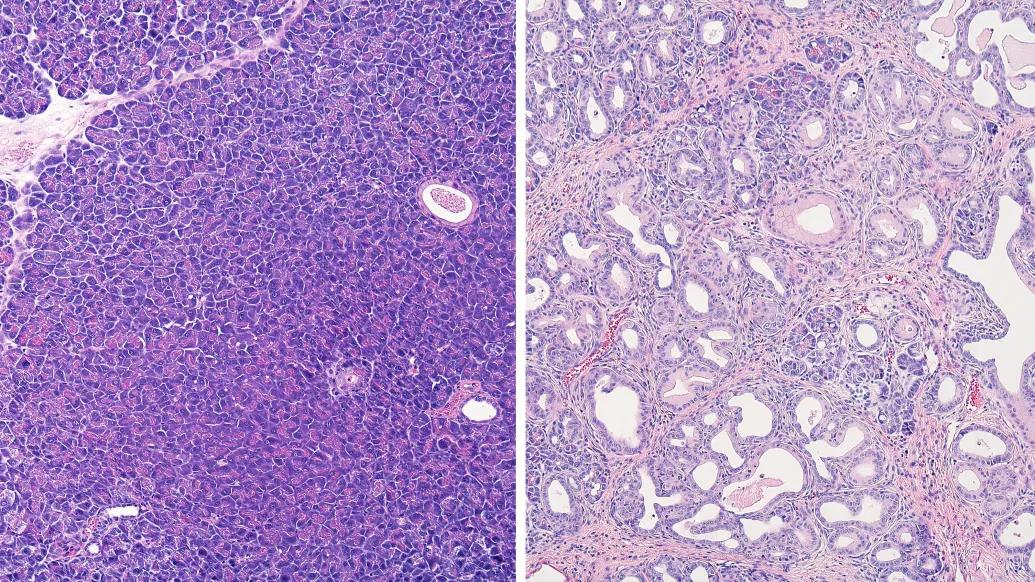
Pancreatic ductal adenocarcinoma is the most common type of pancreatic cancer and has a low five-year survival rate.
It begins with a reversible state called acinar-to-ductal metaplasia, where cells can heal after injury or inflammation.
If there are cancer-causing mutations, metaplasia can continue progressing towards cancer.
In a new study published in Nature Metabolism, researchers identified cellular pathways that can influence metabolic changes when cells progress from metaplasia to cancer.
Their results could help researchers treat benign lesions before they become tumors.
“We know a lot about how pancreatic tumors behave and look, but we don’t know how they become cancerous,” said Megan Radyk, Ph.D., a former Postdoctoral Fellow in the Lyssiotis lab and Assistant Professor at Roswell Park Comprehensive Cancer Center.
“We wanted to learn about what metabolic changes happen before you get an established tumor.”
In the current study, the researchers conducted RNA-sequencing to identify what cellular pathways are important for metaplasia and precancerous lesions in the pancreas.
They found that two enzymes—glucose-6-phosphate dehydrogenase and malic enzyme 1—were present at higher levels.
Using mouse models, the team found that decreased activity of glucose-6-phosphate dehydrogenase increased the number of precancerous lesions.
They found similar results in mouse models that did not have malic enzyme 1.
We know a lot about how pancreatic tumors behave and look, but we don’t know how they become cancerous."
- Megan Radyk, Ph.D.
Both enzymes make NADPH, a molecule that cells use to build lipids and nucleic acids like DNA and RNA.
NADPH also helps cells lower the amount of lesion-forming reactive oxygen species.
The researchers found that when pancreatic cells have lower levels of glucose-6-phosphate dehydrogenase and malic enzyme 1, their levels of reactive oxygen species were higher.
The increased precancerous lesion formation could be prevented by treating the cells with the antioxidant glutathione or animals with the antioxidant N-acetyl cysteine.
The results were the same in pancreatic tissues from human donors.
While both enzymes make NADPH, the researchers observed that loss of only malic enzyme 1 caused progression into cancer.
“This difference highlights why it’s important to understand what metabolic pathways are important during each stage of cancer progression,” Radyk said.
The researchers are interested in identifying other enzymes that might influence the amount of NADPH in the cell, as well as druggable metabolic pathways that enable disease transformation.
They will also investigate whether patients who have mutations in either enzyme have an increased risk of pancreatic disease.
“Our study can help the search for new biomarkers that can intercept pancreatic cancer before it progresses,” said Costas Lyssiotis, Ph.D., Professor of Molecular and Integrative Physiology and Co-Director of the Rogel and Blondy Center for Pancreatic Cancer.
“Depending on the level of these enzymes, we could also identify a patient’s risk for developing cancer.”
Additional authors: Barbara S. Nelson, Mariana Tannus Ruckert, Christopher J. Halbrook, Mengrou Shan, Jonathan M. Alektiar, Brooke L. Lavoie, Lucie Salvatore, Wei Yan, Matthew D. Perricone, Kathryn Buscher, Alexander Wood, Hanna S. Hong, Peter Sajjakulnukit, Li Zhang, Gabriel Corfas, Filip Bednar, Timothy L. Frankel, Marina Pasca di Magliano, Justin A. Colacino, Yatrik M. Shah and Howard C. Crawford.
Funding/disclosures: This study was funded by T32HD007505, F32CA275283, K99GM159354, T32DK094775, T32CA009676, the Sky Foundation, R37CA283575, the Tower Cancer Research Foundation Career Development Award, P30CA062203, F32CA247492, the Department of Molecular & Integrative Physiology Summer Undergraduate Research Fellowship, T32CA009676, T32CA140044, CA271510, the Association of Academic Surgery, the Association of VA Surgeons, the American Surgical Association Foundation, R01CA268426, R01DK128102, U01CA274154, VA BLR&D Merit Award 5I01BX005777, U54CA274371, R01CA271510, R01CA275182, R01CA268426, R01ES028802, R21CA273646, P30ES017885. The work was also supported by NIH grants R01CA148828, R01CA245546, R01DK095201, R01CA247516, U01CA224145, U01CA274154, the Sky Foundation, R37CA237421, U54CA274371, U01CA274154, the UMCCC Core Grant P30CA046592, the DOD Idea Development Award PA240250, R01CA248160, the Stephenson Global Pancreatic Cancer Research Institute, the Emerald Foundation (C.A.L.), the Rogel and Blondy Center for Pancreatic Cancer, the Pancreatic Cancer Action Network/AACR Pathway to Leadership award 13-70-25-LYSS, the V Foundation for Cancer Research V2016-009, the Sidney Kimmel Foundation for Cancer Research SKF-16-005, the AACR NextGen Grant 17-20-01-LYSS
Tech transfer(s)/Conflict(s) of interest: In the past three years, Lyssiotis has consulted for Astellas Pharmaceuticals, Odyssey Therapeutics, Third Rock Ventures, and T-Knife Therapeutics, and is an inventor on patents pertaining to Kras regulated metabolic pathways, redox control pathways in pancreatic cancer, and targeting the GOT1-ME1 pathway as a therapeutic approach (US Patent No: 2015126580-A1, 05/07/2015; US Patent No: 20190136238, 05/09/2019; International Patent No: WO2013177426-A2, 04/23/2015). Corfas was scientific founder of Decibel Therapeutics, had equity interest in the company, and received compensation for consulting.
Paper cited: “NADPH-producing enzymes restrict the formation of pancreatic precancerous lesions,” Nature Metabolism. DOI: 10.1038/s42255-026-01496-x
Sign up for Health Lab newsletters today. Get medical tips from top experts and learn about new scientific discoveries every week.
Sign up for the Health Lab Podcast. Add us wherever you listen to your favorite shows.

Health Lab
Explore thousands of health news & research stories by visiting the Health Lab homepage for more.
Media Contact

Public Relations
Department of Communication at Michigan Medicine
In This Story
Costas A Lyssiotis, PhD
Professor
Related

Diagnosed with pancreatic cancer: Now what?
Study shows how smoking drives pancreatic cancer
Stay Informed
Want top health & research news weekly? Sign up for Health Lab’s newsletters today!
Featured News & Stories
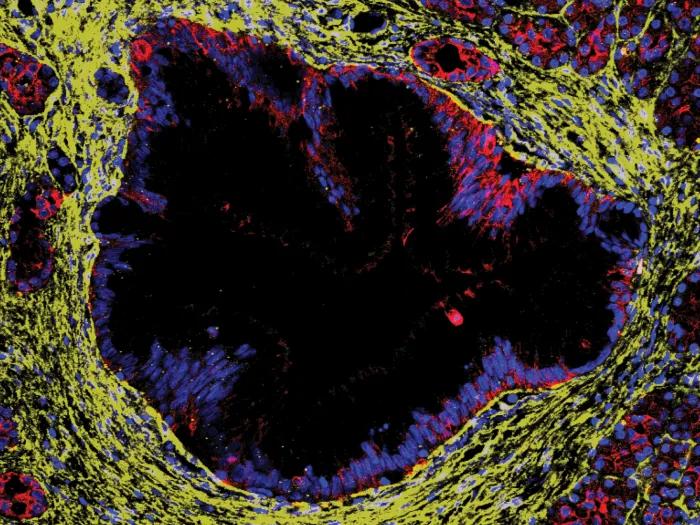
Study sheds light on how early pancreas lesions become cancerous
New dual-target drug may help overcome immunotherapy resistance in pancreatic cancer
Gut microbiome may influence how patients with pancreatic cancer respond to treatment

Online resources and coaching helped people seek genetic testing for cancer
Comprehensive DNA sequencing reveals hidden drivers of cancer