Researchers determine how cells prevent RNA traffic jams under stress
It’s a discovery that could help fight disease
5:00 AM
Author |
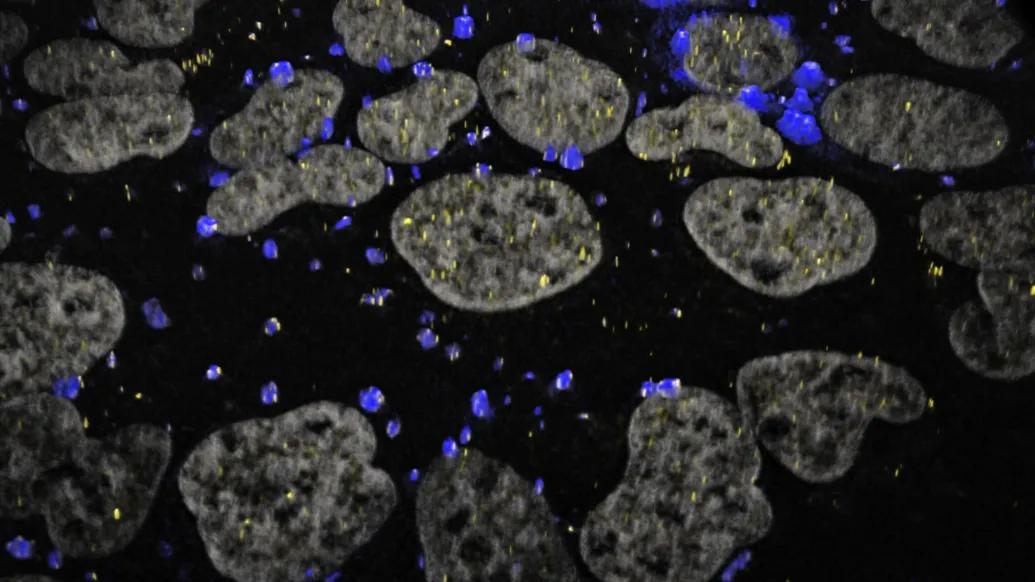
A University of Michigan study offers fresh insights into how cells manage molecular crises.
The study is from the lab of Stephanie Moon, Ph.D., assistant professor of Human Genetics at U-M Medical School, who has for years focused on how cells respond to stress.
In healthy cells, most RNA molecules are covered with ribosomes, which function like miniature factories, translating genetic instructions in RNA into the proteins essential for cellular function.
When cells are stressed by heat, toxins, inflammation, or other challenges, most cellular processes, including protein production, are temporarily shut down to help the cell survive.
Ribosomes typically detach or “run off” RNAs as part of this response.
These unprotected RNAs then clump together in blobs called “stress granules,” which act as temporary storage sites until conditions return to normal.
However, certain mRNAs (messenger RNAs) need to be expressed during stress to help the cell recover and adapt.
“These specialized mRNAs are like emergency vehicles speeding toward a wreck on an interstate highway where they can quickly respond,” said Moon.
“The ‘regular’ traffic (other mRNAs) is sent off the road (into granules) during the crisis.”
Before this study, it wasn’t clear if or how these specialized mRNAs were kept out of stress granules. While many previous studies hinted that translation of these mRNAs during stress would exclude them from stress granules, other recent studies found evidence that these mRNAs could translate inside stress granules.
In the study, described in a paper in the journal Genes & Development and first authored by Ph.D. candidate Noah Helton, showed that these vital mRNAs escape stress granules by interacting with ribosomes.
Trapping these mRNAs in stress granules would halt their protein production at a time when the cell may need them most.
Understanding the integrated stress response pathway is paramount, since disruptions in stress granule dynamics are implicated in neurological diseases (including ALS), cancer, and other conditions where cells are exposed to this heightened state or “chronic” stress.
Given these stakes, the team posed a crucial question: What enables certain mRNAs to stay out of stress granules?
Scientists already knew that uORFs (upstream open reading frames) — “extra instructions” or special sequences found at the front, 5' untranslated region of certain mRNAs — can promote ribosome recruitment and their attachment to mRNAs.
Helton and his team wanted to dig deeper to determine whether uORFs help certain mRNAs keep or attract ribosomes during stress and therefore avoid the stress granule sand trap.
To test this, Helton and the team used chemical inhibitors, single molecule imaging of cellular mRNAs, live-cell imaging with fluorescent proteins, and engineered RNA “reporters.”
They confirmed that the presence of a uORF leads to greater ribosome association with mRNAs under stress.
Their experiments showed that removing the uORF resulted in a loss of ribosome association, and the RNA was then much more likely to end up in a stress granule.
Surprisingly, they also found that even just one ribosome lingering on an mRNA is enough to protect the mRNA from condensation into a granule.
Scientists had previously thought that an RNA strand needed to have multiple ribosomes attached to avoid being silenced in a stress granule.
The new findings from the Moon Lab turn that theory on its head, that even a single ribosome is sufficient to keep an mRNA out of stress granules and allow it to continue making proteins.
Co-author Benjamin Dodd, Ph.D. explained: “If you think of RNA as a string and the ribosome as a bead, it has been the prevailing thought that multiple beads on the string act as a ‘shield’ against the formation of stress granules because there are so many beads. However, what this paper reveals is that having just one bead — or ribosome — on the string (RNA) does the same thing.”
Furthermore, the team clarified how even a tiny, 6-nucleotide change to remove start codons from a uORF would drive an mRNA into a granule.
The fundamental insights gained from the Moon Lab’s study could ultimately help inform the development of new treatments and therapeutic interventions to maintain healthy protein synthesis in diseases where the stress response goes awry.
“We’re excited to further explore the interplay of uORFs and RNAs and learn more about how this single ribosome can prevent mRNA from tangling and forming stress granules,” said Helton.
Funding/disclosures: Supported by National Institute of General Medical Sciences (R35GM146711) and the Chan Zuckerberg Initiative
Paper cited: “Ribosome association inhibits stress-induced gene mRNA localization to stress granules.” Genes & Development. DOI: 10.1101/gad.352899.125

Health Lab
Explore thousands of health news & research stories by visiting the Health Lab homepage for more.
Media Contact

Public Relations
Department of Communication at Michigan Medicine
In This Story

Stephanie Moon, PhD
Assistant Professor
Stay Informed
Want top health & research news weekly? Sign up for Health Lab’s newsletters today!
Featured News & Stories

The AI is listening: Implications of machine generated clinical notes on health care
Comprehensive DNA sequencing reveals hidden drivers of cancer
‘Molecular glue’ stabilizes protein that inhibits development of non-small cell lung cancer and uterine cancer

Many older adults make Medicare decisions quickly and most don’t change plans, poll finds
What’s the latest on 7-OH and kratom availability and addiction care?