Research reveals patient attitudes toward devices like smartwatches
An expert Q&A on wearable technology and sleep apnea
5:00 AM
Author |
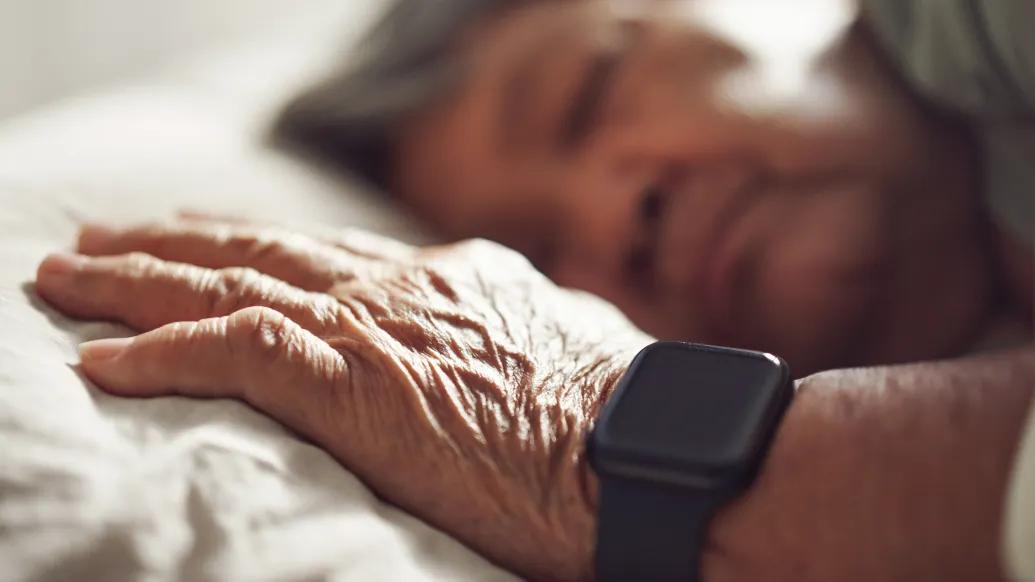
Last year, two popular smartwatches—the Samsung Galaxy Watch and Apple Watch—received Food and Drug Administration approval for features that can potentially alert the wearer they may have sleep apnea.
These “wearables” join products like the Oura Ring in an increasingly crowded field of sleep-tracking hardware.
Can these products help patients who already know they have sleep apnea and are receiving treatment?
That question was central to a recent paper from Michigan Medicine researchers, published in the Journal of Clinical Sleep Medicine.
Lead author Nicholas R. Lenze, M.D., M.P.H., answered questions about how—and who—these technologies potentially help.
Why study consumer sleep technology?
Lenze: Recently there's been a lot of developments with wearable technology. Naturally, we think about how this can help our patients with obstructive sleep apnea.
Could these technologies be used to help detect obstructive sleep apnea in individuals who haven’t yet been diagnosed?
That's an important question because some studies estimate that up to 80% of the population with sleep apnea in the U.S. is undiagnosed.
Other uses of this technology could be to monitor response to treatment of obstructive sleep apnea, such as CPAP or surgical therapy, including the hypoglossal nerve stimulator.
The goal of our survey-based study was to query individuals with a history of obstructive sleep apnea about their patterns of consumer sleep technology use and how it can be used in the setting of obstructive sleep apnea, including monitoring of treatment response.
And we wanted to take it a step further and see if there were any differences based on demographic characteristics of individuals or socioeconomic background.
Not all these technologies are affordable, and we don’t want the technology to exacerbate any existing disparities in obstructive sleep apnea.
What specific findings did you make related to interest and access?
Lenze: One of our key findings was that 92% of individuals indicated that they thought monitoring treatment OSA treatment response would be a useful feature of consumer sleep technology.
So there does seem to be a broad interest.
And then building off that, we found that very few respondents were willing to pay more than $100 for consumer sleep technology.
People are looking for affordable, accessible options.
There’s no doubt that these technologies will expand access to the number of people who would probably otherwise go undetected with sleep apnea.
But you could imagine how consumer sleep technology could exacerbate disparities in the detection or treatment of sleep apnea, especially if it is not accessible or affordable for everyone.
For example, another finding of our study was that individuals with an annual household income less than $30,000 were less likely to use consumer sleep technology.
Is there any evidence that wearables have started to reduce that high percentage of undiagnosed people with sleep apnea?
Lenze: This is an emerging area of research.
Providers are seeing an increasing number of patients who bring their wearables to clinic for help with interpreting the data. It is yet to be determined if this will lead to an increase in the detection of sleep apnea.
It is important to note that this technology does not replace sleep studies.
Rather, it can identify which individuals are at risk of sleep apnea, who should then undergo further evaluation by a provider which may include a diagnostic sleep study.
That being said, if somebody’s Apple Watch tells them, “You have some breathing disturbances and should probably go see a provider,” that doesn't guarantee they'll automatically have access to a provider.
So even though the device potentially identifies a problem, those patients don’t necessarily have the resources to find a solution.
One of our conclusions was that when we're testing these new products, we really need to include stakeholders from different segments of the population—whether that be different geographical settings, gender diversity, racial diversity, socioeconomic diversity, etc.
Are there advantages to wearables combined with traditional sleep studies, compared to sleep studies alone?
Lenze: One advantage of consumer sleep technology is that it is more longitudinal, so it collects data anytime the patient wears it, which is often over multiple nights—and it also collects daytime data when the patients are awake.
We know that sleep can be quite variable across different nights, so longitudinal data from consumer sleep technology may be a more realistic estimate of an individual’s overall sleep than a single night sleep study.
Another area of interest is the relationship between sleep and cardiovascular health.
Patients with obstructive sleep apnea have an increased risk of adverse cardiovascular events such as heart attack or stroke.
We know that obstructive sleep apnea can affect cardiovascular metrics, such as heart rate variability, both during sleep and wake.
Some wearable technologies measure heart rate variability in addition to sleep, which could have implications for risk stratification and treatment monitoring in obstructive sleep apnea.
So, while a sleep study is needed to obtain a formal diagnosis of obstructive sleep apnea, consumer sleep technology may still play important roles across the spectrum of diagnosis and treatment.
These roles may include screening, risk stratification, longitudinal tracking, and monitoring for treatment response.
Additional authors: Ruby J. Kazemi, M.D., Allison K. Ikeda, M.D., M.S., Punithavathy Vijayakumar, MBBS, M.S., Cathy A. Goldstein, M.D., Jeffrey J. Stanley, M.D., Michael J. Brenner, M.D., Paul T. Hoff, M.D.
Funding/disclosures: N. Lenze was supported by the Paul T. Hoff Resident Sleep Surgery Grant and the MORE R25 research grant (DC020262) for this project.
Paper cited: “Consumer sleep technology use in individuals with obstructive sleep apnea: does it have a role in monitoring treatment response?,” Journal of Clinical Sleep Medicine. DOI: 10.5664/jcsm.11504
Sign up for Health Lab newsletters today. Get medical tips from top experts and learn about new scientific discoveries every week.
Sign up for the Health Lab Podcast. Add us wherever you listen to your favorite shows.

Health Lab
Explore thousands of health news & research stories by visiting the Health Lab homepage for more.
Media Contact

Public Relations
Department of Communication at Michigan Medicine
Stay Informed
Want top health & research news weekly? Sign up for Health Lab’s newsletters today!
Featured News & Stories

Many parents face challenges getting kids to eat a healthy breakfast before school

More teens are using AI: What parents should know

Helping kids with ADHD thrive in school
Rethinking how clinicians learn to feel disease
Medical students develop novel technological solutions for unmet patient needs