Planting a tree, and hope, for a heart healthy future
A complex mitral valve repair restores health and happiness to one Michigan family
5:00 AM
Author |
Being a lineman for the power company Detroit Edison is a physically demanding job.
Tim Darnall retired from the company 14 years ago when his chronic obstructive pulmonary disease began to slow him down.
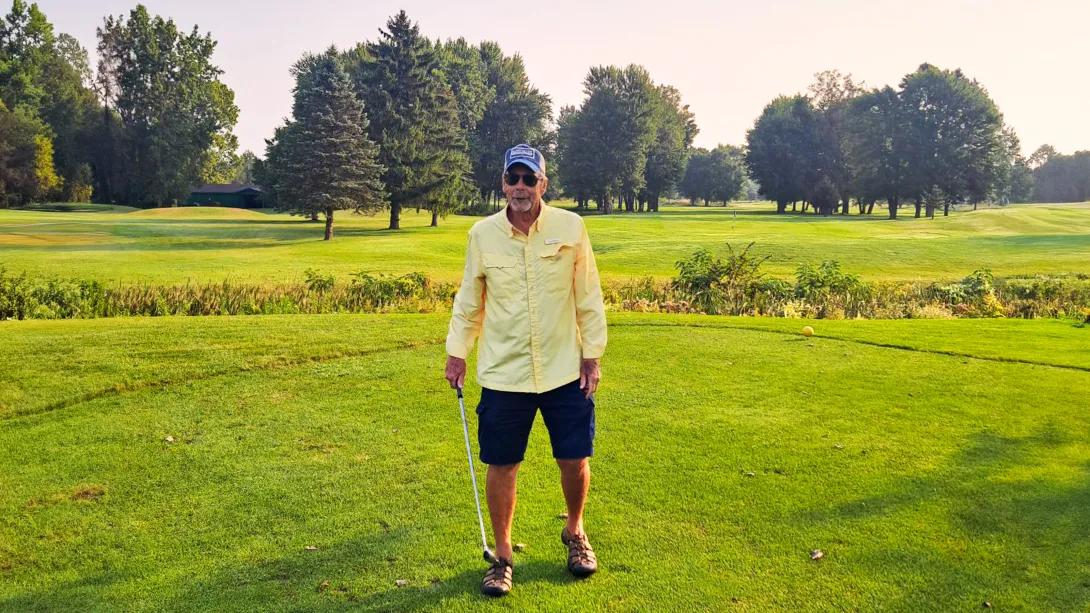
Once retired, Darnall got his exercising in by going on walks with his wife and by playing golf.
But a frightening cardiac episode on a Tennessee golf course in April of 2023 would stop him in his tracks, as it would be his first real brush with his serious cardiac issues that would eventually bring him to University of Michigan Health Frankel Cardiovascular Center for care.
Darnall’s cardiac issue
Darnall would come to find out that he experienced an aortic dissection, a sudden life threatening condition in which the inner layer of the aorta tears and blood enters and rips apart the layers of the aortic wall.
The Clarkston, Mich., resident needed emergency open heart surgery, right then and there, in Tennessee, to prevent it from rupturing.
When back home in Michigan, Darnall thought he would be on the road to recovery.
However, his condition soon worsened.
He also was suffering from episodes of atrial fibrillation, which he was diagnosed with five years prior.
“The open chest surgery set me back quite a bit,” Darnall recalled.
“I was recovering slowly but had reached a plateau where I just couldn’t make any more progress.”
By September, Darnall was in serious heart failure, requiring oxygen, and his Afib was progressing.
He was constantly fatigued and short of breath.
His primary care physician sent him for tests, which found that his mitral and tricuspid valves within his heart were leaking.
These valves separate the upper and lower chambers of the heart. As the heart beats, the valves open and shut to control the flow of blood.
In Darnall’s case, the valves weren’t closing properly which caused the blood to flow backward.
Moving onto advanced care
Darnall was referred to Gorav Ailawadi, M.D., M.B.A., the chair of cardiac surgery and the director of the U-M Frankel Cardiovascular Center. “When we evaluated him first, he appeared frail, in a wheelchair and was in no condition to survive any major intervention or heart operation,” Ailawadi said.
After an initial evaluation, Ailawadi referred him to cardiologist Abbas Bitar, M.D., who specializes in the treatment of advanced heart failure caused by valve disease.
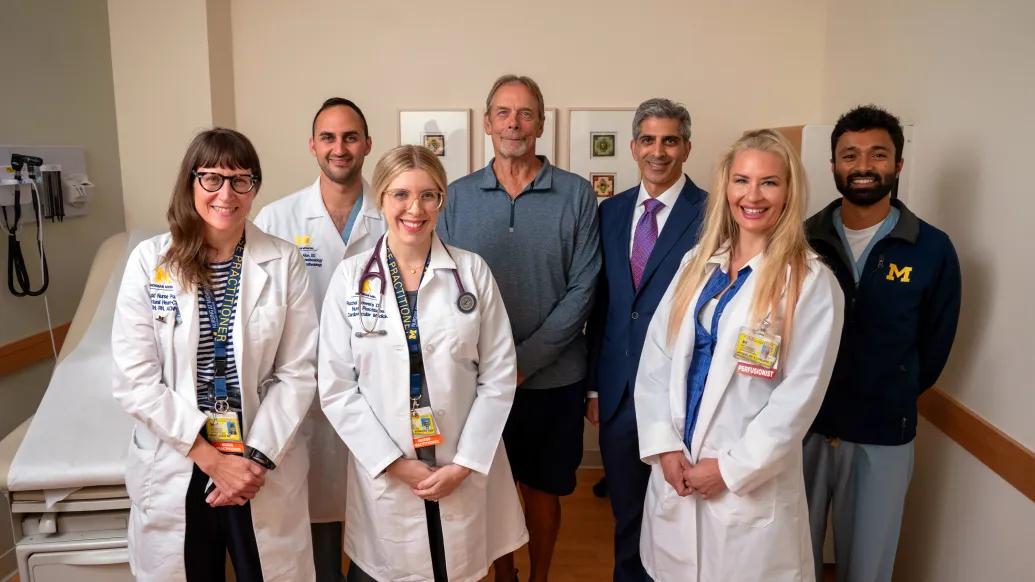
Both doctors are part of Frankel CVC’s Mitral and Tricuspid Interventions, or MATRIx program, a team of cardiac surgeons, cardiologists and heart failure specialists who work together to improve outcomes for patients like Darnall.
I don’t think he would have made it until Christmas if Dr. Bitar and Dr. Ailawadi hadn’t intervened."
-Elizabeth Darnall, Tim Darnall's wife
“Following the MATRIx clinic evaluation, many patients get referred to a MATRIx heart failure specialist for medication adjustments before they have any procedures on their valves,” Bitar said.
“Not uncommonly, for some patients with leaky mitral or tricuspid valves, medication adjustments are all they need to do just fine for many years.”
Bitar first met the Darnalls in October of 2023.
By then, Darnall was still on oxygen and could barely walk 75 yards without stopping to rest.
Bitar got him on the right mix of medicines and followed his progress over the next two months.
“One thing we do well here is we try to get people to the best spot possible before to go to the surgery, which makes the recovery much faster and the outcomes much better,” Bitar explained.
Next step: surgery
The medical therapy was working, to a degree.
When he returned to see Bitar in December he had lost 20 pounds – mostly from fluid retention stressing his heart – was off oxygen and could walk 100 yards without stopping but still was not living life the way he was used to.
A reassessment of his valves showed they were still leaking severely.
The MATRIx team evaluated and deemed there was no percutaneous option for his valves and that surgey was his only option.
Darnall’s previous aortic dissection repair complicated things.
For starters, the team didn’t think Darnall would recover well from a second open heart surgery through the sternum, so Ailawadi planned a minimally invasive procedure through a small incision in Darnall’s right side despite the previous surgery and his high risk nature. The surgery was scheduled for January 7, 2024.
Normally, in a repair of this type, surgeons clamp the aorta to stop the heart from beating, which, while the heart is open, could risk air flow that could lead to a stroke, Ailawadi explained.
But the real challenge in Darnall’s case was that the surgeons were unable to clamp the aorta to stop the heart from beating because it was in the location of his prior aortic dissection repair.
Instead, the team cooled his body down, in order to protect his heart, to stop it from beating.
Ailawadi went into the surgery thinking he’d need to replace Darnall’s valve, but he actually wound up repairing both the mitral and tricuspid valve, in a complex procedure with newer, advanced novel techniques that we have developed, he says.
“We were thrilled with the result,” Ailawadi said. “He has no valve leakages now.”
Clinical data show that repairing a mitral valve yields far better patient outcomes than a replacement. With a minimally invasive approach, patients recover more quickly with less restrictions than the conventional open sternotomy surgery.
The Frankel CVC is nationally recognized for expertise in mitral valve repair and treatment.
U-M was among the first five medical centers in the United States to receive a Mitral Valve Repair Reference Center Award from the American Heart Association based on its high volume of mitral valve procedures and superior outcomes.
Back on track
Darnall recovered quickly and his prognosis remains very good, both Ailawadi and Bitar say.
“My prediction is whenever he does pass in the future it won’t be from his heart,” Ailawadi said. “His heart and the valves will serve him well.”
The Darnalls are just grateful for the expertise and excellent care they received.
“I don’t think he would have made it until Christmas of 2023 if Dr. Bitar and Dr. Ailawadi hadn’t intervened,” said Elizabeth Darnall. “When they took control of his meds and his care even before the January surgery, he was so much better.”
“I couldn’t believe how well those nurses and doctors and assistants took care of me,” Tim Darnall echoed.
“They were always interested in my wellbeing from day one, keeping me informed about what was going on and what they hoped to accomplish.”
Nine months after the surgery, Tim Darnall has a new lease on life, golfs twice a week, and enjoys spending time with family and friends.
“We didn’t think there was any hope,” Elizabeth Darnall said.
“We thought this was going to be his new normal, not being able to golf, not walking anymore, always needing oxygen, taking five or six naps a day and just struggling. And now we have a life.”
It was a long, very difficult, journey, made easier with a lot of physical and emotional support from family and friends, both Darnalls said.
“We are so thankful to the entire U-M team. Now I’m walking the dogs every morning, mowing the lawn. Today we are planting a new tree,” Tim Darnall said.
And the family has faith they’ll be watching that tree, and Tim Darnall, flourish together in the years to come.
Sign up for Health Lab newsletters today. Get medical tips from top experts and learn about new scientific discoveries every week.
Sign up for the Health Lab Podcast. Add us wherever you listen to your favorite shows.

Health Lab
Explore a variety of health care news & stories by visiting the Health Lab home page for more articles.
Media Contact

Public Relations
Department of Communication at Michigan Medicine
In This Story
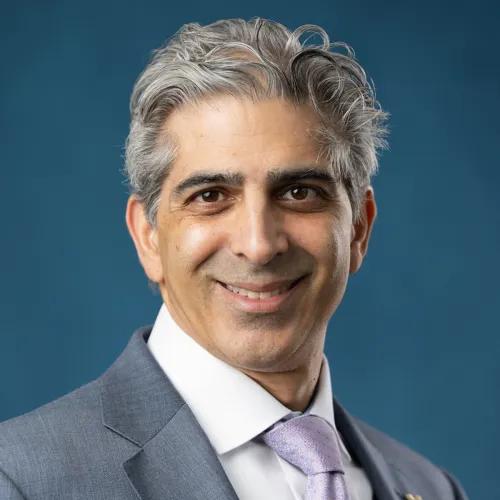
Gorav Ailawadi
Professor
Stay Informed
Want top health & research news weekly? Sign up for Health Lab’s newsletters today!
Featured News & Stories
Could preeclampsia become a thing of the past?
Treating a rare coronary artery aneurysm without open heart surgery
A heart attack 9 days after giving birth: Mother of 4 shares her SCAD experience
Severe strokes linked to 5 times higher dementia risk
Fighting rejection antibodies to make heart transplant possible