Peak performance: how climbing mountains transformed a surgeon
Reaching the tallest peaks has not just made the veteran physician a better surgeon, it’s made him a better person.
5:00 AM
Author |
This article was last updated on June 6, 2022.
As a young doctor training during the late 90s and early 2000s in New York City, days and nights merged. Being a doctor consumed Rakesh Patel; work weeks lasted more than 100 hours, with no focus on balance or well-being. The head of the surgical teams ran the operating room with an iron fist, and Patel emulated that leadership style when he started practicing.
"I trained in a time when burnout was glorified," said Patel, M.D., a spine surgeon at University of Michigan Health. "I had no work-life balance. My entire identity was wrapped up in being a surgeon. I ran the operating room as I was taught, like a dictator, insisting things should be done my way."
MORE FROM MICHIGAN: Sign up for our weekly newsletter
A decade later, Patel (the staff refer to him, fittingly, as Rock) found that elusive balance, resulting in a palpable difference in both his personal life and operating room. This wasn't an overnight change, says the 15-year veteran physician, rather a slow climb to becoming a better surgeon and person – one that started more than 10,000 feet above sea level in Colorado.
At the top, you think about all of the challenges in your life and all the friends and family who have helped you get to this point.Rakesh Patel, M.D.
The climb
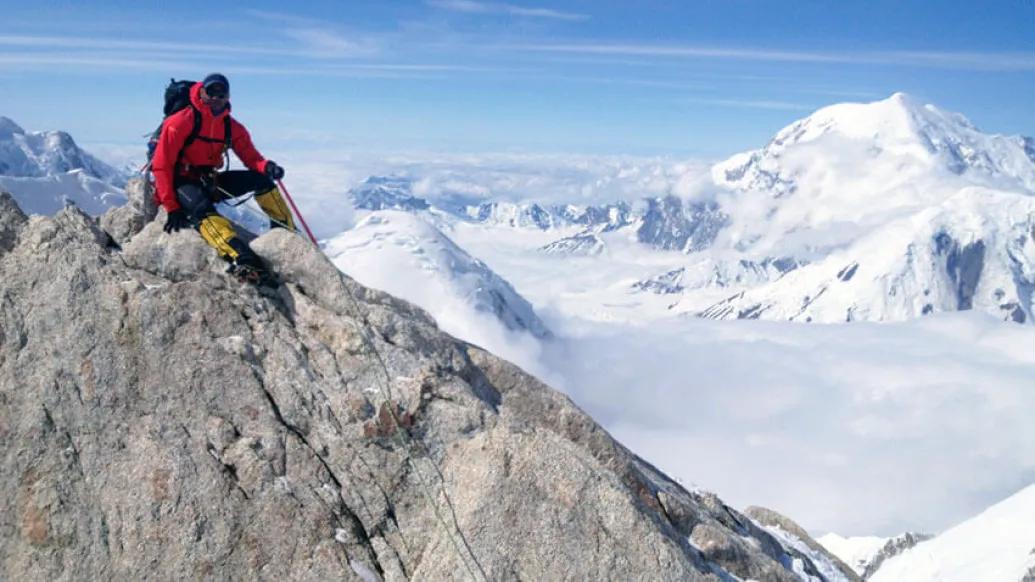
Patel got his first taste of mountaineering at Longs Peak in the northern front range of the Rocky Mountains. A friend asked him to join, and Patel was instantly hooked. He took short trips to climb mountains in Washington state and Ecuador before going on his first major mountaineering expedition to Denali, formerly Mount McKinley, in 2009.
Although he gained helpful experience in his earlier climbs, Denali was an entirely different challenge with brutal, temperamental weather conditions. The recently hired surgeon at U-M Health went home early after not reaching the summit.
But at the same time on Denali, a spine surgeon around Patel's age died after sustaining a fall. "When my family and friends in Ann Arbor heard, 'spine surgeon died on Mount McKinley,' they automatically assumed it was me," Patel said. "That was a really scary moment. Naturally, I thought that it very easily could have been me. I took about two years off from climbing and thought maybe it just wasn't worth it for me."
Eventually, Patel decided to return to climbing. He overhauled his diet, becoming vegan, and drastically altered his training routine to reach peak performance. Going on mountaineering trips at every opportunity, Patel began intentionally focusing on life outside of surgery.
As he became proficient, his goal became clear: complete the "Seven Summits," which are the tallest peaks on each of the seven continents. Patel began in May 2013 by returning to Alaska to conquer Denali and followed it in February 2014 with Aconcagua, South America's largest mountain and the highest peak outside of Asia.
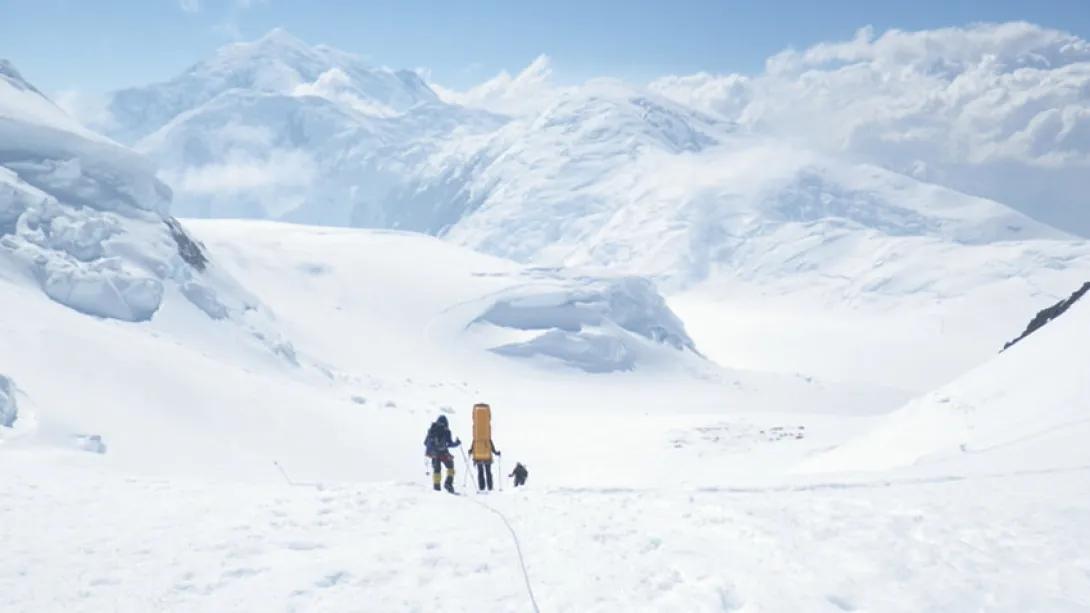
"I figured, if I can deal with the altitude of Aconcagua at nearly 23,000 feet and handle the climate of Denali, then the other peaks should be doable," he said. "Next, I climbed Mount Elbrus in Russia and Kilimanjaro in Africa. The tough one to access is Vinson Massif in Antarctica. I was only going to do that if I summited Everest."
The tallest peak
In 2019, Patel set out for Nepal to climb Mount Everest. Leaving the second-to-last camp during the summit rotation, he broke a rib because of a violent coughing fit and considered not finishing the climb.
He opted to push on to the high camp in the hopes of summiting the next morning. Back pain, anxiety and surrounding turmoil made for a sleepless night.
"One of the most surreal memories I have is watching helicopters drop a long line of dead climbers off the mountain," Patel said.
"Not all the bodies were retrievable, and some climbers lay where they passed away. It became a routine site to see bodies on the route. One of the bodies was an Indian climber, wearing the exact same gear as me. It made me wonder, 'What the hell am I doing?'"
Patel's team kept going, ascending the "Hillary Step" and reaching the summit of Everest at 29,032 feet. At the top, he cried tears of joy. His view was one he'd seen in pictures countless times. There, Patel took out a University of Michigan flag, which he brings on every climb, and some origami birds.
"At the top, you think about all of the challenges in your life and all the friends and family who have helped you get to this point," he said.
"My friend Beth, who I met at the YMCA, was an inspiration to me. Although she had cancer, she lived her life with so much appreciation, courage and joy. After she passed, Beth's family gave me several origami birds that she had made. I took them to the summit and set them free for Beth. I felt privileged to honor her at the summit."
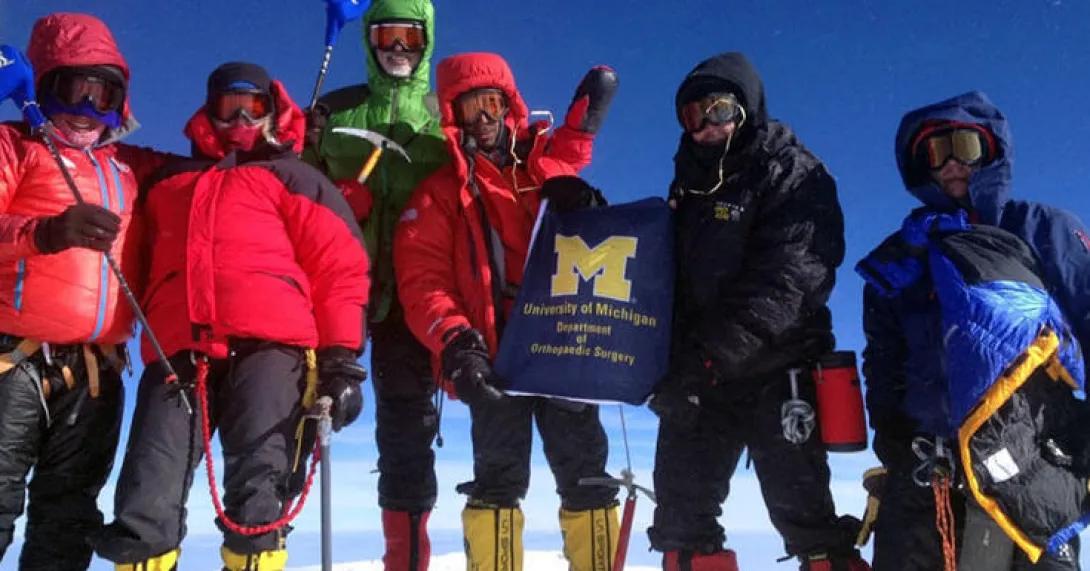
Rock Patel holds his U-M flag at the peak of Denali, his first summit.
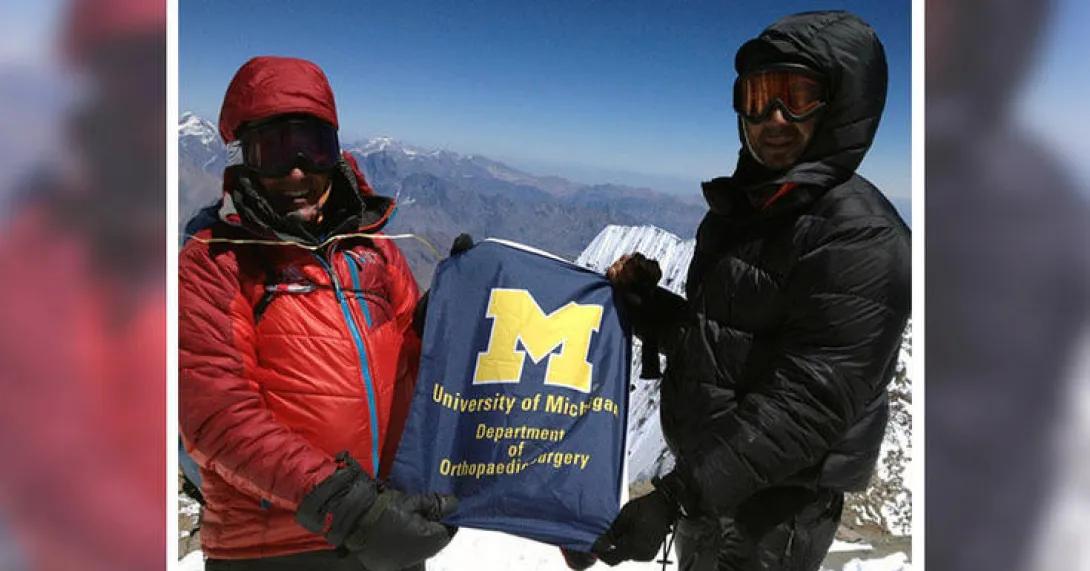
Rock Patel at the summit of Aconcagua in February 2014.
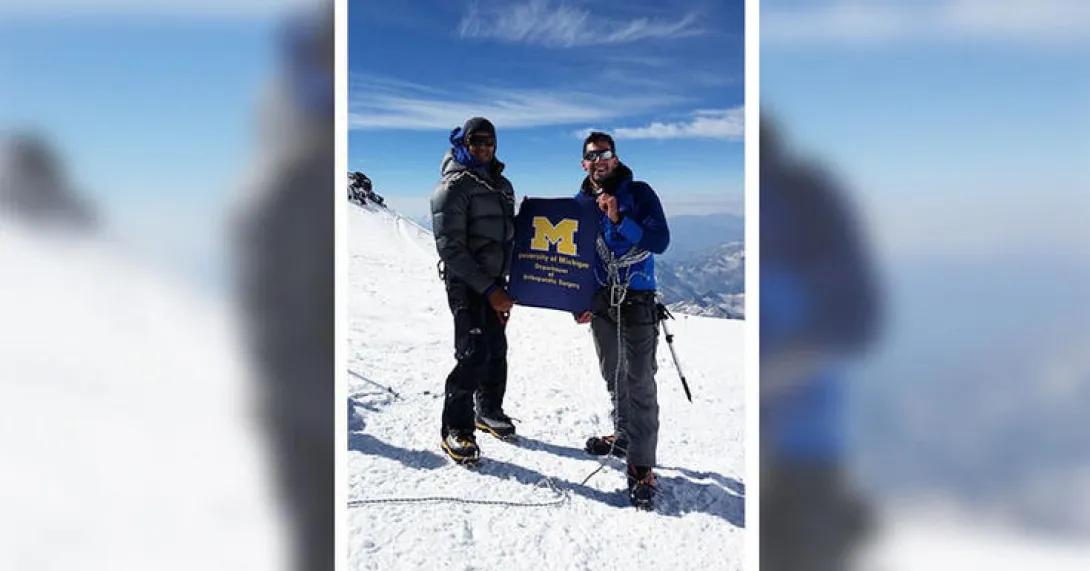
A photo of Patel at the summit of Elbrus in August 2015.
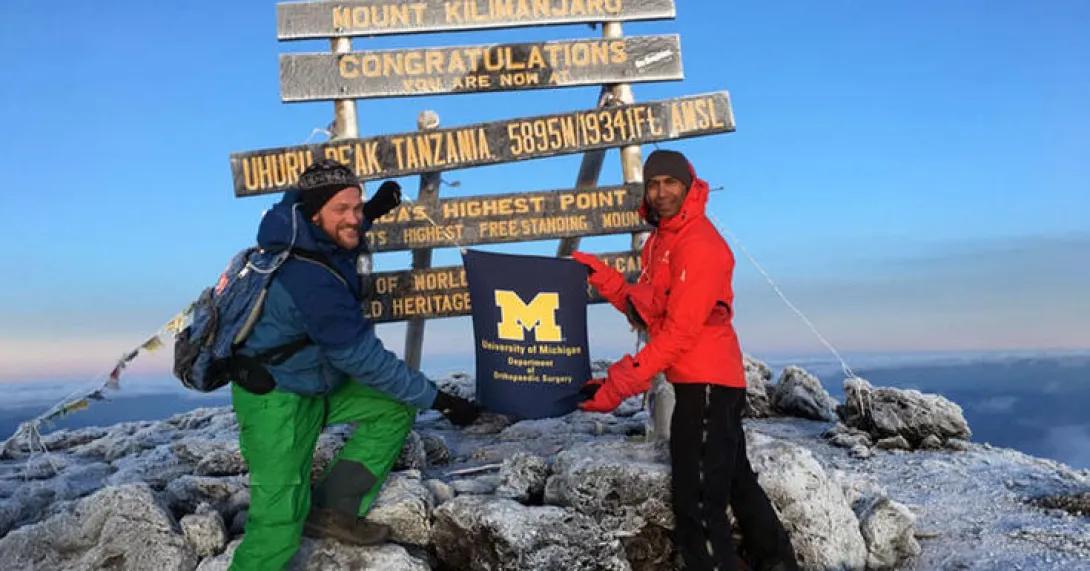
In January 2016, Patel summits Kilimanjaro.
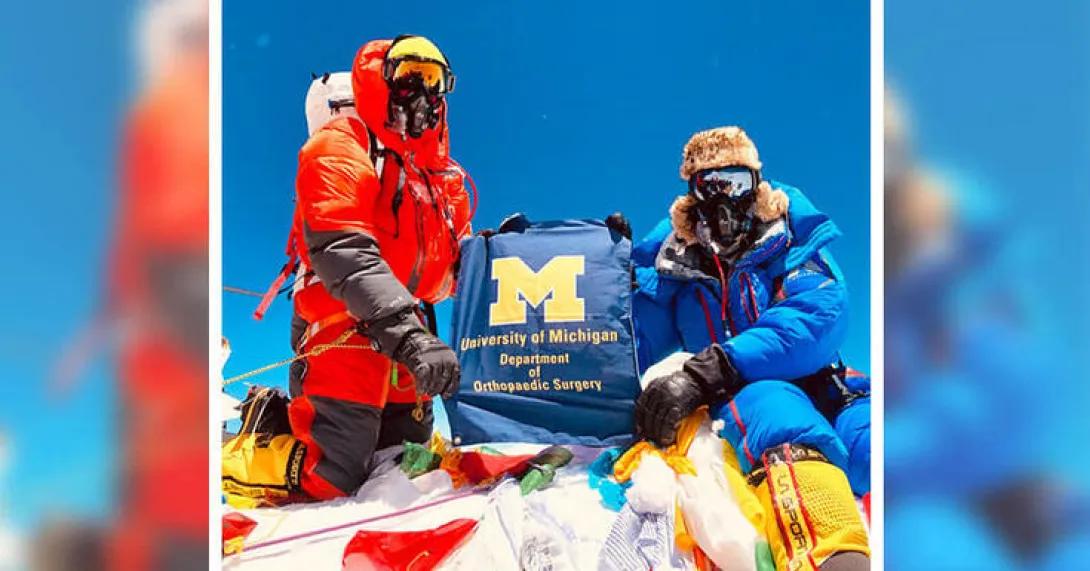
Patel at the summit of Everest in May of 2019.
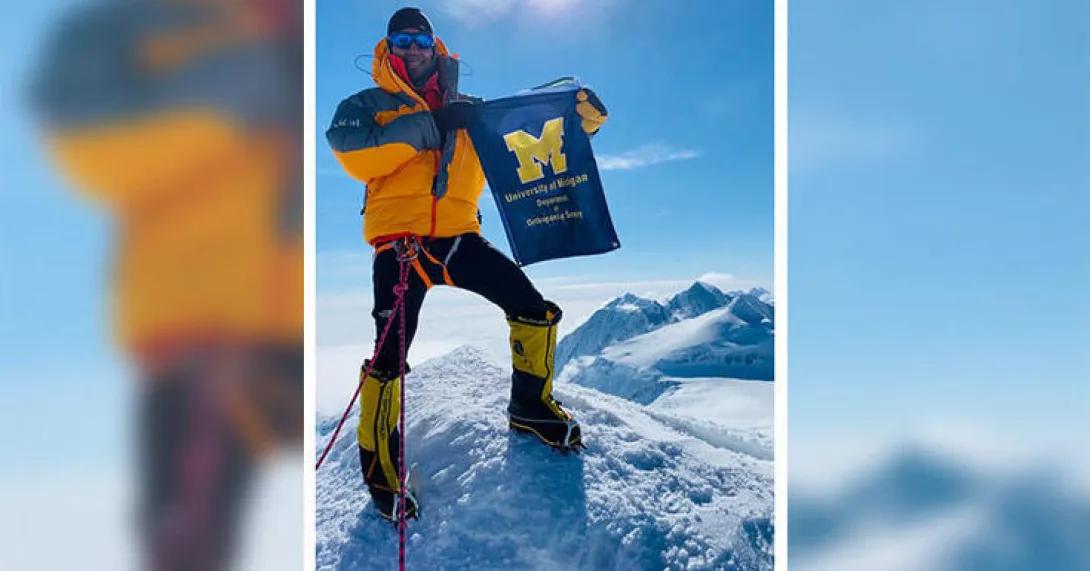
In December 2019, Patel reaches the second-to-last summit at Vinson Massif in Antarctica.
Mountaineering and medicine
Patel completed the Seven Summits on May 21, 2022 by climbing Mount Kosciuszko in Australia.
While he became a better climber and alpinist with each peak, Patel says the most valuable lessons he learned while climbing were those about life – that it must be fully appreciated and that people are not defined by their occupation. Working with others to achieve a common goal, he learned what it means to be a better leader and teammate.
"I was really difficult to work with when I first got to Michigan; I made decisions unilaterally, expected people to follow my lead and was harsh in my criticisms," Patel said.
"My leadership style changed directly because of my experiences in the mountains. I learned that a good leader recognizes other people's strengths as well as their own individual shortcomings. A good leader will recognize when someone is having a bad day, be supportive and, along with the rest of the team, pick up the slack."
Ascending the world's tallest mountains with a team of alpinists, Patel saw that every person on a team must feel valued and aligned to achieve a common goal. Working together in this manner, he says, leads to success in the mountains as well as the operating room.
"When you're climbing on a rope team, you're literally connected to someone via harness to a rope on the side of a mountain, and your success will depend on your ability to do teamwork effectively," he said.
"Similarly, as a surgeon in the operating room, you may think that you alone are responsible for the success or failure of the procedure. However, that's not the way it works; the patient doesn't get better solely because of your hands, it's a team effort.
"Success depends on the cleaners that sterilize and process the equipment, the techs who set up the operating room, the scrub techs who pass the instruments, the nurses' tireless work to provide for the patients, the radiology techs who run the latest imaging devices and the anesthesiologists who put patients to sleep. Success depends on the whole team."
Michelle Caird, M.D., chair of the U-M Health Department of Orthopaedic Surgery, calls Patel's climbing accomplishments amazing.
"His dedication, training and perseverance in climbing have also benefitted the spine surgery team and their patients here at U-M," Caird said.
Just like he built from Long's Peak to Everest, training as hard as possible to reach the highest peaks, Patel feels the same about surgery. He now specializes in complex deformity surgeries, but only after years of training with more straightforward procedures.
Both medicine and climbing taught him resilience in different ways. Both are now part of Patel's DNA.
"Every single climb and every single surgery have some form of adversity," he said. "With experience, a calm head and the support of your team, you can overcome any obstacle."
Like Podcasts? Add the Michigan Medicine News Break on iTunes, Google Podcasts or anywhere you listen to podcasts.

Health Lab
Explore a variety of health care news & stories by visiting the Health Lab home page for more articles.
Media Contact

Public Relations
Department of Communication at Michigan Medicine
Stay Informed
Want top health & research news weekly? Sign up for Health Lab’s newsletters today!
Featured News & Stories
LGBTQ+ people over 50 face more aging-related challenges
AI chatbots spark mental health concerns, including psychosis risk
Teens need private time with doctors, but many aren’t getting it
To reduce chronic pain, a new digital program could help

Permission to Flourish: Well-Being for High Performers with Shigehiro Oishi