Patient with retinitis pigmentosa receives new hope at Kellogg’s low vision clinic
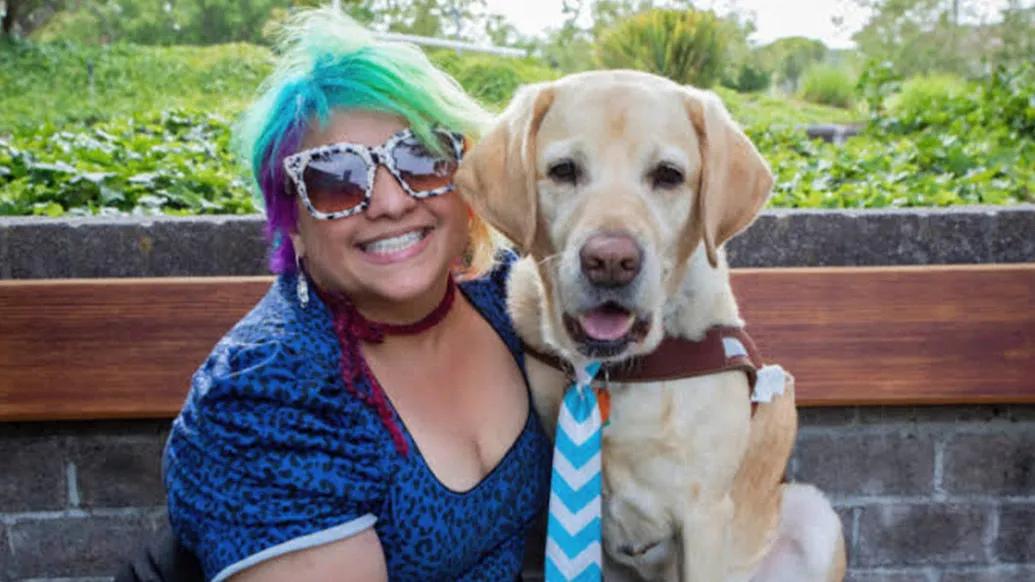
Melba Vélez Ortiz relies on AI glasses and her guide dog to navigate her surroundings
5:00 AM
Author |
Retinitis pigmentosa is a rare eye disease that affects about 1 in 4,000 people in the United States.
The condition affects the cells in the retina, which break down slowly over time, causing vision loss.
Although there is no cure, vision aids and rehabilitation programs can help patients make the most of their existing vision.
Symptoms often start in childhood and include loss of night vision, trouble with dim light and loss of peripheral vision.
Growing up in Puerto Rico, Melba Vélez Ortiz, now 54, noticed she had trouble with her vision but didn’t realize how serious it was.
“The interesting thing about vision is that you never know how other people see,” Ortiz said.
“I was unable to play sports, got into car accidents while learning how to drive and kept bumping into things, but I kept thinking that I was either bad at doing certain things or I was clumsy.”
Ortiz relied on glasses since she was 12 years old and underwent annual vision tests.
She was diagnosed by accident when she was a 22-year-old undergraduate student at the University of Illinois Urbana-Champaign.
During a routine eye examination, she was offered a retinal test that involves a dilated eye exam.
After the test, her optometrist told her she had a textbook case of retinitis pigmentosa.
Although learning about her condition was difficult, Ortiz was glad that she finally had answers that explained her low vision.
After she moved to Michigan to become a Professor of Communications at Grand Valley State University, she relied on a retina specialist in Grand Rapids for her eye care.
“I always asked if there were any new cures on the horizon and was told there was nothing to be done,” Ortiz said.
“I wanted someone who could give me answers.”
Finding hope through DNA testing at W.K. Kellogg Eye Center
Ortiz’s search led her to look for DNA tests that could explain what genes were affected by her condition.
She found Abigail Fahim, M.D., Ph.D., Associate Professor of Ophthalmology and Visual Sciences, who studies retinitis pigmentosa and is part of a specialized inherited retinal disease clinic.
“When you have issues with your vision and you live out of town, Ann Arbor is as far as Pluto,” Ortiz said.
“Fortunately, one of my students volunteered to bring me to Kellogg.”
Ortiz underwent a DNA test, which revealed that she had a mutation in the SNRNP200 gene. This information can help Ortiz choose which clinical trials she would like to apply for.
The mutation is usually autosomal dominant, where only one parent needs to have the altered gene to pass it on. However, Ortiz had no family history of retinitis pigmentosa.
It's possible that Ortiz had a de novo mutation, which happens by chance during the formation of an egg or sperm or during early embryo development.
“Retinal dystrophy specialists are not really like other physicians or ophthalmologists because we don't have ways to treat the underlying disease,” Fahim said.
“Our job is to be involved in research and clinical trials, study new therapeutic targets and empower our patients to use the vision they have.”
Supporting patients has become increasingly important since researchers have shown that how patients cope with their vision loss affects the loss itself.
Depression and anxiety can impact visual function.
“Melba has a positive outlook and is very engaged in her community, which is why she can function at a very high level,” Fahim said.
Relying on AI glasses for guidance
For the past 28 years, Ortiz has been dealing with the challenges her vision poses when she teaches.
She has a service dog, Chad, to help with her daily routine, which includes walking to the bus station and navigating the university campus.
While many visually impaired people rely on their phones for directions, Ortiz found it to be difficult because she also had to simultaneously handle her 80-pound service dog.
Additionally, she has to juggle different electronic platforms for her class, and their lack of accessibility is often a challenge.
As part of the university accommodations, Ortiz learned about the Bureau of Services for Blind Persons whose mission is to provide training and services for the blind and visually impaired.
“I described how hard it can be to teach when I can’t see my students' faces or notice when someone is raising their hand to ask a question,” Ortiz said.
“My caseworker suggested that I try AI glasses developed by Meta.”
Ortiz described the glasses as a game changer because, after a decade of struggling with reading street signs, she can now travel with confidence.
Her glasses also help her find out what the weather will be like, read restaurant menus and access music when she’s waiting for the bus.
She can also answer calls, keep track of her academic calendar and read footnotes in research articles.
“AI glasses don’t improve vision; they bypass it,” Fahim said.
“They do not magnify the image or enhance the contrast. They are basically a camera that uses AI to interpret the surroundings using audio.”
Before she started using her AI glasses, Ortiz described her vision as a cardboard box with a tiny little hole.
She spent most of her effort towards putting together multiple images like pieces of a puzzle. Now her glasses show her what a normal field of vision looks like.
Ortiz credits her glasses and her care team for her newfound optimism.
“People who have incurable diseases sometimes fear hope and that used to be true for me,” she said.
“But now, Kellogg has gifted me with something no doctor in the past could—understanding and hope. I know this is just the beginning.”
Learn more about the Low Vision & Visual Rehabilitation Clinic.
Sign up for Health Lab newsletters today. Get medical tips from top experts and learn about new scientific discoveries every week.
Sign up for the Health Lab Podcast. Add us wherever you listen to your favorite shows.

Health Lab
Explore thousands of health news & research stories by visiting the Health Lab homepage for more.
Media Contact

Public Relations
Department of Communication at Michigan Medicine
In This Story
Abigail Fahim, MD, PhD
Associate Professor
Stay Informed
Want top health & research news weekly? Sign up for Health Lab’s newsletters today!
Featured News & Stories
Innovative children’s vision research gets a boost from the Knights Templar Eye Foundation

Nerf gun accident causes retinal detachment in pediatric patient

Kellogg care inspires gift to vision research

Mediterranean diet can slow progression of age-related macular degeneration
Rare genetic eye disease treated with gene therapy helps 2 children see again